
1400W Hybrid Wind Solar Charge Controller Review: One Box for Two Renewable Energy Sources
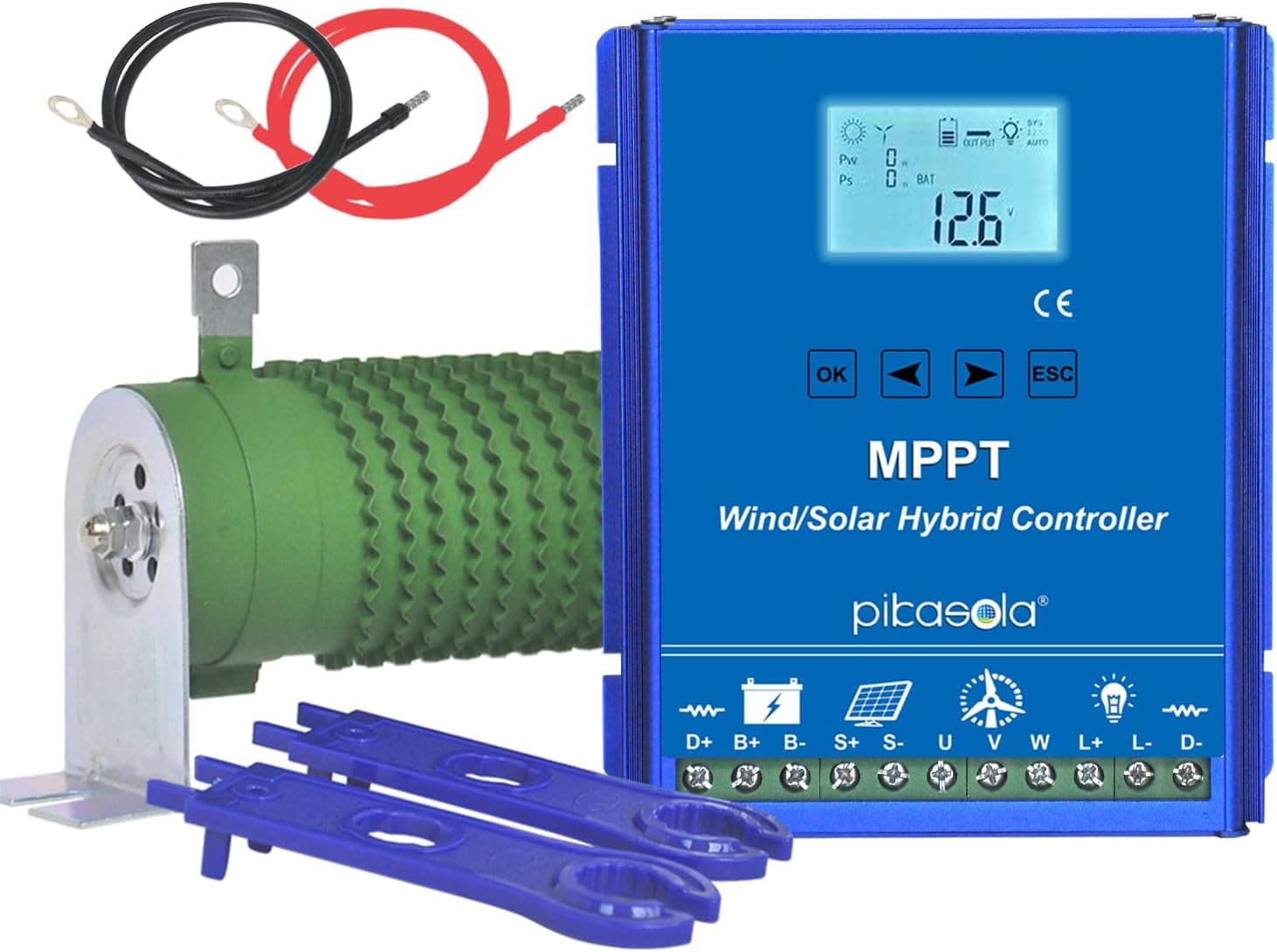
Building a small off-grid power system sounds simple.
Get some solar panels.
Add a battery.
Connect a charge controller.
Done.
But then you decide to add a wind turbine.
And suddenly things get more complicated.
Wind power and solar power behave very differently, so combining both sources into the same battery system normally requires additional hardware and some careful system design.
That’s what makes this 1400W Hybrid Wind Solar Charge Controller interesting.
It’s designed to manage up to 800W of wind generation and 600W of solar, automatically work with 12V or 24V battery systems, provide dedicated wind turbine load management, and give you an LCD interface for monitoring and configuration.
Basically, it’s trying to become the central traffic controller for a small hybrid renewable energy system.
Check the latest price on Amazon:
https://link.amazon/B0h3xlpvt
As an Amazon Associate, we may earn from qualifying purchases.
Why Combine Wind and Solar?
Solar power has one extremely obvious weakness.
The sun goes away every night.
Wind doesn’t have that exact problem.
Depending on where you live, wind conditions can sometimes become stronger in the evening, overnight, during storms, or during seasons when solar production is lower.
That makes wind and solar potentially complementary technologies.
When the sun is shining, your panels generate electricity.
When conditions are windy, your turbine generates electricity.
Sometimes both produce power simultaneously.
Sometimes neither does.
The battery sits in the middle and stores whatever usable energy the system can capture.
The problem is controlling all of that safely.
That’s where a hybrid controller comes in.
1400W Total Capacity
The headline specification here is 1400W.
But that’s not 1400W of solar.
The controller is designed for a maximum combination of:
800W wind turbine
plus
600W solar panels
for up to 1400W of connected renewable generation.
It supports both 12V and 24V battery systems, with automatic voltage recognition according to the listing.
That makes it suitable for relatively small off-grid installations rather than giant residential solar arrays.
Think cabins.
Boats.
Remote equipment.
Street lighting.
Workshops.
Small off-grid buildings.
Or simply an experimental home renewable energy setup.
The Wind Side Is More Interesting
Here’s where things get technically interesting.
The wind charging portion uses what the manufacturer describes as boost MPPT technology.
MPPT stands for Maximum Power Point Tracking.
The basic idea is to dynamically manage the electrical operating point so the system can extract useful power from a variable energy source more effectively.
And variable is definitely the right word for wind.
A solar panel sitting under stable sunlight can produce relatively predictable output.
A wind turbine is constantly dealing with changing wind speeds.
One second you’ve got a strong gust.
Then the wind drops.
Then it picks up again.
The controller needs to deal with those changing conditions while still delivering usable charging power to the battery.
The manufacturer says its boost MPPT implementation is specifically designed to help maintain charging even at relatively low wind speeds.
For a hybrid system, that’s potentially valuable.
But the Solar Side Is PWM
This distinction is important.
While the wind input uses the manufacturer’s boost MPPT system, the solar charging section uses PWM control.
PWM stands for Pulse Width Modulation.
It’s a simpler and generally less sophisticated approach than a dedicated solar MPPT charge controller.
That doesn’t automatically make it bad.
PWM controllers can work perfectly well in appropriately designed smaller systems, particularly when panel and battery voltages are well matched.
But if you’re specifically shopping for maximum solar energy harvesting efficiency, you should understand what you’re buying.
This is not an MPPT solar controller.
It’s a hybrid controller with MPPT-style management on the wind side and PWM charging on the solar side.
That’s an important difference.
Wind Turbines Need Somewhere to Put Excess Energy
Here’s another reason wind systems are different from solar.
With solar panels, the controller can essentially reduce or interrupt charging when the battery is full.
Wind turbines can be more complicated.
The rotor might still be spinning.
Energy is still being generated.
And under certain conditions, simply removing the electrical load from a wind turbine can allow it to accelerate.
That’s why wind turbine systems often use a dump load, sometimes called a diversion load.
This controller includes an external dump-load resistance and what the manufacturer describes as a stepless unloading function.
Essentially, when the system can’t send additional energy into the battery, it can redirect excess wind-generated electrical energy toward a resistive load.
That energy gets dissipated as heat.
It sounds wasteful.
But that’s the point.
Sometimes safely getting rid of excess energy is exactly what you want.
Battery Management Is Built In
The controller is designed to work with multiple 12V and 24V battery types, including lithium batteries, according to the manufacturer.
Once you select the appropriate battery type, the system can automatically configure charging parameters.
There are also options for manual adjustment.
That’s useful because different battery chemistries require different charging behavior.
A lead-acid battery and a lithium battery should not simply be treated as interchangeable boxes that happen to store electricity.
Their voltage characteristics and charging requirements differ.
The controller is designed to provide different charging stages, including boost and float behavior where appropriate.
But there’s an important caveat here.
Always verify that the controller’s actual configurable charging voltages match the specifications provided by your battery manufacturer or battery management system.
“Supports lithium” is not enough information by itself.
The voltage settings still need to be correct for your specific battery pack.
The LCD Is Actually Useful
There’s a large LCD display on the front.
And for something like this, that’s much more than decoration.
Off-grid systems generate a surprising amount of information.
Battery voltage.
Charging status.
Input conditions.
Load status.
Operating mode.
Warnings.
Configuration parameters.
Having an integrated screen means you can see what the system is doing without immediately connecting another monitoring device.
It also gives you a straightforward interface for changing supported settings.
This is one of those products where a physical display is still better than forcing everything into a smartphone app.
No account.
No cloud connection.
No Wi-Fi configuration.
Look at the screen.
See what’s happening.
There’s Also a DC Load Output
The controller includes a configurable DC load output with three operating modes.
That’s particularly useful for systems like street lights or other autonomous DC equipment.
For example, a solar and wind system could charge a battery during available generation periods and then use that stored energy to power a DC light according to the configured output behavior.
It makes the controller more than just a battery charger.
It can also become part of the actual power-management system for the connected load.
That’s especially useful for remote installations where you want the entire setup to operate automatically.
The Protection Features Matter
Renewable energy controllers have a pretty difficult job.
They’re sitting between variable energy sources, a battery capable of delivering substantial current, and whatever electrical loads you’ve connected downstream.
So protection circuitry matters.
The manufacturer lists protection features including reverse charging protection for the solar input, overcharge protection, undervoltage protection, overload protection, battery reverse-connection protection, open-circuit protection, and lightning protection.
Those are useful features to have.
But I wouldn’t interpret the word “lightning protection” as meaning the controller can magically survive a direct lightning strike.
Proper grounding, surge protection, disconnects, fusing, wiring, and installation practices still matter.
A protection feature inside the controller is not a replacement for correctly designing the rest of the electrical system.
This Is Where Installation Gets Serious
Unlike installing a solar garden light, this is not really a plug-and-play consumer gadget.
You’re potentially dealing with hundreds of watts of generation, significant DC current, batteries, a wind turbine, solar panels, and an external dump load.
Cable sizing matters.
Fuse sizing matters.
Polarity matters.
Battery chemistry matters.
Voltage matters.
The wind turbine specifications matter.
The solar array configuration matters.
Even the order in which components are connected can matter depending on the controller.
So this is one product where reading the manual before connecting anything is absolutely worth the time.
If you’re not comfortable designing and wiring DC renewable energy systems, professional installation is the sensible route.
Where a Hybrid System Makes Sense
I think the most interesting application isn’t necessarily a normal suburban house with an existing grid connection.
Solar alone is often dramatically simpler there.
Hybrid wind and solar gets more interesting when you move away from the grid.
Imagine a remote cabin.
During sunny conditions, the solar panels charge the battery.
Clouds arrive, reducing solar production.
But the weather system bringing those clouds also brings stronger wind.
Now the turbine starts contributing.
At night, solar output reaches zero, but the wind turbine can potentially continue generating.
Neither source is perfectly predictable.
But combining two different renewable resources can potentially give you more opportunities to generate electricity.
That’s the entire appeal of hybrid renewable energy.
Boats Are Another Interesting Use Case
Boats are another environment where this kind of controller could make sense.
Solar panels are already common on cruising sailboats and other vessels with significant DC electrical systems.
Small wind turbines are also used in some marine installations.
Combining both sources into the same battery bank can provide additional charging opportunities when you’re away from shore power.
Of course, marine electrical systems introduce their own installation, corrosion, safety, and equipment requirements.
So compatibility should be verified carefully before treating this as a marine solution simply because the Amazon listing mentions boats.
What I Like
The biggest advantage is integration.
Instead of treating your wind turbine and solar array as completely separate systems, this controller gives both generation sources a central place to meet.
You get support for up to 800W of wind and 600W of solar, automatic 12V or 24V battery recognition, wind-side boost MPPT technology, solar PWM charging, an external dump load, configurable battery parameters, DC load control, and an integrated LCD.
That’s quite a lot happening inside one box.
I also like that the manufacturer doesn’t appear to disguise the solar charging method.
The wind side is described as MPPT.
The solar side is PWM.
Knowing that distinction makes it much easier to understand where this controller fits.
What You Should Know Before Buying
The first thing is compatibility.
Don’t buy a charge controller purely because your wind turbine says 800W and your solar panels say 600W.
Check voltage ranges, maximum current, turbine specifications, battery chemistry, solar array configuration, and the controller’s actual electrical limits.
Second, the solar input uses PWM rather than MPPT. If maximizing solar harvest is your priority, a system using a dedicated solar MPPT controller may be worth considering.
Third, manufacturer claims around efficiency, low-wind charging, protection, and compatibility should be interpreted within the specifications and installation requirements provided by the manufacturer.
And finally, remember that you’re dealing with a fairly substantial DC electrical system.
A 12V system carrying hundreds of watts can involve very high current.
Correct wiring and overcurrent protection aren’t optional.
Who Is This For?
This controller makes the most sense for someone deliberately building a small hybrid off-grid energy system.
Maybe you’ve already got solar and want to add a wind turbine.
Maybe you’re powering a remote cabin.
Maybe you’re designing an autonomous street-lighting system.
Maybe you’re working on a boat.
Or maybe you’re experimenting with renewable energy and specifically want to combine wind and solar generation into one battery bank.
If you’re building a solar-only system, there are simpler controllers.
If you’re building a large residential energy system, there are much more sophisticated solutions.
But somewhere between those two extremes, this hybrid controller becomes interesting.
The Bottom Line
The 1400W Hybrid Wind Solar Charge Controller solves a very specific problem.
You have two completely different renewable energy sources.
One depends on sunlight.
One depends on moving air.
And you want both of them charging the same battery system.
This controller is designed to handle up to 800W of wind generation plus 600W of solar, with automatic 12V or 24V battery operation, wind-side boost MPPT technology, PWM solar charging, dump-load management, an LCD interface, configurable DC output, and multiple electrical protection features.
It’s not the most glamorous part of an off-grid renewable energy system.
But that’s kind of the point.
Solar panels and wind turbines get all the attention because they’re the parts actually capturing energy.
The controller is the box sitting quietly between everything, deciding where that energy should go.
And in a hybrid renewable energy system, that’s a pretty important job.
Check the 1400W Hybrid Wind Solar Charge Controller on Amazon:
https://link.amazon/B0h3xlpvt