
1600W 24V Wind Turbine Review: Serious Off-Grid Power From Six Blades
Small wind turbines are interesting because they sit in this weird middle ground.
They’re much smaller than the enormous turbines you see at wind farms, but they’re also capable of doing considerably more than powering a decorative LED in your backyard.
And this 1600W 24V Wind Turbine Generator is definitely leaning toward the more serious end of that spectrum.
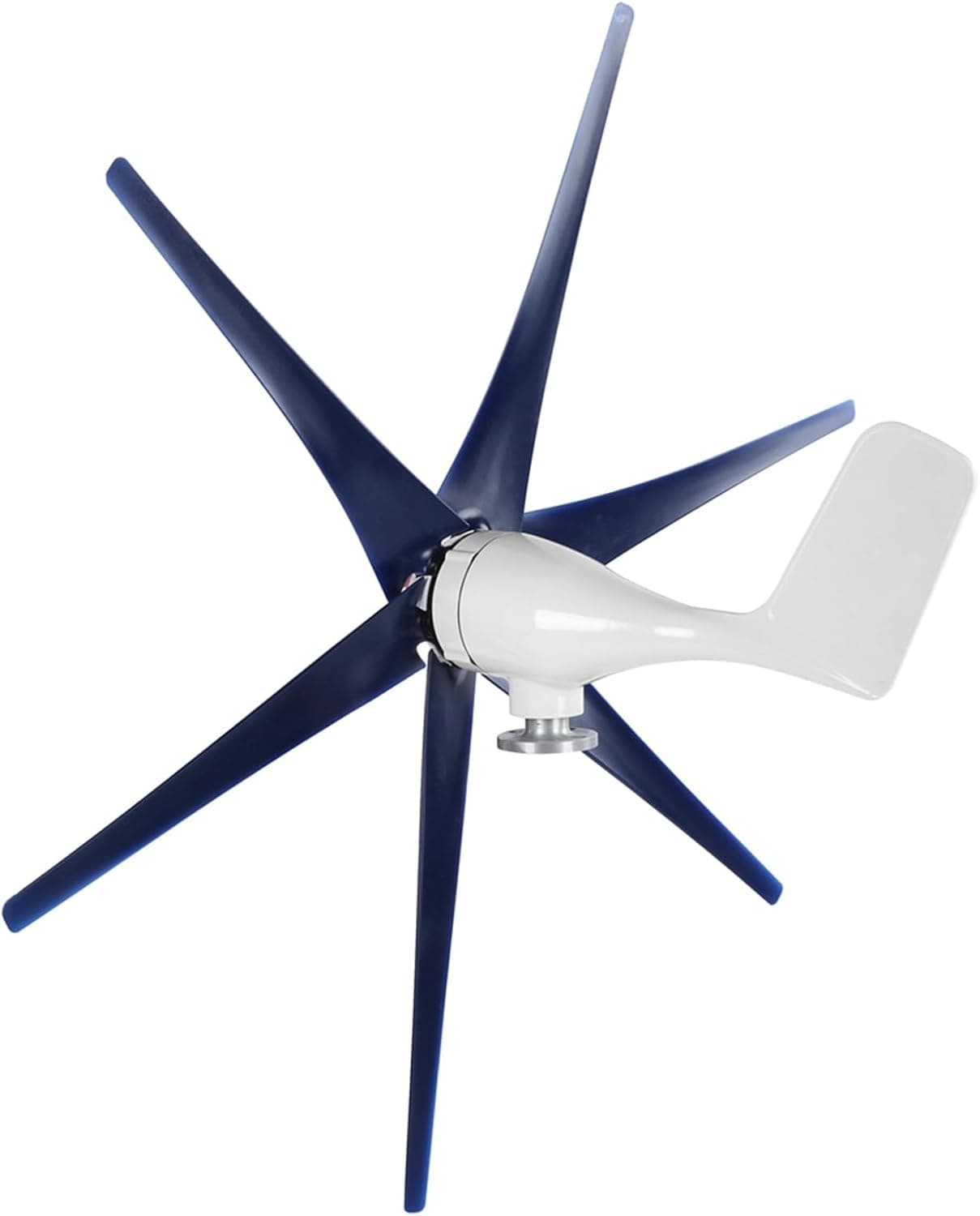
You get six nylon fiber blades, a permanent magnet AC alternator, a 24V architecture, and a rotor design intended for off-grid applications ranging from cabins and mobile homes to boats and potentially larger residential or commercial systems.
The headline number is 1600 watts.
That’s enough to get your attention.
But as always with wind power, there’s a much more important question than the number printed on the listing:
How much energy will it actually generate where you install it?
Because with wind turbines, location is everything.
Check the latest price on Amazon:
https://link.amazon/B04q3qPmC
As an Amazon Associate, we may earn from qualifying purchases.
1600W Is Getting Into Serious Small-Wind Territory
Let’s start with the obvious specification.
This turbine is advertised at 1600W.
That’s 1.6 kilowatts.
For a small off-grid wind turbine, that’s a substantial headline output.
If the turbine were actually generating its full rated 1600W for one hour, that would theoretically correspond to 1.6kWh of electrical energy before downstream system losses.
Five hours at that output would be 8kWh.
Ten hours would be 16kWh.
But those examples are just math.
Real wind turbines don’t sit at maximum output all day.
Wind speed constantly changes, and turbine output changes with it.
So the 1600W rating tells you the upper operating territory of the product, but it doesn’t tell you how much electricity you’ll actually generate over a typical day.
For that, you’d want the turbine’s full power curve and detailed wind-speed specifications.
Six Blades Instead of Three
One of the first things you’ll notice is the six-blade rotor.
We’re used to seeing three blades on giant utility-scale wind turbines, but small wind turbines can use different blade counts depending on their design priorities.
Here, the manufacturer uses six precision blades made from nylon fiber.
The listing says the blades have been combined with an optimized aerodynamic and structural design intended to improve wind-energy utilization and increase annual power generation.
More blades can influence characteristics such as starting torque and rotor speed, although the complete aerodynamic design matters much more than blade count alone.
You can’t simply say six blades are automatically better than three.
It’s about how the entire rotor is engineered.
Nylon Fiber Makes Sense Here
Wind turbine blades live a difficult life.
They’re constantly moving.
They’re exposed to sunlight.
Rain.
Temperature changes.
Wind pressure.
Vibration.
And potentially thousands of hours of operation.
So you want something that’s strong without being unnecessarily heavy.
The turbine uses nylon fiber blades, which the manufacturer positions as durable while still keeping the rotor manageable for installation and maintenance.
Reducing unnecessary rotating mass can also be useful for startup behavior and mechanical loading.
But as with any outdoor turbine, long-term durability will ultimately depend on the actual material quality, installation conditions, climate, and wind environment.
The Permanent Magnet Alternator Is the Heart of the System
Behind the blades is an AC permanent magnet alternator.
This is where the actual energy conversion happens.
The wind moves the blades.
The blades rotate the generator.
The generator converts that mechanical rotation into electrical energy.
Permanent magnet alternators are particularly useful in small wind systems because the magnetic field is provided by permanent magnets.
You don’t need a separate excitation system just to establish that field.
The manufacturer also says the generator uses a specially designed stator and permanent magnet rotor to reduce drag torque.
And that’s actually an important detail.
Why Lower Drag Matters
Imagine trying to spin a generator that strongly resists rotation.
You need more mechanical force just to get everything moving.
For a wind turbine, that force has to come from the wind.
Reducing generator resistance can potentially make it easier for the rotor and generator to operate together effectively, particularly as wind conditions change.
The manufacturer says the specialized rotor and stator design helps improve the matching between the wind rotor and generator.
That’s the goal.
The blades and generator shouldn’t feel like two unrelated components bolted together.
They should operate as a system.
The rotor captures mechanical energy.
The generator converts it into electricity.
And the characteristics of both components need to complement each other.
This Is a 24V System
The turbine is designed around a 24V electrical architecture.
That’s a common voltage for medium-sized off-grid battery systems.
Compared with 12V, moving to 24V can reduce the current required to transfer the same amount of power.
And once you’re talking about 1600W, current becomes a serious consideration.
Using the basic relationship between power, voltage, and current, 1600W at 24V corresponds to roughly 67 amps before accounting for conversion losses and actual system behavior.
That’s substantial.
So this isn’t something I’d wire casually.
Cable gauge matters.
Connection quality matters.
Fusing matters.
Charge-controller capacity matters.
Battery specifications matter.
And every component in the electrical path needs to be appropriately rated.
You’ll Need the Right Charge Controller
A wind turbine doesn’t just connect directly to a battery because both happen to say 24V.
Wind is variable.
Generator output is variable.
Battery charging needs to be controlled.
A suitable wind turbine charge controller is therefore a critical part of the system.
Depending on the controller and turbine design, the system may also need to manage excess energy or braking when the battery is full.
That’s one of the fundamental differences between wind and solar.
You can electrically disconnect a solar panel from charging and the panel simply sits in the sunlight.
A wind turbine might still be physically spinning.
That mechanical energy still needs to be managed safely.
So before buying this turbine, I’d verify the exact controller requirements, maximum current, braking strategy, dump-load requirements, and battery compatibility.
Where 1600W Starts Getting Interesting
Assuming you’ve got the wind resource to support meaningful generation, a turbine in this power class opens up more possibilities than the tiny 200W systems.
The manufacturer mentions boats, terraces, cabins, and mobile homes.
Cabins are an obvious example.
Imagine an off-grid cabin with a battery bank.
During the day, solar panels generate electricity.
When it’s windy, this turbine contributes additional energy.
At night, solar production disappears completely, but wind generation can potentially continue.
Both sources charge the battery.
The battery then powers your electrical loads whenever you need them.
That’s a much more resilient concept than depending entirely on one intermittent renewable source.
Wind and Solar Are Natural Partners
This is probably where I’d be most interested in using something like this.
Not as a replacement for solar.
As a complement to solar.
Solar output follows a fairly predictable daily cycle.
Morning.
Peak around the middle of the day.
Then back toward zero in the evening.
Wind follows a completely different pattern.
It might be windy during the afternoon.
It might be windy at night.
It might be windy during cloudy weather.
Or it might not be windy at all.
That’s the benefit of combining different renewable resources.
You’re diversifying your energy inputs.
When one isn’t generating, the other might be.
And when both are generating, you’re potentially charging the battery faster.
Boats Are Another Interesting Application
The manufacturer also mentions boats.
Small wind turbines have been used on some cruising vessels because they can potentially contribute to battery charging while the boat is away from shore power.
Again, the ability to generate outside daylight hours can complement onboard solar.
But marine environments are harsh.
Saltwater.
Humidity.
Corrosion.
Constant movement.
Strong gusts.
So I’d verify whether the specific turbine, generator housing, fasteners, electrical connectors, and mounting hardware are actually suitable for the intended marine environment before installing it on a boat.
“Can be used on boats” and “designed for years of saltwater exposure” aren’t necessarily the same statement.
Mobile Homes Could Make Sense Too
A mobile or tiny home in an exposed location could also be interesting.
You might have rooftop solar handling most of your daytime generation while a nearby turbine contributes whenever wind conditions are favorable.
But there is an important distinction here.
I wouldn’t necessarily put a 1600W turbine directly on the roof of a mobile home without careful structural and vibration considerations.
Wind turbines create dynamic mechanical loads.
Those forces can travel through the mounting structure.
A properly designed independent pole or tower may be more appropriate depending on the installation.
The turbine is only one component.
How you mount it matters enormously.
The Real Question Is Your Wind Resource
This is where every small wind turbine review eventually ends up.
How windy is your location?
Not:
“Does it feel windy sometimes?”
Not:
“My trees move quite a lot.”
Actual wind data.
Wind turbines are extremely sensitive to wind speed.
And nearby obstacles can dramatically affect airflow.
Buildings create turbulence.
Trees create turbulence.
Rooflines create turbulence.
Terrain affects wind direction and speed.
Height matters.
A turbine installed low behind a house may perform dramatically worse than the same turbine installed higher in clean, unobstructed airflow.
Before spending serious money on a wind system, understanding your local wind resource is incredibly valuable.
Rated Power Isn’t the Same as Daily Energy
This distinction is worth repeating.
The turbine is advertised as 1600W.
But what actually matters to you is usually watt-hours or kilowatt-hours generated over time.
Suppose one turbine can produce a huge peak output but rarely reaches it.
Another turbine has a lower headline rating but spends much more time generating useful power.
Depending on the location, the second system could potentially produce more energy over the course of a year.
That’s why serious wind turbine evaluation should look beyond maximum wattage.
You want to know the power curve.
You want to know your wind-speed distribution.
Then you can estimate actual energy production.
That’s much more useful.
I’d Want to See the Power Curve
If I were considering this turbine for a real off-grid system, the first technical document I’d look for would be the manufacturer’s power curve.
Something showing output at different wind speeds.
For example:
What does it generate at 3 m/s?
At 5 m/s?
At 8 m/s?
At 10 m/s?
At what wind speed does it reach the advertised 1600W?
What’s the startup wind speed?
What’s the rated wind speed?
What’s the maximum operating wind speed?
Those numbers would tell you considerably more about the turbine than the 1600W headline.
Without them, it’s difficult to estimate real-world energy production.
Installation Looks Relatively DIY-Friendly
The manufacturer describes the six-blade design as being relatively easy to install, maintain, and repair.
That’s useful for off-grid systems because you may be maintaining the equipment yourself.
Replaceable or accessible components can make long-term ownership easier.
But “easy to install” is relative.
You’re still installing a rotating machine that may experience substantial wind loads while producing potentially significant electrical current.
The turbine needs a structurally appropriate mounting system.
The electrical side needs proper wiring and protection.
And maintenance needs to be performed safely.
DIY-friendly doesn’t mean engineering-free.
What I Like
There are a few things that make this turbine interesting.
The 1600W rating puts it above the tiny experimental wind generators and into a category where useful off-grid energy production becomes much more plausible if the wind resource is good.
The six nylon fiber blades are designed around durability and aerodynamic performance.
The permanent magnet AC alternator makes sense for small wind generation.
The specialized rotor and stator design is intended to reduce drag torque and improve the relationship between the turbine and generator.
And the 24V architecture fits naturally into many medium-sized off-grid battery systems.
Conceptually, the pieces make sense.
What You Should Know Before Buying
There are several things I’d verify before ordering.
First, find the full power curve and confirm the wind speed required to reach 1600W.
Second, check the turbine’s startup, rated, and maximum operating wind speeds.
Third, verify the rotor diameter. Rotor swept area has a major influence on how much wind energy is available to capture.
Fourth, make sure your wind controller can handle the turbine’s actual voltage and current.
Fifth, confirm compatibility with your battery chemistry and charging architecture.
Sixth, determine whether a dump load or additional braking system is required.
And finally, evaluate your installation site properly.
A 1600W turbine without sufficient wind is just an expensive object that occasionally spins.
Who Is This For?
This turbine makes the most sense for someone building a serious small off-grid renewable energy system.
Maybe you have a cabin in an exposed location.
Maybe you’re building a wind-solar hybrid system.
Maybe you’re powering a remote property.
Maybe you’ve got a mobile home or workshop away from reliable grid electricity.
Or maybe you’re working on a larger DIY renewable energy project where 200W or 400W simply isn’t enough.
If you’ve got a genuinely strong wind resource, 1600W-class wind generation becomes interesting.
If you don’t, solar may be dramatically easier.
The environment should determine the technology, not the other way around.
The Bottom Line
The 1600W 24V Wind Turbine Generator sits in an interesting category.
It’s considerably more substantial than the little wind turbines designed for experiments and light battery charging, but it’s still small enough to be considered for DIY and off-grid installations.
You get six nylon fiber blades, a 24V architecture, a permanent magnet AC alternator, and a specialized rotor and stator design intended to reduce drag torque and improve generator matching.
The manufacturer also positions it for cabins, boats, mobile homes, terraces, residential applications, and broader off-grid systems.
But the most important specification isn’t necessarily 1600W.
It’s your wind.
Because a wind turbine can only capture the energy moving through its rotor.
Get the installation location right, pair it with the correct controller and battery system, and a turbine like this could become a useful second renewable energy source alongside solar.
Get the location wrong, and the biggest number on the product page won’t save you.
That’s the weird thing about wind power.
The hardware matters.
But the air around it matters even more.
Check the 1600W 24V Wind Turbine Generator on Amazon:
https://link.amazon/B04q3qPmC