
200W Vertical Axis Wind Turbine Review: A Different Approach to Small-Scale Wind Power
When you picture a wind turbine, you probably imagine three enormous blades spinning on top of a tower.
That’s the design we’ve all become familiar with.
But wind turbines don’t have to look like that.
This 200W Vertical Axis Wind Turbine takes a completely different approach.
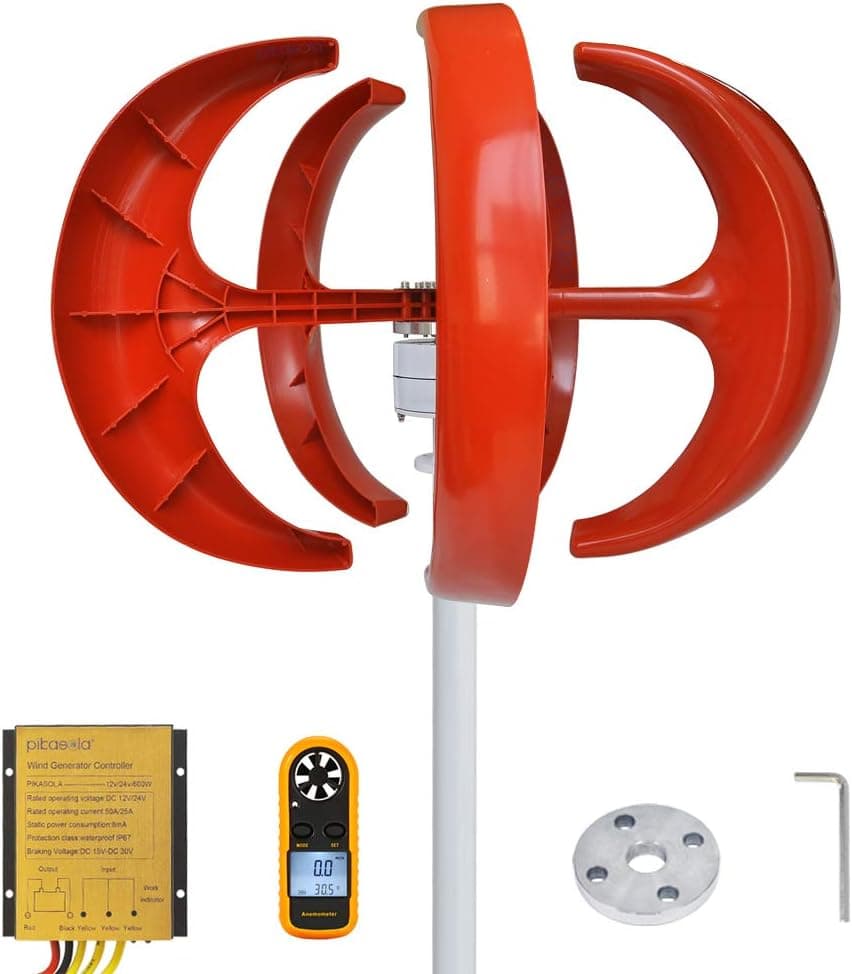
Instead of a traditional horizontal rotor pointing toward the wind, you get five vertically arranged blades surrounding a central axis. The manufacturer describes the design as looking a little like a red lantern.
And there’s a functional reason for that unusual shape.
Because it’s a vertical axis wind turbine, it can accept wind from different directions without needing a conventional yaw system to constantly point the rotor toward the incoming wind.
Add a three-phase permanent magnet generator, included controller, five reinforced fiber nylon blades, and a claimed maximum output of 220W, and you’ve got an interesting little turbine for small off-grid and hybrid renewable energy projects.
Check the latest price on Amazon:
https://link.amazon/B03axKUun
As an Amazon Associate, we may earn from qualifying purchases.
First, That Design Is Very Different
This definitely doesn’t look like a conventional wind turbine.
The five blades are arranged vertically around the central structure, creating something that looks closer to a rotating lantern than a miniature version of a utility-scale turbine.
It’s a vertical axis wind turbine, commonly abbreviated as VAWT.
Traditional wind turbines usually use a horizontal axis.
Their rotor needs to face into the wind, so some kind of yaw mechanism or directional system is typically required.
A vertical axis turbine works differently.
Because the rotor is arranged around a vertical axis, it can interact with wind coming from different horizontal directions.
That means you don’t need the entire turbine constantly rotating to face the wind.
And for certain small-scale applications, that’s an appealing idea.
Wind Direction Matters Less
Imagine putting a traditional small horizontal-axis turbine somewhere with frequently changing wind direction.
The turbine needs to keep orienting itself toward the incoming airflow.
Many small turbines solve this using a tail vane.
It’s simple and effective.
But this vertical design doesn’t need one.
The manufacturer says the turbine can respond to wind from 360 degrees around the rotor.
Wind shifts direction?
The turbine doesn’t need to turn the entire generator assembly toward it.
That can make vertical axis turbines interesting in environments where wind direction is variable.
Of course, accepting multidirectional wind doesn’t mean installation location stops mattering.
Clean airflow is still extremely important.
It’s Rated at 200W, With 220W Maximum
The headline power rating is 200W, with a claimed maximum output of 220W.
And this is where it’s important to understand wind turbine specifications.
A 200W turbine does not continuously generate 200 watts just because the blades are spinning.
Actual output depends heavily on wind speed.
At relatively low wind speeds, output can be dramatically lower than the rated figure.
As wind speed increases, available wind energy increases significantly, allowing the turbine to generate more power until it reaches its designed operating range.
So think of 200W as the turbine’s rated power specification, not as a promise that you’ll receive 200 watts around the clock.
Your actual energy production depends on the wind resource at your installation site.
200 Watts Can Still Be Useful
Compared with a modern residential solar panel producing several hundred watts under good sunlight, 200W might not sound particularly impressive.
But that’s not necessarily the right comparison.
A small wind turbine like this is more interesting as part of an off-grid battery system.
You could potentially use generated electricity to contribute toward charging batteries that later power lighting, monitoring equipment, electronics, or other relatively small loads.
The manufacturer specifically mentions applications such as homes, boats, marine installations, monitoring systems, and hybrid wind-solar street lighting.
And that last category is particularly interesting.
Wind Plus Solar Makes More Sense Than Wind Versus Solar
People sometimes talk about renewable technologies like they’re competing with each other.
Solar versus wind.
But for an off-grid system, the more interesting question can be:
Why not both?
Solar panels generate electricity when sufficient sunlight is available.
Wind turbines generate electricity when sufficient wind is available.
Those conditions don’t always happen at the same time.
Your solar panels obviously stop generating at night.
A wind turbine doesn’t care whether it’s noon or 2 AM.
If there’s wind, there’s potentially energy available.
Likewise, on a perfectly sunny but windless day, your solar panels can continue generating while the turbine sits still.
Pair the two with an appropriately designed battery and charging system, and you’ve got two different renewable resources contributing to the same energy system.
That’s where a small turbine like this becomes much more interesting.
The Manufacturer Claims Low-Wind Startup
The manufacturer says the turbine can start rotating in relatively light wind.
That makes sense as a design priority.
A turbine that requires extremely strong wind just to overcome its own mechanical resistance isn’t particularly useful for many small-scale installations.
The blade shape, generator resistance, bearings, and overall rotor design all influence startup behavior.
The manufacturer says the aerodynamic and structural design has been optimized to improve wind-energy utilization and low-wind startup.
But there’s an important distinction.
Starting to rotate is not the same thing as generating rated power.
A turbine might begin spinning in a gentle breeze while producing relatively little usable electricity.
Meaningful power generation generally requires stronger airflow.
So don’t confuse low startup speed with high output at low wind speeds.
Five Reinforced Fiber Nylon Blades
The turbine uses five blades made from reinforced fiber nylon, according to the listing.
That’s an interesting material choice.
The blades need to be relatively lightweight while also dealing with continuous rotation, sunlight, weather, vibration, and wind loading.
The manufacturer specifically emphasizes durability and wind resistance.
The five-blade configuration also gives this turbine its distinctive enclosed-looking shape.
And according to the manufacturer, the blades are secured internally using a flange to reduce the risk of individual blades becoming detached.
For any rotating machine installed outdoors, mechanical security is obviously extremely important.
The Generator Is Three-Phase AC
Inside the turbine is a three-phase permanent magnet AC generator.
That’s worth explaining because the battery you’re probably trying to charge is DC.
The turbine generates three-phase alternating current.
The controller then needs to process that electrical output appropriately before it can be used by the battery system.
Permanent magnet generators are common in small wind applications because they don’t require a separate external excitation system to establish their magnetic field.
The manufacturer also claims this generator design helps reduce resistance torque and provides a better match between the rotor and generator.
In practical terms, the goal is straightforward.
You want the turbine rotor and generator to work together efficiently across useful wind conditions.
Double Bearings Are Supposed to Keep Things Stable
Another interesting specification is the use of double bearings.
Wind turbines rotate.
A lot.
So bearing quality matters.
The manufacturer says the dual-bearing configuration helps make the rotor more stable and reduces shaking during operation.
That matters for several reasons.
Less vibration can mean less noise.
Less vibration can also reduce unnecessary mechanical stress on the turbine, mounting structure, and surrounding components.
And because this turbine may be installed near homes, boats, monitoring stations, or street lights, quiet operation is a meaningful feature.
Nobody wants to install a renewable energy system and then listen to it rattle all night.
About the “Silent” Claim
The manufacturer describes the turbine as offering silent rotation.
I’d interpret that as a relative claim rather than expecting literal silence.
Anything with blades moving through air, bearings rotating, and mechanical components under load has the potential to produce some sound.
Actual noise will also depend on wind speed, installation quality, mounting structure, vibration, wear, and the surrounding environment.
Still, vertical axis turbines are often considered for applications where compactness and noise characteristics matter.
If you’re installing any wind turbine close to an occupied building, noise is something worth considering before choosing the final location.
The Included Controller Matters
The listing says this turbine kit includes a controller.
That’s important because you generally don’t want to connect a variable-output wind generator directly to a battery and call it a day.
Wind speed constantly changes.
Generator output changes with it.
The charging system needs to manage that energy appropriately.
A controller can help regulate the relationship between the generator and battery.
Before installation, though, I’d verify the exact controller specifications, supported battery chemistry, voltage thresholds, maximum current, braking or dump-load behavior, and wiring requirements.
This is especially important if you’re using lithium batteries.
“12V” tells you the nominal system voltage.
It doesn’t tell you everything about the charging requirements of the battery.
The Screw Pile Idea Is Interesting
One of the more unusual things mentioned in the listing has nothing to do with the generator itself.
It’s the foundation.
The manufacturer says the turbine can be installed using a screw pile foundation rather than relying exclusively on a conventional concrete foundation.
Screw piles are essentially structural anchors that are driven or screwed into the ground.
Depending on the installation and soil conditions, this can potentially reduce installation time and avoid some of the work associated with pouring concrete.
The manufacturer also points out that screw piles can potentially be removed and recycled at the end of the installation’s life.
That’s an interesting approach, especially for smaller renewable energy installations.
But foundation requirements depend heavily on the tower, turbine, wind loading, soil conditions, local building requirements, and installation height.
Don’t choose a foundation method solely because it’s mentioned in the product listing.
The mounting structure needs to be designed safely.
Placement Is Everything With Small Wind
This might be the single most important thing to understand before buying a small wind turbine.
Your wind resource matters more than how cool the turbine looks.
Wind turbines need moving air.
And ideally, they need relatively clean, unobstructed airflow.
Buildings, trees, walls, and other obstacles can create turbulence.
So mounting a turbine low in a backyard surrounded by two-story houses might produce disappointing results even if the weather regularly feels “windy.”
Height can make an enormous difference.
Location can make an enormous difference.
Local wind conditions can make an enormous difference.
The turbine can only capture energy that’s actually available in the wind passing through its rotor.
Don’t Buy It Based on Wattage Alone
This is also why comparing small wind turbines purely by their maximum wattage can be misleading.
A 200W turbine in a good wind location could potentially be more useful than a supposedly larger turbine installed somewhere with poor airflow.
What you really care about is energy over time.
Not just maximum instantaneous power.
If a turbine generates 200W for a few moments but spends most of the day producing almost nothing, that’s a very different system from one generating useful lower output consistently.
For serious off-grid planning, understanding your site’s wind conditions is crucial.
Boats Are an Interesting Use Case
The manufacturer mentions marine and boat applications.
Conceptually, small wind generation can be attractive for some boats because wind may be available at times when solar production is low or nonexistent.
A wind turbine can potentially contribute energy to a battery bank while the vessel is away from shore power.
But marine environments are demanding.
Salt.
Humidity.
Corrosion.
Movement.
Strong gusts.
Installation constraints.
So if you’re considering this turbine specifically for a boat, I’d verify that every component, connector, fastener, controller, and mounting method is appropriate for the intended marine environment.
A listing mentioning “marine” isn’t enough by itself to establish long-term saltwater suitability.
This Could Also Be a Fun Renewable Energy Project
There’s another audience for this turbine.
People who simply want to experiment with wind power.
Pair it with a battery.
Add the appropriate monitoring equipment.
Measure wind speed.
Measure turbine output.
Track daily energy generation.
Compare windy days with calm days.
Then add solar panels and compare the two generation profiles.
Suddenly you’ve got a miniature hybrid renewable energy laboratory.
And because wind generation is highly variable, the data can actually become pretty interesting.
What I Like
The most interesting thing about this turbine is the vertical axis design.
It looks different, but that difference also serves a functional purpose.
You get multidirectional wind acceptance without a traditional yaw system.
The five reinforced fiber nylon blades create a compact rotor design.
The three-phase permanent magnet generator is purpose-built for wind generation.
The dual-bearing configuration is intended to improve stability.
And the included controller gives you a starting point for integrating the turbine into a battery-based energy system.
I also like that this isn’t pretending to be a giant home power plant.
At 200W rated output, this is clearly a small-scale renewable energy product.
What You Should Know Before Buying
First, the turbine is rated at 200W with a claimed maximum of 220W. That does not mean you’ll continuously receive 200W.
Second, low-wind startup doesn’t necessarily mean significant low-wind power generation.
Third, installation location is critical. Poor wind conditions can make even a well-designed turbine produce disappointing results.
Fourth, verify the included controller’s compatibility with your specific battery system before connecting everything.
Fifth, claims around quiet operation, wind-energy utilization, durability, and low-wind performance come from the manufacturer and can vary under real-world conditions.
And finally, make sure the tower and foundation are appropriately engineered for the turbine, installation height, soil conditions, and expected wind loads.
Who Is This For?
This turbine makes the most sense for someone interested in a small 12V wind energy system.
Maybe you’re building an off-grid setup.
Maybe you’re adding wind generation alongside solar.
Maybe you’re powering monitoring equipment.
Maybe you’re experimenting with renewable energy.
Or maybe you have a location with a genuinely good wind resource and want another way to contribute energy to a battery bank.
If your goal is to significantly offset the electricity consumption of an entire house, 200W is obviously small.
But for battery charging and modest off-grid applications, small amounts of renewable generation can still be useful.
Especially when they’re complementing another energy source.
The Bottom Line
The 200W Vertical Axis Wind Turbine is an interesting alternative to the miniature horizontal-axis turbines you normally see in small off-grid systems.
You get a five-blade vertical rotor, 200W rated output with a claimed 220W maximum, 12V architecture, three-phase permanent magnet generator, dual-bearing design, multidirectional wind operation, and an included controller.
But the specification sheet is only half the story.
Wind turbines live and die by their environment.
Put it somewhere with poor airflow and those 200 watts on the product page won’t mean much.
Put it somewhere with a genuinely useful wind resource and integrate it properly with a battery and potentially a solar array, and suddenly you’ve got another renewable energy source that can generate whether the sun is shining or not.
And that’s the most interesting thing about small wind.
It’s not necessarily about replacing solar.
It’s about having another way to capture energy when the conditions are right.
Check the 200W Vertical Axis Wind Turbine on Amazon:
https://link.amazon/B03axKUun