
300mL/min Hydrogen Gas Generator Review: Lab-Grade Hydrogen Without the Cylinder?
Hydrogen is having a moment.
Cars, energy storage, green steel, aviation, industrial decarbonization. Almost every conversation around hydrogen seems to involve enormous infrastructure and billions of dollars.
But sometimes you just need a small, controlled stream of hydrogen in a laboratory.
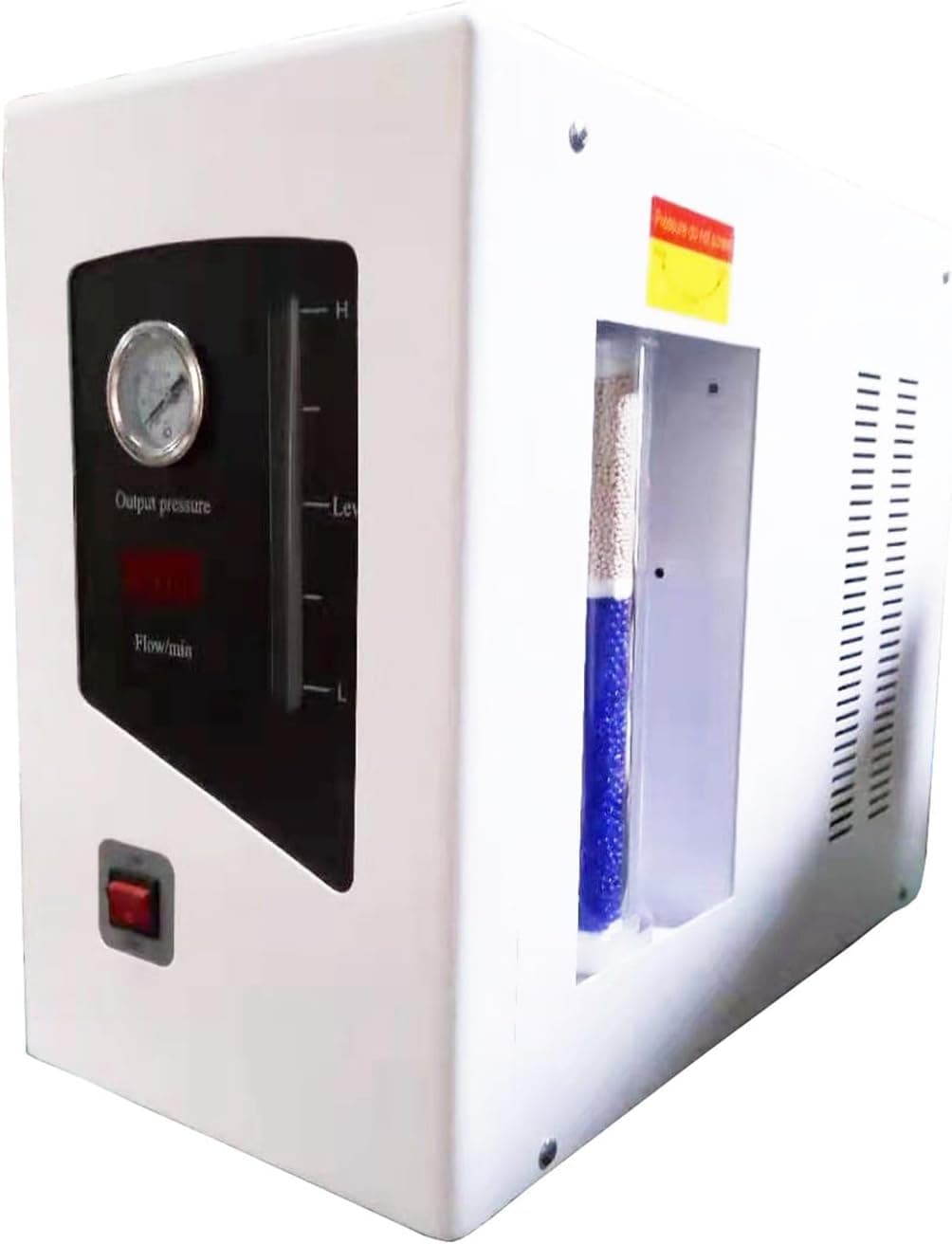
And that’s where something like this 300mL/min Hydrogen Gas Generator comes in.
Instead of storing hydrogen in a conventional high-pressure cylinder, this machine is designed to generate H2 on demand through electrolysis. The manufacturer claims up to 300mL per minute of adjustable output, 99.999% hydrogen purity, stable pressure, an LED flow display, and compatibility with applications such as gas chromatography.
It’s basically a small hydrogen factory that sits on a laboratory bench.
And that’s a pretty interesting idea.
Check the latest price on Amazon:
https://link.amazon/B074vDmEu
As an Amazon Associate, we may earn from qualifying purchases.
So, What Exactly Is This?
At its core, this is an electrolysis-based hydrogen generator.
Electrolysis uses electrical energy to separate water into hydrogen and oxygen.
Instead of buying hydrogen, storing it in a cylinder, and regulating that stored gas into your laboratory equipment, the generator produces hydrogen when required.
The manufacturer describes operation as relatively straightforward. Supply the appropriate distilled water, switch the unit on, and the system generates hydrogen.
That fundamentally changes how you think about the gas supply.
You’re not primarily storing hydrogen.
You’re producing it as you need it.
Up to 300mL Per Minute
The generator supports an adjustable output of 0 to 300mL/min, according to the listing.
That’s obviously tiny compared with industrial hydrogen production.
But that’s not what this machine is trying to compete with.
It’s intended for laboratory-scale applications where controlled gas flow matters much more than producing kilograms of hydrogen.
The adjustable output also means you don’t necessarily have to run the machine at maximum production.
The flow can be matched to the requirements of compatible equipment and experimental conditions within the manufacturer’s specified operating range.
The Big Claim Is 99.999% Purity
The headline specification is hydrogen purity.
The manufacturer claims 99.999% H2.
That’s often referred to as five-nines purity.
And for laboratory applications, purity can be extremely important.
If hydrogen is being supplied to analytical equipment, unwanted contaminants can interfere with measurements, baselines, detectors, or other aspects of an experiment.
So this isn’t simply about making hydrogen.
It’s about making hydrogen with sufficiently controlled purity for the intended laboratory application.
That said, 99.999% is a significant performance claim.
For analytical or critical work, I’d verify the manufacturer’s detailed purity specification, test documentation, operating requirements, and compatibility with your application rather than relying solely on the Amazon listing.
Gas Chromatography Is the Obvious Use Case
The manufacturer specifically mentions compatibility with various gas chromatographs.
And this is where a compact hydrogen generator starts making a lot of sense.
Gas chromatography laboratories can require a reliable supply of high-purity gases.
Traditionally, that can mean cylinders.
Cylinders work.
But they also need to be ordered, transported, stored, secured, monitored, and eventually replaced.
An on-site hydrogen generator changes that workflow.
Instead of waiting for a cylinder to empty and replacing it, you have a machine producing hydrogen as needed.
For laboratories that regularly consume hydrogen within the generator’s capacity, that’s potentially much more convenient.
It Could Replace Cylinders in Some Applications
The manufacturer describes the generator as a potential replacement for high-pressure hydrogen cylinders in suitable laboratory applications.
And conceptually, that’s probably the most interesting feature here.
A cylinder stores a relatively large quantity of compressed hydrogen.
An on-demand generator produces hydrogen continuously in much smaller quantities.
That doesn’t automatically make every application suitable for a generator, and it doesn’t eliminate the need for proper hydrogen safety measures.
But it changes the amount of hydrogen that needs to be stored and handled as part of the routine workflow.
For the right laboratory setup, that can be a meaningful operational advantage.
Stable Pressure Matters
Generating hydrogen is only one part of the job.
You also need to deliver it consistently.
The manufacturer says the generator maintains stable hydrogen output pressure, which is important when feeding analytical equipment.
A gas chromatograph doesn’t particularly care that your hydrogen generator is technically impressive.
It cares that the gas supply meets its requirements consistently.
Unstable gas delivery can potentially affect instrument operation and analytical performance.
So pressure stability is one of those specifications that sounds boring but could matter more in everyday use than the headline hydrogen-production rate.
There’s an LED Display
The unit also includes an LED display for real-time flow information.
That’s a simple feature, but a useful one.
Instead of treating the generator like a mysterious box that’s either on or off, you get visual feedback about its operation.
For laboratory equipment, that’s exactly what you want.
You should be able to look at the system and quickly understand what it’s doing.
The more immediately visible the operating state is, the easier it becomes to integrate the generator into a regular laboratory workflow.
Distilled Water Is the Main Consumable
According to the manufacturer, regular operation primarily requires replenishing distilled water.
That’s one of the biggest conceptual advantages of an electrolysis generator.
Your hydrogen feedstock is water.
Add the appropriate water.
Supply electricity.
The system performs the electrolysis.
Produce hydrogen.
Of course, that doesn’t mean the machine is maintenance-free.
Laboratory gas generators can still have service requirements, consumables, filters, drying components, seals, or other parts that need inspection or replacement according to the manufacturer’s instructions.
But compared with constantly swapping gas cylinders, the workflow can potentially be much simpler.
Continuous or Intermittent Operation
The listing says the generator can be used continuously or intermittently.
That’s useful because laboratories don’t all operate the same way.
One instrument might run for extended analytical sessions.
Another might only need hydrogen periodically.
A generator that can accommodate both operating patterns gives the laboratory more flexibility.
Again, I’d verify the manufacturer’s duty-cycle specifications before planning truly continuous operation over long periods.
“Continuous” in a product description should ideally be backed by detailed operating limits and maintenance intervals.
The Anti-Backflow System Is Important
One of the more interesting safety-oriented features is a device designed to prevent liquid return.
Backflow is something you don’t want in a gas-delivery system.
The manufacturer says the design helps maintain smooth operation while reducing the need for frequent replacement of color-changing silica gel.
This is another example of a feature that isn’t exciting on a specification sheet but could make the machine easier to live with.
Good laboratory equipment is often about removing little maintenance headaches.
You want the machine quietly doing its job rather than constantly demanding attention.
300mL/min Is Not an Industrial Hydrogen Plant
The product title mentions laboratory and industrial use, but it’s worth putting the output into perspective.
At maximum output, the listing claims 300 milliliters of hydrogen per minute.
That’s 18 liters per hour under the referenced volumetric conditions.
This is clearly not a machine intended to produce bulk hydrogen for industrial heating, hydrogen vehicles, large fuel cells, or industrial-scale energy storage.
It’s much closer to a laboratory gas-supply instrument.
That’s an important distinction because “hydrogen generator” can mean wildly different things.
A green hydrogen project might involve megawatts of electrolyzers.
This sits on a bench.
Same fundamental molecule.
Completely different scale.
This Isn’t a Home Hydrogen Experiment
And because we’re talking about hydrogen, there’s an important safety distinction.
Hydrogen is highly flammable and has properties that require appropriate ventilation, leak prevention, compatible equipment, and laboratory safety procedures.
This product should be treated as specialized equipment rather than a casual DIY gadget.
The fact that hydrogen is produced on demand doesn’t mean safety considerations disappear.
Installation and operation should follow the manufacturer’s instructions and the applicable laboratory or workplace requirements.
For professional use, I’d also want to confirm appropriate certifications, pressure specifications, gas connections, ventilation requirements, and compatibility with the downstream instrument.
Why On-Demand Hydrogen Is Interesting
There’s something elegant about the concept.
With a cylinder, you manufacture hydrogen somewhere else.
Purify it.
Compress it.
Put it into a heavy pressure vessel.
Transport that vessel.
Store it.
Connect it.
Use the hydrogen.
Return or replace the cylinder.
With an on-site generator, the supply chain becomes much shorter.
Water enters the machine.
Electricity enters the machine.
Hydrogen comes out.
For small-volume applications, that’s a very different operational model.
And depending on usage, cylinder pricing, delivery logistics, and maintenance costs, it could potentially make economic sense too.
But Cost Per Hydrogen Isn’t the Only Calculation
If you’re comparing this with cylinders, don’t just compare the purchase price.
Think about the complete cost.
The generator has an upfront cost.
It consumes electricity.
It may require maintenance and replacement consumables.
It has a finite service life.
Cylinders have recurring gas costs.
There may be delivery charges.
Cylinder rental or deposits may apply.
Staff spend time changing cylinders.
Storage space is required.
The better comparison is the total cost of ownership over several years.
For a laboratory that uses hydrogen regularly, that’s where an on-site generator may become particularly interesting.
What I Like
The strongest part of this product is the simplicity of the concept.
You get on-demand hydrogen production, adjustable output from 0 to 300mL/min, manufacturer-claimed 99.999% purity, stable pressure, real-time LED flow information, and an anti-backflow design.
The regular feedstock is straightforward too.
Distilled water.
For a laboratory that would otherwise depend on hydrogen cylinders, having an on-site supply could simplify day-to-day operation.
And because the hydrogen is generated as needed, the workflow is fundamentally different from keeping a large reserve of compressed gas nearby.
What You Should Know Before Buying
First, the 99.999% purity figure is a manufacturer claim. For sensitive analytical work, verify the specification and supporting documentation before relying on it.
Second, make sure the 0 to 300mL/min output range is sufficient for your instrument and application.
Third, verify the required outlet pressure and confirm that it matches the downstream equipment.
Fourth, check exactly what maintenance and consumables the system requires beyond replenishing distilled water.
Fifth, confirm relevant electrical, laboratory, and product certifications for your workplace.
Sixth, remember that generating hydrogen on demand does not eliminate hydrogen safety requirements. Proper installation, ventilation, leak management, compatible connections, and operating procedures remain important.
And finally, if you’re purchasing this specifically for a gas chromatograph, verify compatibility with the exact instrument and detector configuration rather than relying solely on the general compatibility claim.
Who Is This For?
This hydrogen generator makes the most sense for a laboratory or professional environment that needs a relatively small, consistent supply of high-purity hydrogen.
Maybe you’re operating gas chromatography equipment.
Maybe you’re tired of managing hydrogen cylinders.
Maybe cylinder delivery is inconvenient.
Maybe you want an on-demand hydrogen source for compatible analytical work.
Or maybe your laboratory wants to simplify its gas-supply infrastructure.
That’s where a compact generator becomes interesting.
For large industrial hydrogen consumption?
This isn’t remotely the right scale.
For casual experimentation at home?
Also not what I’d consider its intended role.
This is specialized laboratory equipment.
The Bottom Line
The 300mL/min Hydrogen Gas Generator takes something that normally arrives in a pressurized cylinder and turns it into an on-demand utility.
Add distilled water.
Supply electricity.
And the system is designed to generate a controlled stream of hydrogen whenever compatible laboratory equipment needs it.
The manufacturer claims up to 300mL/min output, adjustable flow, 99.999% hydrogen purity, stable pressure, an LED real-time display, and an anti-backflow system, with gas chromatography highlighted as a key application.
The purity and performance specifications should be independently verified for critical analytical work, and hydrogen still demands appropriate professional safety precautions.
But the broader concept is compelling.
Instead of asking:
“How much hydrogen do we have left in the cylinder?”
The question becomes:
“Is the generator ready?”
And for a laboratory that uses hydrogen every day, that could be a much better question to have.
Check the High-Efficiency Hydrogen Gas Generator on Amazon:
https://link.amazon/B074vDmEu