
36W-40W Wind Turbine Generator Motor Review: A Tiny Generator for DIY Energy Projects
Most renewable energy products arrive as finished systems.
Solar panel.
Wind turbine.
Charge controller.
Battery.
Plug everything together and you’re basically done.
But sometimes the interesting part isn’t using the finished product.
It’s building the thing yourself.
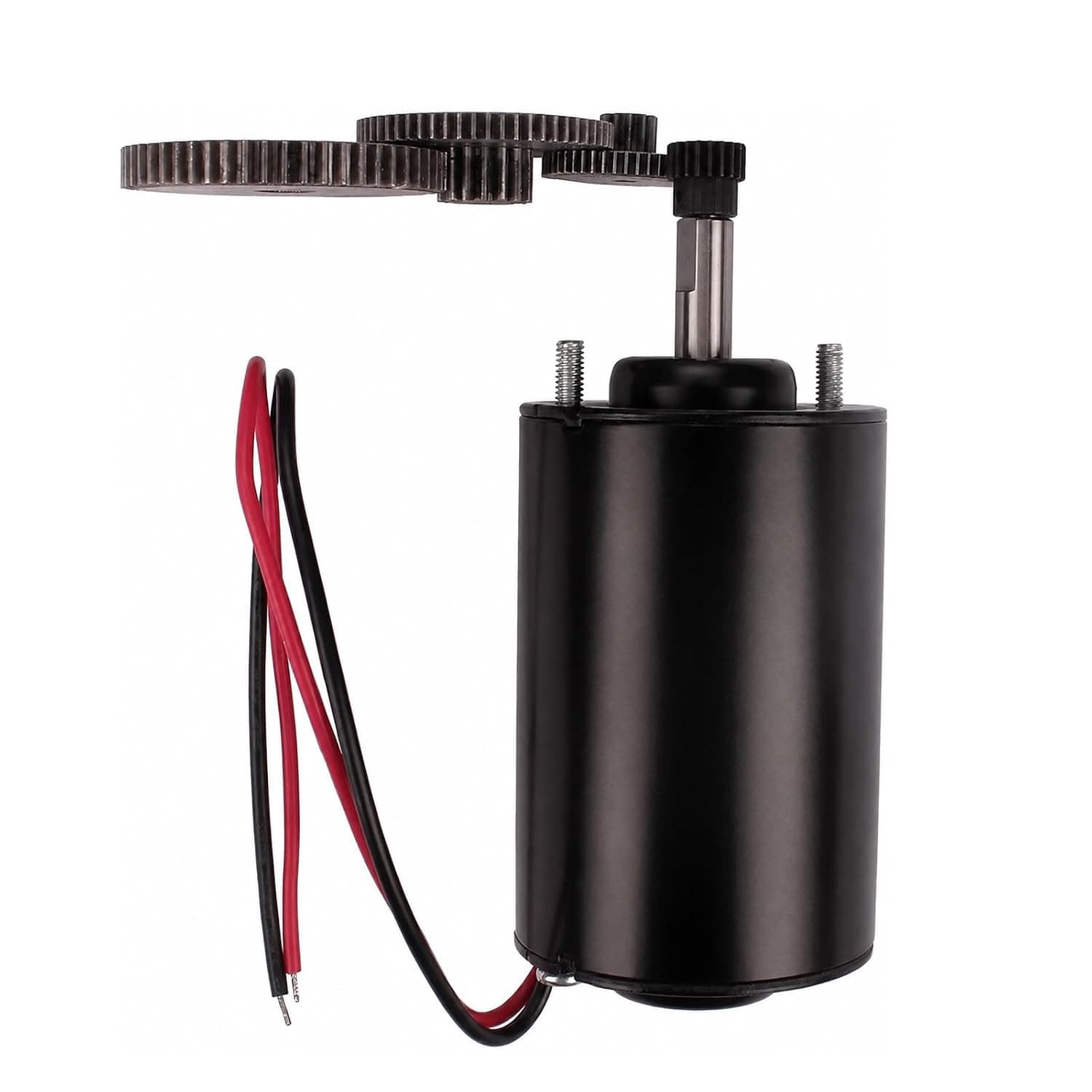
That’s where this 36W-40W Wind Turbine Generator DC Motor with Gearbox comes in.
This isn’t a complete wind turbine. There are no blades, tower, charge controller, or battery included.
Instead, you’re getting one of the core components needed to build your own small generator: a permanent magnet DC motor paired with a 1:42 reduction gearbox.
And because permanent magnet motors can also generate electricity when mechanically driven, this little motor opens up a surprising number of possibilities.
Wind turbine.
Hand-crank generator.
Experimental power system.
Mechanical automation project.
Or just something to put on your workbench and see how much electricity you can generate by spinning it.
Check the latest price on Amazon:
https://link.amazon/B039Qw523
As an Amazon Associate, we may earn from qualifying purchases.
First, This Is Not a Complete Wind Turbine
Let’s make that clear immediately.
If you order this expecting to pull a tiny wind turbine out of the box and stick it in your backyard, that’s not what you’re getting.
This is essentially a DC permanent magnet motor and gearbox assembly that can be incorporated into DIY power-generation and mechanical projects.
To turn it into an actual wind turbine, you’d still need to think about things like:
Blades.
Hub.
Mounting structure.
Wind direction.
Electrical rectification or regulation where required.
Charge control.
Battery compatibility.
Overcurrent protection.
Weather protection.
And probably a lot of experimentation.
That’s also what makes it fun.
This is much more of a maker component than a finished consumer appliance.
A Motor Can Also Be a Generator
Here’s the interesting physics.
An electric motor takes electrical energy and turns it into mechanical rotation.
Apply electricity.
Shaft spins.
But many permanent magnet DC motors can essentially perform that process in reverse.
Rotate the shaft mechanically and the motor can generate electrical voltage.
Instead of:
Electricity → rotation
you get:
Rotation → electricity.
That’s why motors like this can be used in DIY wind turbines and hand-crank generators.
The wind spins your turbine blades.
The blades rotate the generator.
The generator converts some of that mechanical energy into electrical energy.
Simple concept.
Getting it to work efficiently in the real world is where the engineering begins.
It’s Rated at 36W to 40W
The manufacturer describes this as a 36W to 40W motor.
That’s an important number to put into perspective.
40 watts isn’t going to power your house.
It’s not going to run your air conditioner.
And it’s definitely not competing with a rooftop solar installation.
But for a DIY generator project, 40W is enough to make things interesting.
Small electronics.
LED lighting.
Battery experiments.
Educational projects.
Power-generation demonstrations.
Sensors.
And other low-power applications can all fall within this general territory, depending on the actual output conditions and supporting electronics.
Just remember that rated motor power and real-world generator output are not automatically the same thing.
Actual generated power depends on rotational speed, mechanical input, electrical load, losses, and the characteristics of the motor.
The Gearbox Is the Interesting Part
Attached to the motor is a four-gear reduction system with a 1:42 ratio.
According to the listing, the 24V motor itself operates at approximately 2600 RPM, which is reduced to around 61.9 RPM after the gearbox.
2600 divided by 42 gives you roughly 61.9.
So the numbers line up.
The reason you would use gearing is straightforward.
Speed and torque are a trade-off.
A reduction gearbox decreases output rotational speed while increasing available torque at the output, subject to efficiency losses.
That’s useful for mechanical systems that need slower, stronger movement rather than extremely fast rotation.
And this is where you need to pay close attention when using a geared motor as a generator.
The direction in which the gearbox is being driven matters, and not every gearbox is equally suitable for being back-driven from its output shaft.
So if your plan is specifically to use the geared assembly for wind generation, verify the manufacturer’s intended mechanical configuration before designing your turbine around it.
Permanent Magnets Make It Interesting for DIY Generation
The motor uses a permanent magnet design.
That’s useful for generator applications because the magnetic field already exists inside the motor.
You don’t need a separate external excitation source just to establish that magnetic field.
Rotate the motor appropriately and you can induce voltage in the windings.
That’s one reason permanent magnet motors are popular in small DIY generator experiments.
They’re relatively compact.
They’re conceptually straightforward.
And they make it easy to demonstrate the relationship between mechanical movement and electrical generation.
Spin faster and the electrical characteristics change.
Apply a load and the mechanical resistance changes.
Suddenly a textbook explanation of electromagnetic induction becomes something you can physically feel.
You Can Turn It Into a Hand-Crank Generator
This might actually be more approachable than building a wind turbine.
Attach an appropriate crank mechanism and you’ve got the basis of a manual generator.
The manufacturer claims the unit can produce more than 20V DC when rotated at approximately one revolution per second in the specified configuration.
That’s an interesting claim, but I’d treat the exact voltage as dependent on the setup, rotational speed, load, and measurement conditions.
The broader concept is absolutely useful.
You turn the handle.
Mechanical energy goes into the generator.
Electrical energy comes out.
And once again, the harder you load the electrical side, the more resistance you may feel mechanically.
That’s a great way to physically experience energy conversion.
About Charging a Phone With It
The listing suggests that the generator can be used to charge devices such as mobile phones and power banks with appropriate controllers.
Those last three words are extremely important.
Appropriate controllers.
Do not simply connect the raw output from a DIY generator directly to your smartphone.
Your phone expects properly regulated power.
The generator output can vary as rotational speed changes.
Spin faster.
Voltage can increase.
Slow down.
Voltage decreases.
That’s not what you want feeding directly into sensitive USB electronics.
You’d need suitable voltage regulation and charging electronics between the generator and the device.
For USB charging, that typically means providing the correct regulated USB output through appropriate electronics.
The generator creates the energy.
The power electronics make that energy usable by your device.
Those are two different jobs.
The Same Applies to Charging a 12V Battery
The manufacturer also mentions charging 12V batteries.
Again, you need appropriate charging control.
A battery isn’t something you should connect directly to an uncontrolled variable-voltage generator and hope for the best.
Different battery chemistries have different charging requirements.
Lead-acid.
LiFePO4.
Other lithium-ion chemistries.
They’re not interchangeable.
A proper charging system needs to regulate voltage and current according to the battery specifications and provide appropriate protection.
So think of this motor as the generation component.
Not the complete charging system.
Dual Ball Bearings
Mechanically, the motor uses dual ball bearings.
That’s a nice specification for something designed to rotate repeatedly.
Bearings support the rotating shaft and help reduce friction.
The manufacturer claims the dual-bearing arrangement provides smoother operation with lower vibration and noise.
For DIY equipment, that’s useful.
Excessive vibration doesn’t just create noise.
It can loosen mounts, accelerate wear, and make your entire project feel considerably less refined.
A smoother rotating assembly gives you a better foundation to build around.
And It Only Weighs About 585 Grams
The complete assembly weighs approximately 585 grams, or around 1.29 pounds, according to the listing.
That’s fairly compact for something combining a motor and reduction gearbox.
Weight matters in DIY projects.
If you’re building a small turbine, robotic system, portable generator, model, or experimental machine, every additional component affects the mechanical structure around it.
A compact generator assembly is much easier to integrate than a giant industrial motor.
There’s Overload and Stall Protection
The manufacturer also highlights overload and stall protection.
This is intended to help protect the motor windings when the mechanism encounters excessive load or temporary stall conditions.
That’s useful because stalled electric motors can experience significant current and heat when they’re being operated as motors.
Again, I’d treat this as a protection feature rather than permission to intentionally overload the unit.
Protection circuitry is the backup plan.
Proper system design is still the first line of defense.
It’s Not Just for Wind Power
Despite the product title emphasizing wind turbines, the motor can potentially be used in a much broader range of projects.
The manufacturer mentions:
Automation equipment.
HVAC valves.
Electric models.
Massage equipment.
Wire-twisting machines.
Hand generators.
Small electrical machines.
And other DIY mechanical systems.
That makes sense because fundamentally, this is a geared permanent magnet DC motor.
Wind generation is one possible application.
Mechanical actuation is another.
Manual generation is another.
For makers, that’s actually more useful than having a component that only does one thing.
Building a Tiny Wind Turbine Would Be the Fun Project
But obviously, the most interesting experiment is building a small wind turbine.
You’d need an appropriate rotor and blade system capable of capturing energy from the wind.
That rotor needs to transfer mechanical rotation to the generator.
Then you’d need to take the electrical output and condition it appropriately for whatever you’re trying to power.
If you’re charging a battery, you’ll need the correct charging electronics.
If you’re powering LEDs, you’ll need to make sure voltage and current stay within acceptable limits.
If you’re trying to measure generation, adding voltage and current monitoring could make the project much more interesting.
Suddenly you’re not just building a windmill.
You’re building a miniature renewable energy laboratory.
You Could Actually Experiment With Blade Design
This is where DIY wind power becomes genuinely educational.
Try different blade sizes.
Different blade counts.
Different blade angles.
Different materials.
Different wind speeds.
Then measure the resulting voltage and current.
You can start asking real engineering questions.
Does a larger rotor generate more useful power in lower wind?
What happens when you add more blades?
How does electrical load affect turbine speed?
What happens when the generator is disconnected?
What happens when you connect a load?
Those experiments teach you much more about wind power than simply buying a finished turbine and watching it spin.
Wind Power Is Harder Than It Looks
And you’ll probably discover something else.
Small wind generation is difficult.
The amount of energy available in wind changes dramatically with wind speed.
Then you have aerodynamic losses.
Mechanical losses.
Gearbox losses.
Generator losses.
Electrical conversion losses.
And losses in whatever you’re charging.
That’s why a small rotor turning slowly in a gentle breeze isn’t necessarily going to produce anywhere near the motor’s headline wattage.
The 36W to 40W rating should not be interpreted as guaranteed wind turbine output.
Your actual electrical generation will depend heavily on how you build and operate the system.
That’s part of the challenge.
This Could Be an Excellent STEM Project
For education, this thing has a lot going for it.
You can demonstrate:
Mechanical energy.
Electrical energy.
Gear ratios.
Torque.
Rotational speed.
Electromagnetic induction.
Voltage regulation.
Energy losses.
Battery charging.
Wind power.
That’s a surprisingly large amount of engineering packed into one little motor.
And unlike simply reading about those concepts, you can physically interact with them.
Turn the shaft.
Measure the voltage.
Add a load.
Feel the resistance.
Change the mechanical input.
Watch the electrical output change.
That’s the kind of experiment people remember.
What I Like
The biggest appeal here is flexibility.
It’s not pretending to be a finished renewable energy product.
It’s a component.
And that means what you build around it is entirely up to you.
The permanent magnet DC design makes it interesting for small generator experiments.
The 1:42 gearbox gives you a substantial reduction ratio for low-speed, high-torque mechanical applications.
The dual ball bearings should help with smooth operation.
And the relatively compact 585-gram design makes it easier to integrate into DIY projects.
You could use it to generate electricity.
You could use it as a geared motor.
Or you could build something completely different.
That’s the fun part.
What You Should Know Before Buying
First, this is not a complete wind turbine kit.
You’ll need additional mechanical and electrical components to build a functioning wind power system.
Second, the 36W to 40W specification shouldn’t be interpreted as guaranteed electrical generation from your DIY turbine.
Third, if you’re planning to back-drive the gearbox for power generation, verify that the gearbox and intended configuration are suitable for that use.
Fourth, don’t directly connect variable generator output to smartphones, power banks, or batteries. Use appropriate regulation, charging circuitry, and protection.
And finally, remember that every stage of energy conversion introduces losses.
The mechanical power going into the system will always be greater than the usable electrical power you ultimately get out.
Who Is This For?
This motor makes the most sense for makers, hobbyists, students, teachers, and DIY renewable energy enthusiasts.
If you want a finished wind turbine that you can install and immediately start using, this probably isn’t what you’re looking for.
But if your reaction to seeing a motor, gearbox, wires, and specifications is:
“I wonder what I can build with this?”
Then you’re exactly the target audience.
The Bottom Line
The 36W-40W Wind Turbine Generator DC Motor with Gearbox isn’t particularly impressive if you look at it purely as a power source.
Forty watts is tiny compared with residential solar panels and commercial wind turbines.
But that’s not really the point.
This is a compact permanent magnet DC motor with a 1:42 gearbox, dual ball bearings, approximately 585-gram construction, and potential applications ranging from automation to hand-crank and wind-powered generation projects.
And because it’s a component rather than a finished system, it gives you something increasingly rare in modern technology.
The opportunity to actually understand how the thing works.
Build a turbine.
Add a crank.
Connect a multimeter.
Experiment with gearing.
Measure the output.
Try different loads.
You might not generate enough electricity to make a meaningful difference to your power bill.
But you could learn a surprising amount about how mechanical energy becomes electricity.
And for a DIY project, that’s arguably much more interesting.
Check the 36W-40W Wind Turbine Generator DC Motor on Amazon:
https://link.amazon/B039Qw523