
5kW Wind Turbine Generator Review: Serious Home Wind Power, but Read the Specs Carefully
Five kilowatts.
Now we’re getting into some serious numbers.
Most of the small wind turbines you find online are rated for a few hundred watts. They’re interesting for battery charging, lighting, remote equipment, and DIY renewable energy projects.
This one is advertised at 5kW.
That’s a completely different category.
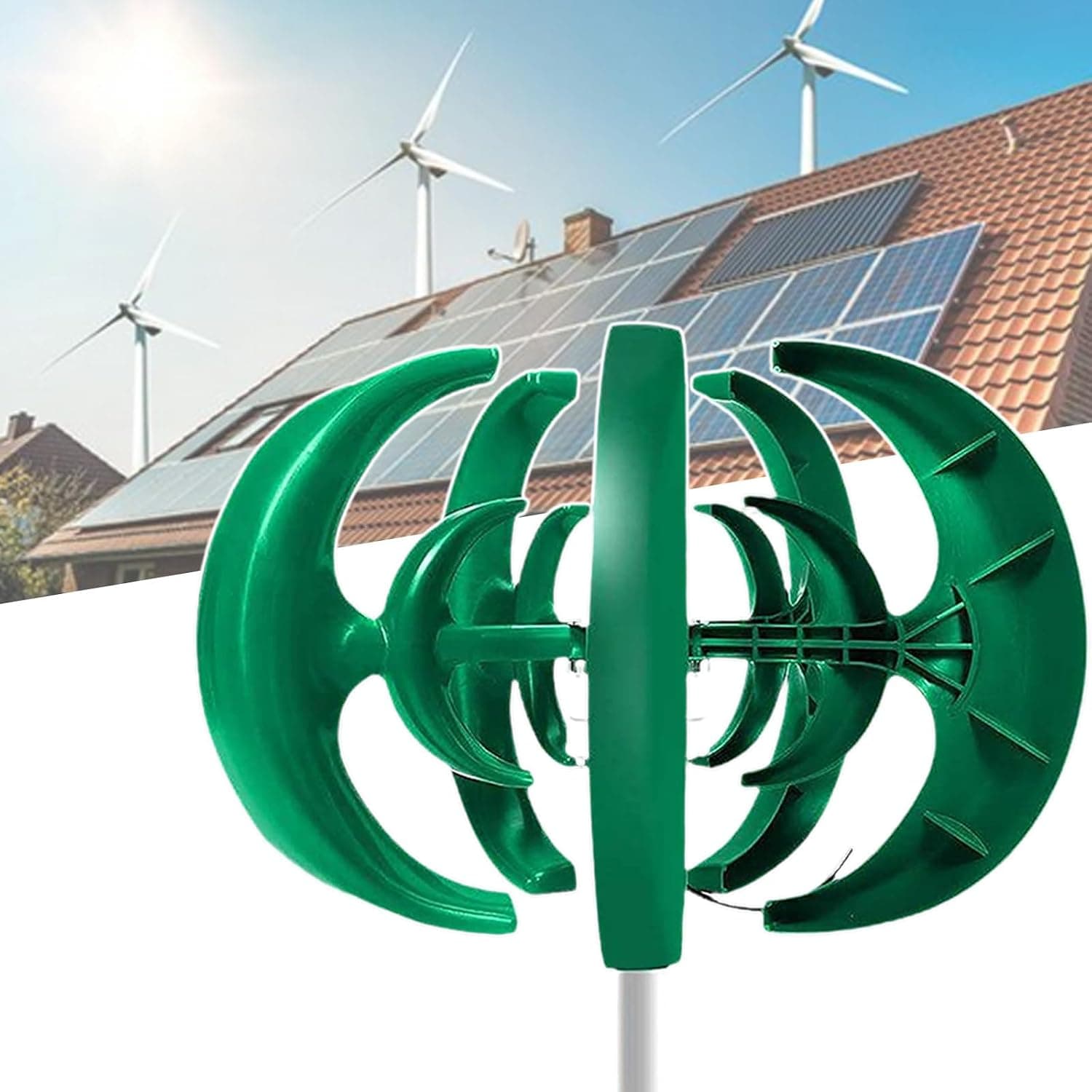
The listing describes a 24V wind turbine with five lightweight blades, a permanent magnet AC generator, dual bearings, a claimed 1.5 m/s startup wind speed, low-noise operation, and an included controller.
On paper, that sounds like a surprisingly capable renewable energy system for homes, camping, remote installations, street lighting, weather stations, and other off-grid applications.
But there’s also a lot to unpack here.
Because when a relatively compact wind turbine claims 5,000 watts of output, the first question shouldn’t be:
“How much can I power with 5kW?”
It should be:
“Under what wind conditions does it actually produce 5kW?”
That’s the question that matters.
Check the latest price on Amazon:
https://link.amazon/B02GNPRUf
As an Amazon Associate, we may earn from qualifying purchases.
5kW Is a Lot of Power
Let’s start with the headline specification.
The turbine is advertised as a 5kW wind generator.
That’s 5,000 watts.
For perspective, that’s significantly more than the peak output of many individual rooftop solar arrays consisting of several panels.
If a wind turbine could genuinely produce 5kW continuously, that would represent a substantial amount of energy.
One hour at 5kW would theoretically produce 5kWh.
Ten hours would produce 50kWh.
But that’s not how real-world wind generation works.
A turbine’s rated power is associated with particular operating conditions, especially wind speed.
And wind speed is constantly changing.
So the 5kW number by itself doesn’t tell us how much electricity this turbine will actually generate over a day, month, or year.
For that, we’d want something much more useful.
A power curve.
The Missing Number Is Rated Wind Speed
This is one of the first specifications I’d want to verify before buying.
At what wind speed does the turbine actually reach its advertised 5kW output?
The supplied Amazon description doesn’t tell us.
And that’s important.
Two turbines can both say “5kW” while delivering completely different real-world energy production depending on their rotor size, generator characteristics, rated wind speed, control system, and installation conditions.
A turbine that reaches 5kW only under extremely strong wind isn’t equivalent to one capable of producing substantial power under the wind conditions normally experienced at your site.
So I’d treat the 5kW figure as the manufacturer’s advertised maximum or rated specification until a detailed power curve confirms exactly how output changes with wind speed.
And 1.5 m/s Does Not Mean 5kW
The listing also claims a minimum startup wind speed of 1.5 meters per second.
That sounds impressive.
And it could be useful.
But there’s a very important distinction between:
Startup wind speed
and
Rated wind speed.
At 1.5 m/s, the manufacturer says the rotor can begin moving.
That does not mean the turbine is producing 5,000 watts.
It doesn’t even necessarily mean it’s producing a large amount of usable electrical power.
It means the rotor can start rotating.
That’s it.
Meaningful energy generation requires sufficient energy in the moving air.
As wind speed increases, the amount of energy available to the turbine rises dramatically.
So low startup speed can be a nice characteristic, but it should never be confused with high output at low wind speeds.
The Five-Blade Design Is Interesting
The turbine uses five blades made from lightweight materials.
More blades can influence characteristics such as starting behavior, rotational speed, torque, noise, and how the rotor interacts with the generator.
The manufacturer specifically emphasizes low-wind startup and quiet operation.
The blades are also designed to withstand significant wind pressure while maintaining a balanced rotating assembly.
That’s important because balance becomes increasingly critical as rotational speed increases.
An unbalanced rotor creates vibration.
Vibration creates noise.
And over time, excessive vibration can contribute to mechanical wear.
So the rotor isn’t just about capturing wind.
It needs to do it smoothly.
Dual Bearings Help With Stability
The turbine uses a dual-bearing design.
Again, this sounds like a small detail until you remember what a wind turbine spends its entire life doing.
Rotating.
Potentially thousands upon thousands of times.
Bearings support the rotating assembly and help minimize friction, vibration, and unwanted movement.
According to the manufacturer, the dual-bearing arrangement contributes to quieter and more stable operation.
That’s particularly important if you’re thinking about installing a turbine relatively close to a home.
A turbine can generate renewable electricity.
But if everyone in the house can hear it vibrating through the structure at 2 AM, that’s probably not the kind of renewable energy experience you were hoping for.
About the “Noiseless” Claim
The product title describes this turbine as noiseless.
I’d interpret that as marketing language rather than expecting literal silence.
Wind turbines contain moving blades.
Those blades interact with air.
The generator rotates.
Bearings rotate.
The mounting structure experiences mechanical forces.
All of those things can potentially produce sound.
The manufacturer says the turbine’s lightweight blades, dual bearings, streamlined design, and rotating balance help reduce noise and vibration.
Those are useful design goals.
But actual noise will depend on wind speed, installation, tower structure, mechanical condition, surroundings, and distance from the turbine.
So I’d read “noiseless” as “designed for relatively quiet operation,” not “physically incapable of producing sound.”
The Generator Uses Permanent Magnets
Inside the turbine is what the manufacturer describes as a pure copper permanent magnet AC alternator.
Permanent magnet generators make a lot of sense for small wind systems.
The magnetic field is provided by permanent magnets rather than requiring a separate electrical excitation system.
As the turbine blades rotate the generator, mechanical energy from the wind is converted into electrical energy.
The manufacturer also highlights a rotor design intended to reduce resistance torque.
That’s particularly relevant at lower wind speeds.
If the generator requires too much torque just to begin rotating effectively, the turbine may struggle to take advantage of weaker winds.
The goal is to match the aerodynamic characteristics of the rotor with the electrical characteristics of the generator.
When those two systems work well together, you get a more usable turbine.
It’s a 24V System
The listing describes this as a 24V wind energy system.
That’s where the 5kW claim raises another important technical question.
Power is related to voltage and current.
At very high power levels and relatively low system voltages, current can become extremely large.
So if you’re actually designing a system intended to handle kilowatts of power at 24V, you need to pay very close attention to the controller’s electrical ratings, wiring, connectors, protection devices, battery configuration, and complete system architecture.
This is not the point where you grab some random wire from the garage and start connecting things.
Before installation, verify the controller’s maximum current rating and the turbine’s actual output specifications carefully.
The Included Controller Is Essential
The kit includes a controller, which is exactly what you’d expect from a wind power system.
Wind doesn’t deliver perfectly stable electrical output.
Wind speed changes.
Turbine speed changes.
Generator output changes.
Meanwhile, your battery needs controlled charging.
The controller sits between those two systems and manages the energy transfer.
Depending on the design, a wind controller may also help manage the turbine when the battery is full or when electrical conditions move outside acceptable limits.
Before connecting the system, I’d want to know exactly what the included controller supports.
Battery chemistry.
Maximum input voltage.
Maximum current.
Braking behavior.
Dump-load requirements.
Charging thresholds.
Protection functions.
These details matter considerably more than the color or shape of the controller enclosure.
This Could Be Interesting in a Wind-Solar Hybrid System
The listing repeatedly references wind and solar hybrid applications.
And that’s probably one of the most compelling ways to use small-scale wind.
Solar and wind aren’t necessarily competitors.
They can be complementary.
Solar panels generate electricity when sunlight is available.
Wind turbines generate when sufficient wind is available.
At night, your solar panels produce nothing.
Your turbine doesn’t care whether the sun is up.
During cloudy weather, solar production may fall while wind conditions could potentially increase.
Of course, there will also be times when it’s dark and completely calm.
That’s why the battery is so important.
The broader system captures energy when renewable resources are available, stores it, and then makes that energy available when you actually need it.
Street Lighting Is a Logical Application
The manufacturer specifically mentions hybrid street lighting.
That actually makes a lot of sense conceptually.
Imagine a remote street light equipped with both a solar panel and wind turbine.
During sunny periods, solar contributes energy.
During windy periods, the turbine contributes energy.
The battery stores that energy.
Then the light uses the stored electricity after dark.
Because the system can potentially operate independently of the electrical grid, this type of architecture can be useful in certain remote installations.
The listing also mentions parks, highways, tourist attractions, communication base stations, and weather stations.
These are all applications where autonomous power can potentially be valuable.
What About Camping?
The title also mentions camping.
Technically, yes, a wind generator can be useful in remote environments.
But this isn’t the same kind of camping accessory as a folding solar panel.
A meaningful wind turbine installation requires a suitable mounting structure and appropriate exposure to wind.
You also have blades, cables, a controller, and potentially a substantial battery system.
So I’d think of this more as a solution for semi-permanent camps, remote cabins, RV-adjacent setups, or longer-term off-grid installations rather than something you casually throw into a backpack for a weekend hike.
Portability and wind generation don’t always go together particularly well.
Removable Blades Help With Transportation
That said, the blades are removable, which makes storage and transportation considerably easier.
The turbine also uses a flange-based connection system intended to simplify assembly and disassembly.
The package includes installation accessories and a manual, according to the manufacturer.
That’s useful if the turbine needs to be transported between locations or stored when it’s not being used.
It also makes component replacement potentially easier.
But installation convenience shouldn’t be confused with structural simplicity.
A turbine exposed to strong winds can experience significant mechanical loads.
The tower, pole, foundation, fasteners, and surrounding structure all need to be appropriate for the turbine.
Placement Is Everything
This is probably the most important section of the entire review.
You can buy the best wind turbine in the world and get terrible results if you install it in the wrong location.
Wind turbines need clean airflow.
Buildings create turbulence.
Trees create turbulence.
Walls create turbulence.
Nearby terrain affects wind.
Installation height affects wind.
A turbine installed low between buildings might spin occasionally while producing very little meaningful energy.
Meanwhile, the same turbine installed in an appropriately exposed location could experience dramatically better wind conditions.
Before spending serious money on small wind power, understanding your local wind resource is one of the smartest things you can do.
The Power Curve Matters More Than the Product Title
If I were evaluating this turbine for an actual energy project, there are several pieces of data I’d want before designing the system around it.
Most importantly, I’d want the full manufacturer power curve.
How much does it produce at 3 m/s?
5 m/s?
8 m/s?
10 m/s?
At what wind speed does it reach 5kW?
What’s the cut-in speed?
What’s the rated wind speed?
What’s the maximum safe wind speed?
What is the rotor diameter?
What controller current is supported?
Those numbers would tell us considerably more about real-world performance than “5kW” printed in the title.
Don’t Design Your Home Around 5kW Without Verifying It
This is especially important because the listing positions the turbine for home use.
If you’re building a serious home energy system, don’t assume you have 5kW of dependable generation available simply because the turbine carries that rating.
Wind is variable.
Real energy production is measured over time.
What ultimately matters is not maximum power.
It’s kilowatt-hours generated over the day, month, and year.
That’s what determines how much useful energy the turbine actually contributes.
For a home or serious off-grid installation, I’d want verified technical specifications and ideally real-world performance data before sizing batteries, inverters, cables, and other components around the turbine.
What I Like
Conceptually, there’s quite a lot to like.
The five-blade rotor is designed for relatively low startup speed.
The dual-bearing configuration is intended to reduce vibration.
The permanent magnet AC generator is a logical choice for small wind generation.
The removable blades and flange connection make transportation and assembly easier.
And the included controller means you’re not starting with the turbine alone.
I also like the idea of pairing it with solar.
A properly designed wind-solar hybrid system is considerably more interesting than treating the two technologies as competitors.
What You Should Know Before Buying
This is one product where I’d verify several specifications before placing an order.
First, confirm exactly what the 5kW rating represents and at what wind speed that output is achieved.
Second, request or check the turbine’s full power curve.
Third, verify the included controller’s voltage and current ratings, particularly given the claimed 5kW output and 24V architecture.
Fourth, check compatibility with your intended battery chemistry and charging system.
Fifth, don’t confuse the claimed 1.5 m/s startup wind speed with meaningful power production at 1.5 m/s.
Sixth, treat “noiseless” as a claim of low-noise operation rather than literal silence.
And finally, make sure your mounting structure, tower, wiring, protection devices, grounding, and installation are appropriately engineered for the turbine and local conditions.
Who Is This For?
This turbine is potentially interesting for someone building a larger DIY or off-grid renewable energy system where wind conditions are genuinely suitable.
That could include a remote property.
A cabin.
A weather station.
A communication installation.
A hybrid street-lighting system.
A long-term camping or remote-site setup.
Or a wind-solar battery system.
But because the headline 5kW rating is substantial, I’d want much more detailed technical information before treating it as the primary energy source for a home.
For experimentation and supplemental renewable generation, the concept is interesting.
For critical home power, verify everything.
The Bottom Line
The 5kW Wind Turbine Generator sounds impressive on paper.
You get a five-blade design, claimed 1.5 m/s startup wind speed, dual bearings, permanent magnet AC generator, 24V architecture, removable blades, flange mounting, and an included controller.
The manufacturer positions it as a relatively quiet renewable energy solution for homes, remote installations, street lighting, weather stations, communication equipment, and hybrid wind-solar systems.
But there’s one specification that dominates everything else.
5kW.
That’s a serious amount of power.
And before buying this turbine specifically because of that number, I’d want to know exactly when and how it reaches that output.
Give me the rated wind speed.
Give me the rotor diameter.
Give me the power curve.
Give me the controller’s full electrical specifications.
Because with wind energy, the biggest number on the box isn’t necessarily the number that matters most.
Real-world energy production is.
If the specifications match your installation, you’ve got a potentially interesting addition to an off-grid renewable energy system.
Just make sure you understand exactly what you’re buying before designing the rest of that system around 5,000 watts.
Check the 5kW Wind Turbine Generator on Amazon:
https://link.amazon/B02GNPRUf