
Aipechy NACS to CCS1 Adapter Review: Tesla Supercharger Access for Compatible CCS EVs
One of the biggest changes happening in the EV world has almost nothing to do with batteries, range, or motors.
It’s the plug.
For years, North American EV charging was fragmented across different connector standards. Tesla had its own connector, while many other manufacturers built vehicles around CCS1.
Then NACS started becoming the new center of gravity.
And that creates an interesting problem for existing CCS1 EV owners.
Your car has CCS1.
The charger has NACS.
So how do you connect the two?
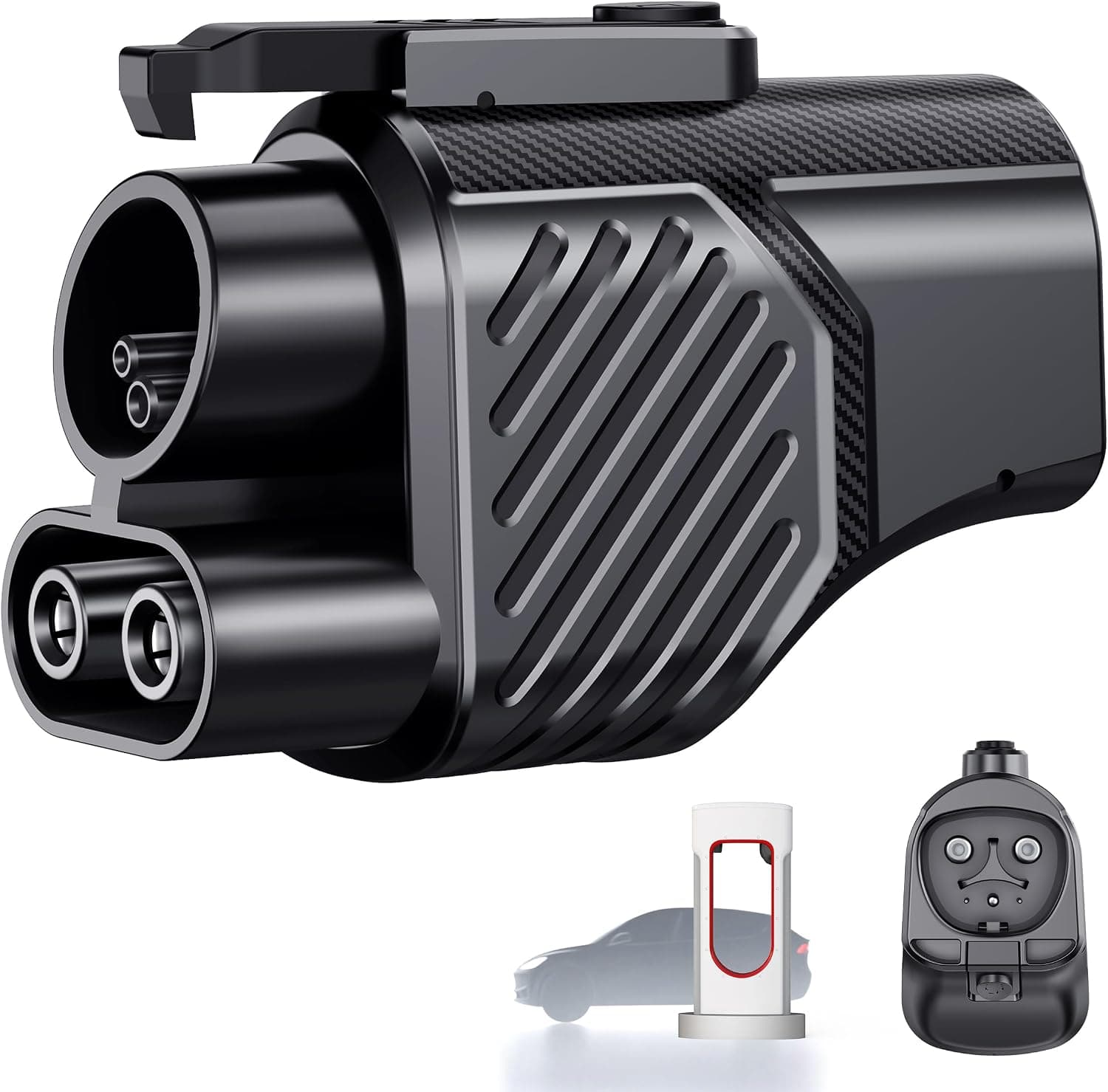
That’s exactly what the Aipechy NACS to CCS1 Fast Charging Adapter is designed to do.
The 2026 version is advertised for up to 500A, 1000V, and 250kW DC fast charging, potentially allowing compatible CCS1 vehicles to physically connect to supported Tesla Superchargers.
But there’s one extremely important thing to understand before buying it.
This adapter changes the physical connection.
It does not magically make every CCS1 EV compatible with every Tesla Supercharger.
We’ll get into that.
Check the latest price on Amazon:
https://link.amazon/B00I6cX7I
As an Amazon Associate, we may earn from qualifying purchases.
First, What Is NACS?
NACS stands for North American Charging Standard.
It’s based on the charging connector originally developed and used by Tesla in North America.
One of the impressive things about the NACS connector is how compact it is.
Instead of having separate physical connectors for AC and DC charging, the same basic vehicle connector can support both.
And over the last few years, NACS has moved beyond being simply “the Tesla plug.”
Multiple automakers have adopted or announced support for the standard, and the connector has been standardized as SAE J3400.
That’s great for the future.
But there are already millions of EVs on the road with CCS1 ports.
That’s where adapters become useful.
What This Adapter Actually Does
The concept is pretty straightforward.
On one side, the adapter accepts a compatible NACS DC fast-charging connector.
On the other side, it interfaces with a CCS1 vehicle charging port.
So the physical chain becomes:
Tesla Supercharger connector → NACS-to-CCS1 adapter → compatible CCS1 EV.
That’s the simple part.
The complicated part is everything happening electronically behind that connection.
Modern DC fast charging involves communication between the charger and vehicle.
The charging station needs to identify the vehicle and establish a charging session.
The vehicle and charger need to negotiate charging parameters.
The network needs to authorize access and payment.
So an adapter isn’t a universal translator that makes every combination work.
It’s one piece of a much larger compatibility puzzle.
This Is for DC Fast Charging Only
This distinction is extremely important.
The Aipechy adapter is designed for DC fast charging.
It is not intended for Level 1 or Level 2 AC charging, according to the manufacturer.
So don’t buy this expecting to connect a CCS1 vehicle to every NACS-equipped destination charger, home wall connector, or AC charging station.
That’s a different charging scenario and may require different hardware.
This adapter has one primary job:
Connecting compatible CCS1 vehicles to supported NACS DC fast-charging infrastructure.
That’s it.
The Headline Number Is 250kW
The adapter is advertised for up to 250kW charging, with manufacturer-listed electrical limits of up to 500A and 1000V.
250kW is seriously fast.
In ideal conditions, that’s enough power to add a substantial amount of energy to a modern EV battery in a relatively short period.
The manufacturer claims a compatible vehicle could reach around 80 percent charge in approximately 30 minutes.
But I’d put a giant asterisk next to that statement.
Actual charging speed depends on the vehicle.
A lot.
Your EV Decides How Fast It Charges
Let’s say the adapter can handle 250kW.
And the Supercharger can supply 250kW.
But your EV only accepts 150kW.
You’re charging at up to roughly 150kW, not 250kW.
The weakest link determines the maximum.
And even if your vehicle supports 250kW peak charging, it probably doesn’t maintain that speed from 0 to 100 percent.
EV batteries follow a charging curve.
Charging can be very fast at certain states of charge and then gradually slow as the battery fills.
Battery temperature matters too.
Ambient conditions matter.
Preconditioning matters.
The charging station itself matters.
So “250kW adapter” means the adapter is advertised to support that level of power.
It doesn’t mean your car will continuously charge at 250kW.
80 Percent in 30 Minutes Isn’t Universal
The same logic applies to the manufacturer’s 30-minute claim.
Different EVs have dramatically different battery capacities and charging curves.
A smaller battery accepting high charging power might reach 80 percent relatively quickly.
A larger battery could take longer.
Cold weather could slow charging.
A battery arriving at the station without proper preconditioning could charge more slowly.
Starting state of charge matters too.
Going from 10 to 80 percent is very different from going from 60 to 80 percent.
So I’d treat the 30-minute figure as an illustrative manufacturer claim rather than a universal charging time.
The adapter doesn’t determine your vehicle’s charging curve.
The vehicle does.
The Real Selling Point Is Supercharger Access
Charging speed is nice.
But the real reason you’d buy this adapter is charging-network access.
Tesla built one of the most extensive DC fast-charging networks in North America.
And as access has expanded to compatible non-Tesla EVs, that network has become increasingly relevant to CCS1 owners.
The manufacturer says this adapter can be used with compatible V3 and V4 Tesla Superchargers, subject to vehicle and network support.
That could dramatically increase the number of useful charging locations available during a road trip.
And when you’re driving an EV long distance, charging availability matters just as much as maximum charging speed.
Sometimes the best charger isn’t the fastest one.
It’s the one that’s actually where you need it.
But the Adapter Does Not Unlock the Network by Itself
This is the most important thing in the entire article.
Buying this adapter does not automatically give your EV access to Tesla Superchargers.
Your vehicle manufacturer needs to support Tesla Supercharger access for your specific vehicle.
Your vehicle may need a software update.
The particular Supercharger location needs to support compatible non-Tesla vehicles.
Authentication and payment need to work.
And the vehicle itself needs to support the appropriate charging protocol.
The Amazon listing specifically tells buyers to confirm compatibility before purchasing.
That’s good advice.
Do that first.
Then buy the adapter.
Not the other way around.
Ford, GM, Rivian and Others
The manufacturer lists compatibility with CCS1 vehicles from brands such as Ford, GM, and Rivian, along with other supported CCS vehicles.
But I’d avoid treating brand-level compatibility as universal.
A manufacturer might enable Supercharger access for certain models or model years while others have different requirements.
Software support can also change.
So instead of asking:
“Does this work with Ford?”
Ask:
“Does this work with my exact Ford model, model year, software version, and the Supercharger network I intend to use?”
That’s a much better compatibility question.
Why Carry an Adapter at All?
If your EV already has CCS1 and there are CCS fast chargers everywhere you drive, maybe you don’t need one.
But road trips are about options.
Imagine you’re planning a 500-mile journey.
There are CCS chargers along the route.
There are also Tesla Superchargers.
Having access to both potentially gives you more flexibility when choosing where to stop.
One station might be busy.
Another might be offline.
One might require a significant detour.
Another might be directly beside the highway.
The adapter effectively becomes another tool in your charging kit.
You might not use it every day.
But the day you need it, you’ll probably be very glad it’s sitting in the trunk.
It’s Surprisingly Small for the Power Involved
This is something I still find fascinating about EV charging technology.
We’re talking about a relatively compact adapter potentially handling hundreds of amps and hundreds of volts.
That’s a lot of electrical power moving through something you can hold in your hand.
Which means build quality matters enormously.
Electrical contacts matter.
Mechanical fit matters.
Temperature management matters.
Insulation matters.
Locking mechanisms matter.
This isn’t like buying a cheap USB adapter.
At DC fast-charging power levels, the adapter is part of a high-voltage, high-current electrical system.
That’s why specifications, certification, vehicle approval, and manufacturer guidance are important.
Using It Should Be Pretty Simple
Physically, the process is designed to be straightforward.
Connect the adapter to the appropriate charging interface.
Connect everything securely to the vehicle.
Initiate the charging session using the process required by your automaker or charging network.
Then the charger and vehicle handle the actual DC charging process.
The manufacturer emphasizes the adapter’s portable design, which makes sense.
This isn’t something you permanently install.
Keep it in the car.
Take it out when you need a compatible Supercharger.
Put it back when you’re finished.
For a road-trip accessory, that’s exactly how it should work.
The Adapter Doesn’t Convert the Electricity
Here’s another useful technical distinction.
This isn’t a giant power converter.
During DC fast charging, the station is already supplying DC electricity appropriate for the vehicle’s high-voltage battery system after the charging session negotiates the required parameters.
The adapter’s primary role is enabling the physical and electrical interface between compatible NACS charging equipment and a CCS1 vehicle.
That’s one reason something relatively compact can potentially support hundreds of kilowatts.
It’s not taking 250kW and performing some enormous internal AC-to-DC conversion.
The fast-charging station has already handled the power conversion.
Heat Is Still Something I’d Watch
Any time you’re moving hundreds of amps through electrical contacts, heat matters.
A good connection minimizes electrical resistance.
A poor or contaminated connection can increase resistance and therefore heat generation.
So I’d keep the charging interfaces clean and inspect the adapter periodically for damage.
If the adapter or connector behaves abnormally during charging, follow the manufacturer’s instructions and stop using damaged equipment.
Again, we’re not talking about a phone charger here.
High-power DC charging deserves appropriate respect.
This Is Really a Transitional Technology
There’s something else interesting about products like this.
They’re probably most useful during the transition from CCS1 toward NACS/J3400 in North America.
Future EVs increasingly come with native NACS-compatible ports.
Those vehicles may not need an NACS-to-CCS1 adapter for Tesla Supercharger access.
But millions of existing CCS1 vehicles aren’t suddenly going to disappear.
They’re going to remain on the road for years.
So adapters like this become a bridge between generations of charging infrastructure.
Your car uses yesterday’s dominant connector.
The charging network is moving toward tomorrow’s connector.
The adapter connects the two.
Literally.
What I Like
The biggest advantage is obvious.
More charging options.
If your CCS1 vehicle is officially supported for compatible Tesla Supercharger access, carrying an NACS-to-CCS1 adapter can make road-trip planning much more flexible.
The manufacturer advertises support for up to 500A, 1000V, and 250kW, which puts it into serious DC fast-charging territory.
It’s also portable and mechanically straightforward.
No complicated installation.
No permanent modification to the vehicle.
Just another charging interface you can keep in the car.
What You Should Know Before Buying
There are several things you absolutely need to check.
First, verify that your exact vehicle model and model year support NACS-based Tesla Supercharger access.
Second, check whether your vehicle needs a software update.
Third, verify that the Tesla Supercharger locations you intend to use support your vehicle.
Fourth, remember that this is for compatible DC fast charging, not Level 1 or Level 2 AC charging.
Fifth, don’t assume you’ll receive 250kW just because the adapter supports that figure. Your vehicle and charging station determine the actual charging power.
Sixth, treat the claimed 80 percent in 30 minutes as a manufacturer estimate rather than a universal charging time.
And because this device can be part of a very high-power charging connection, I’d also verify applicable safety certification, warranty coverage, and whether your automaker permits use of the specific third-party adapter.
Who Is This For?
This adapter is primarily for someone with a CCS1-equipped EV that has officially been enabled for compatible Tesla Supercharger access.
Maybe you’ve got a Ford.
A GM EV.
A Rivian.
Or another compatible CCS1 vehicle.
You take road trips.
You want more charging options.
And you don’t want your route planning to be limited entirely to traditional CCS charging networks.
In that situation, an NACS-to-CCS1 adapter can be an incredibly useful thing to keep in the car.
Not because you’ll necessarily use it every charging session.
But because it gives you another option when you need one.
The Bottom Line
The Aipechy NACS to CCS1 Adapter represents something bigger happening across the EV industry.
Charging standards are converging.
Tesla’s connector evolved into NACS and SAE J3400.
Automakers began adopting it.
Supercharger access expanded.
And suddenly millions of CCS1 vehicles needed a bridge into that ecosystem.
That’s what this adapter is designed to provide.
It’s advertised for up to 500A, 1000V, and 250kW DC fast charging, works with compatible CCS1 vehicles, and is designed to connect those vehicles to supported NACS Tesla Superchargers.
But remember the most important point:
The adapter provides the connection. Your vehicle and charging network provide the compatibility.
Check your exact EV first.
Check manufacturer support.
Check the charging network.
Check whether the adapter meets the requirements specified for your vehicle.
If everything lines up, this little piece of hardware could significantly expand your road-trip charging options.
And that’s pretty impressive for something small enough to live in your trunk.
Check the Aipechy NACS to CCS1 Adapter on Amazon:
https://link.amazon/B00I6cX7I