
AQUZO E8 Solar WiFi Extender Review: Outdoor WiFi Without Running Power Cables?
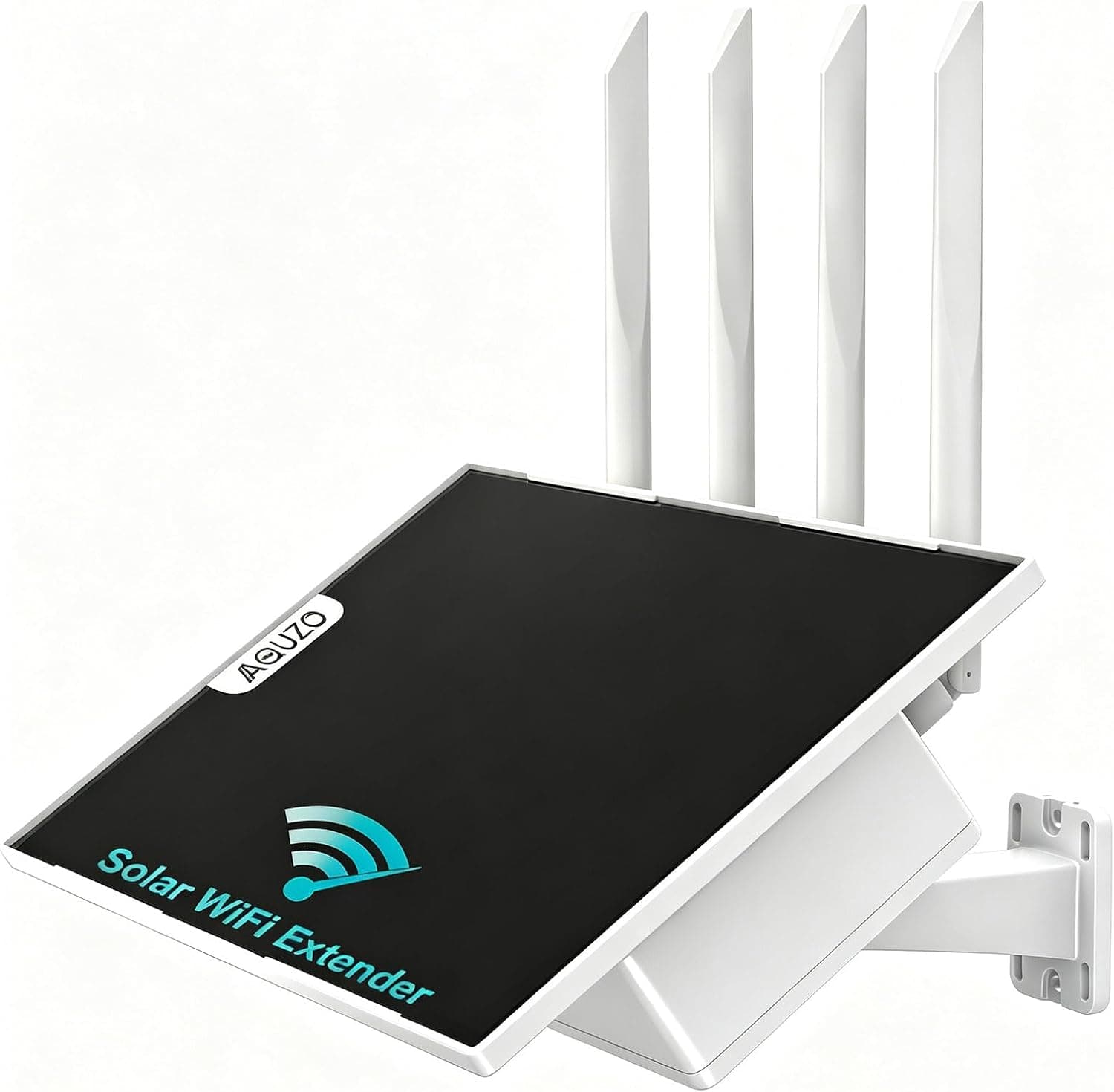
WiFi is great.
Until you walk outside.
You can have a ridiculously fast internet connection, a powerful router, and excellent coverage throughout your house.
But move 100 feet into your backyard, and suddenly everything falls apart.
Your security camera disconnects.
Your smart garden devices stop responding.
And that outdoor workspace you were planning? Not so smart anymore.
Normally, extending WiFi outdoors means finding a way to power another networking device.
And that can get complicated.
But what if the WiFi extender could power itself?
That’s the idea behind the AQUZO E8 Solar-Powered Outdoor WiFi Extender.
It combines four 5dBi antennas, a 15W solar panel, a 27,000mAh battery, 2.4GHz WiFi, and an IP66-rated enclosure into a standalone outdoor networking solution.
The manufacturer claims coverage extending up to a 120-meter radius, making it an interesting option for gardens, farms, security cameras, RV sites, and other outdoor spaces.
And the most interesting part isn’t actually the WiFi.
It’s the solar power.
Check the latest price on Amazon:
https://link.amazon/B0fEFkOTO
As an Amazon Associate, we may earn from qualifying purchases.
An Outdoor WiFi Extender That Doesn’t Need a Power Outlet
Most WiFi extenders have one obvious limitation.
They need electricity.
That’s not a problem inside your house.
Just plug one into a wall outlet.
But outside?
Things get more complicated.
Maybe you’ve got a security camera mounted near the edge of your property.
Maybe there’s a barn a short distance from your house.
Maybe you want internet access in your garden or outdoor workshop.
Running electrical cables across a large outdoor area can be expensive and inconvenient.
The AQUZO E8 takes a different approach.
Instead of depending on a nearby outlet, it uses a 15W solar panel and an internal rechargeable battery to power the WiFi repeater.
That means you can potentially install it in locations where conventional powered extenders would be impractical.
You still need to position it where it can receive a usable signal from your existing network.
But you don’t necessarily need to run a separate electrical power line to the installation point.
That’s a pretty clever solution.
The 15W Solar Panel Is the Star
Let’s talk about the solar system.
The AQUZO E8 includes a 15-watt solar panel.
That’s not a huge solar panel.
But it doesn’t need to be.
A WiFi repeater typically consumes far less electricity than something like an air conditioner or electric heater.
The goal is to generate enough energy during daylight hours to operate the device and replenish its battery.
Then, when the sun goes down, the battery takes over.
At least, that’s how the system is designed to work.
The manufacturer advertises year-round solar operation, including cloudy and rainy conditions.
But I’d be careful with that claim.
Solar performance depends heavily on sunlight exposure, panel orientation, weather, battery capacity, and the device’s actual power consumption.
A 15W panel doesn’t continuously generate 15W throughout the day.
Its output changes with sunlight.
So while the solar-powered design is compelling, I’d treat the manufacturer’s 365-day self-sufficiency claim as an intended operating scenario rather than a guarantee for every location.
A 27,000mAh Battery Is Pretty Substantial
The E8 also includes a 27,000mAh rechargeable battery.
That’s a large capacity figure for a compact networking device.
And it matters because WiFi extenders are different from something like a solar garden light.
A garden light might only need to operate at night.
A WiFi extender is expected to remain online throughout the day and night.
That means the battery needs to support the device when solar generation isn’t available.
However, there’s an important technical detail.
Battery capacity expressed in milliamp-hours doesn’t tell you the complete energy capacity unless you also know the battery’s nominal voltage.
For example, 27,000mAh at 3.7V represents a different amount of energy than 27,000mAh at 12V.
So I’d want to see the battery’s watt-hour rating before estimating how many cloudy days the E8 can operate without meaningful solar charging.
Still, having an integrated battery is essential for this kind of product.
Without it, the extender would stop working every evening.
Four Antennas for Outdoor Coverage
Now let’s talk about the actual networking hardware.
The AQUZO E8 features four external 5dBi antennas.
And visually, that’s probably the first thing you’ll notice.
Four antennas sticking out of a weather-resistant enclosure make this look much more like dedicated networking equipment than a typical indoor WiFi extender.
The purpose is to improve wireless signal reception and transmission.
But more antennas don’t automatically mean unlimited range.
Actual coverage depends on several factors.
The distance from your main router.
Obstacles between devices.
Trees.
Walls.
Metal structures.
Terrain.
Interference from nearby networks.
And the capabilities of the devices connecting to the extender.
Still, the four-antenna configuration suggests that outdoor coverage is a major design priority.
Up to a 120-Meter Radius
Here’s the headline coverage claim.
AQUZO advertises wireless coverage reaching up to a 120-meter radius, approximately 394 feet.
That’s a significant distance.
For context, that’s potentially enough to cover a large residential yard or reach devices positioned across a small property.
But I’d treat this as a manufacturer-stated maximum rather than a guaranteed coverage boundary.
WiFi doesn’t work like drawing a perfect circle on a map.
The signal gets weaker with distance.
Obstacles absorb and reflect radio waves.
And different devices have different antenna capabilities.
A security camera with a small internal antenna may struggle to communicate over distances that the extender itself can theoretically cover.
Wireless communication is a two-way process.
The extender needs to reach your device.
And your device needs to reach the extender.
That’s why real-world coverage can be very different from the number printed on the box.
Placement Is Everything
Here’s something important about WiFi repeaters.
They don’t create internet access from nothing.
They extend an existing network.
So the AQUZO E8 still needs to receive a sufficiently strong signal from your main router or another compatible access point.
Imagine your router is inside your house.
Your garden is 100 meters away.
If you install the repeater at the far end of the garden where there’s already no usable WiFi signal, it may have nothing reliable to repeat.
The better approach is to install the extender somewhere that receives a stable signal from your existing network while also providing useful coverage to the outdoor devices you want to connect.
That might be on an exterior wall.
A garden structure.
A pole.
Or another suitable location with good sunlight and a clear wireless path.
The solar panel solves the power problem.
It doesn’t eliminate the need for good network placement.
2.4GHz WiFi Makes Sense Outdoors
The AQUZO E8 operates on 2.4GHz WiFi.
And while that might sound less exciting than newer 5GHz or 6GHz WiFi technology, there’s a good reason for it.
2.4GHz generally offers better range and obstacle penetration than higher-frequency WiFi bands under comparable conditions.
That’s useful outdoors.
Especially when you’re trying to connect devices spread across a large area.
Many smart-home and outdoor IoT devices also use 2.4GHz.
Security cameras.
Smart plugs.
Garden controllers.
Weather stations.
Various sensors.
So for the intended applications, 2.4GHz is a practical choice.
The trade-off is that it generally offers lower maximum speeds and can experience more interference than newer higher-frequency WiFi systems.
Up to 300Mbps, But There’s a Catch
The manufacturer advertises wireless transmission speeds of up to 300Mbps.
That’s a familiar specification for certain 2.4GHz WiFi configurations.
But there’s a difference between theoretical wireless link speed and actual internet throughput.
A 300Mbps wireless link doesn’t necessarily mean you’ll get 300Mbps internet speeds at the far end of your garden.
Actual performance depends on signal quality, interference, protocol overhead, the connection to your main router, and the repeater’s operating mode.
Traditional wireless repeaters can also reduce effective throughput because they may need to receive and retransmit traffic over the same wireless channel.
So I wouldn’t buy this expecting fiber-like speeds across an entire farm.
But for security cameras, basic web browsing, smart garden devices, and outdoor audio streaming, the available bandwidth may be perfectly adequate when the signal is stable.
This Could Be Great for Outdoor Security Cameras
One of the most obvious use cases is WiFi security cameras.
Let’s say you’ve got a camera installed near your gate.
Or at the far end of your driveway.
Or overlooking a storage shed.
The camera has power, perhaps from its own solar panel or battery.
But the WiFi connection is unreliable.
That becomes frustrating quickly.
Video feeds disconnect.
Notifications arrive late.
Recorded footage may be difficult to access remotely.
An appropriately positioned outdoor WiFi extender could improve the connection.
And because the AQUZO E8 has its own solar power system, you may not need to install an additional electrical outlet just to support the network.
That’s a particularly appealing combination for remote camera locations.
Farms and Gardens Are Another Obvious Use Case
Now imagine a small farm.
You’ve got your main internet connection at the house.
But you’ve also got equipment farther away.
Maybe a smart irrigation controller.
A weather monitoring device.
A security camera near a greenhouse.
Or a sensor system collecting environmental information.
These devices might not need extremely fast internet.
They need a reliable connection.
And they may be located in places without convenient electrical infrastructure.
A solar-powered WiFi repeater could help extend connectivity into those areas.
Of course, larger farms may require dedicated outdoor access points, directional wireless bridges, or other networking equipment.
A single repeater isn’t automatically a solution for an entire agricultural property.
But for smaller installations, the concept makes sense.
What About RVs and Camping?
The listing also mentions RVs and camping.
And this is where things get interesting.
If you’re parked somewhere with an existing WiFi network that you are authorized to use, an outdoor repeater could potentially help improve coverage around your campsite.
But remember that this device doesn’t provide cellular internet by itself.
It doesn’t magically connect to the internet in the middle of nowhere.
It needs an existing compatible WiFi network to extend.
If there’s no usable WiFi source, you’ll still need something like a cellular router, satellite internet connection, or another internet service.
The E8 extends connectivity.
It doesn’t create an internet connection.
That’s an important distinction.
It Works With Starlink?
The manufacturer lists compatibility with Starlink and most mainstream routers.
That’s potentially useful.
Starlink can provide internet connectivity in rural or remote locations.
But the WiFi coverage from the main router may not reach every corner of a large property.
An outdoor repeater could help extend that network.
However, compatibility depends on the router’s wireless configuration and the extender’s supported operating modes.
I’d verify the specific setup requirements before assuming it will work with every Starlink configuration.
Still, combining satellite internet with solar-powered outdoor networking is an interesting concept for off-grid locations.
IP66 Protection Is Important
Outdoor networking equipment needs to survive the weather.
And the AQUZO E8 comes with an advertised IP66-rated enclosure.
That generally means the enclosure is designed to resist dust ingress and powerful water jets under standardized testing conditions.
For outdoor use, that’s a meaningful feature.
Rain.
Dust.
Wind.
Outdoor humidity.
These are normal conditions for equipment installed outside.
But IP66 doesn’t mean the device is indestructible.
It doesn’t mean you can submerge it underwater.
And it doesn’t guarantee that every mounting arrangement or exposed connection will remain protected indefinitely.
Proper installation still matters.
I’d also pay attention to heat exposure, mounting security, and the manufacturer’s recommended operating temperatures.
The Three-Minute Setup Claim
AQUZO advertises setup in approximately three minutes.
The basic process involves connecting to the extender’s WiFi network using a phone or computer, opening the web-based configuration interface, and following the setup instructions.
That’s a fairly familiar process for WiFi repeaters.
And I like that the configuration is described as web-based.
You don’t necessarily need another dedicated mobile app just to configure a networking device.
Of course, actual setup time may vary.
You might need to adjust router settings.
Find a better installation location.
Test the connection.
Or reposition the solar panel.
So I’d view three minutes as an optimistic setup estimate rather than a guaranteed installation time.
The Biggest Advantage Is Avoiding Outdoor Wiring
This is the feature that really makes the E8 interesting.
Not the four antennas.
Not the 300Mbps specification.
Not even the advertised 120-meter range.
It’s the fact that the device is designed to operate without a dedicated electrical power cable.
Installing outdoor electrical infrastructure can be expensive.
You may need conduit.
Weatherproof electrical boxes.
Appropriate wiring.
Professional installation.
And potentially a long cable run.
A solar-powered networking device could avoid much of that work in suitable locations.
That’s a meaningful advantage.
Especially for temporary installations or remote areas where running power would be inconvenient.
Solar Power Isn’t the Same as Free Internet
There’s another distinction worth making.
The manufacturer promotes zero electricity bills and solar self-sufficiency.
But solar power only addresses the electricity used by the extender.
You still need an existing internet connection.
And that connection may have a monthly subscription cost.
The main router or internet equipment also consumes electricity.
So this isn’t a completely free internet solution.
It’s a solar-powered way to extend an existing WiFi network.
And that’s still useful.
What I Like
The most compelling part of the AQUZO E8 is the combination of networking and renewable energy.
You get four 5dBi antennas, a 15W solar panel, a 27,000mAh battery, 2.4GHz WiFi, advertised speeds up to 300Mbps, a claimed 120-meter coverage radius, and IP66 outdoor protection.
That’s an interesting feature set for a device designed to operate away from convenient power outlets.
I also like the web-based setup and the claimed compatibility with common routers.
For outdoor security cameras, garden sensors, and small rural installations, the overall concept makes a lot of sense.
What You Should Know Before Buying
There are a few important limitations to understand.
First, the 120-meter coverage radius is a manufacturer claim. Actual range depends on placement, obstacles, interference, and connected devices.
Second, the advertised 300Mbps is a theoretical wireless link rate, not a guarantee of real-world internet throughput.
Third, the device operates on 2.4GHz WiFi, so don’t expect modern dual-band or WiFi 6 performance.
Fourth, the solar system’s ability to operate continuously depends on sunlight, power consumption, and battery capacity. The manufacturer’s 365-day self-sufficiency claim shouldn’t be treated as a guarantee in every climate.
Fifth, the extender still needs a usable connection to your existing WiFi network. It cannot repeat a signal that it cannot reliably receive.
Sixth, verify the actual battery energy capacity in watt-hours if backup runtime is particularly important.
And finally, check the manufacturer’s wireless security support, firmware update process, and router compatibility before installing it on a network that handles sensitive devices.
Who Is This For?
The AQUZO E8 makes the most sense for someone who needs WiFi coverage outdoors but doesn’t have a convenient power outlet near the installation location.
Maybe you’ve got a large backyard.
A garden office.
A greenhouse.
A barn.
A farm with smart sensors.
An outdoor security camera.
Or an RV setup with access to an existing WiFi network.
It’s especially interesting if running electrical cables would be expensive or impractical.
For a small apartment with weak WiFi in the bedroom?
A conventional indoor mesh system or extender probably makes more sense.
But for outdoor spaces where electricity is the biggest obstacle, solar-powered networking becomes much more attractive.
The Bottom Line
The AQUZO E8 Solar-Powered Outdoor WiFi Extender is a pretty interesting combination of two technologies that don’t usually appear together.
WiFi networking.
And solar energy.
On paper, the package is compelling.
You get a 15W solar panel, 27,000mAh rechargeable battery, four 5dBi antennas, 2.4GHz WiFi with advertised speeds up to 300Mbps, a claimed 120-meter coverage radius, and an IP66-rated outdoor enclosure.
The goal is simple.
Extend your existing WiFi network into outdoor spaces without having to install a dedicated electrical power connection.
There are limitations.
You still need a strong enough signal from your main router.
Real-world speeds will vary.
Solar performance depends on the weather.
And the advertised coverage radius shouldn’t be mistaken for a guaranteed result.
But the fundamental idea is genuinely useful.
Because sometimes the biggest problem with extending WiFi isn’t the network itself.
It’s getting electricity to the place where you need another networking device.
The AQUZO E8 tries to solve both problems at once.
And if your setup is suitable, that could make outdoor connectivity a whole lot easier.
Check the AQUZO E8 Solar-Powered WiFi Extender on Amazon:
https://link.amazon/B0fEFkOTO