
BACOENG 12V Solar Water Pump Review: A Simple Off-Grid Pump for Farms, Ranches, and Water Transfer
Solar power gets a lot of attention for the big stuff.
Powering houses.
Charging electric vehicles.
Running entire farms.
But sometimes, one of the most useful things you can do with solar energy is much simpler.
Move water from one place to another.
That’s it.
And if you’ve ever needed to move water on a farm, drain a flooded area, or supply water somewhere without access to the electrical grid, you’ll understand why that matters.
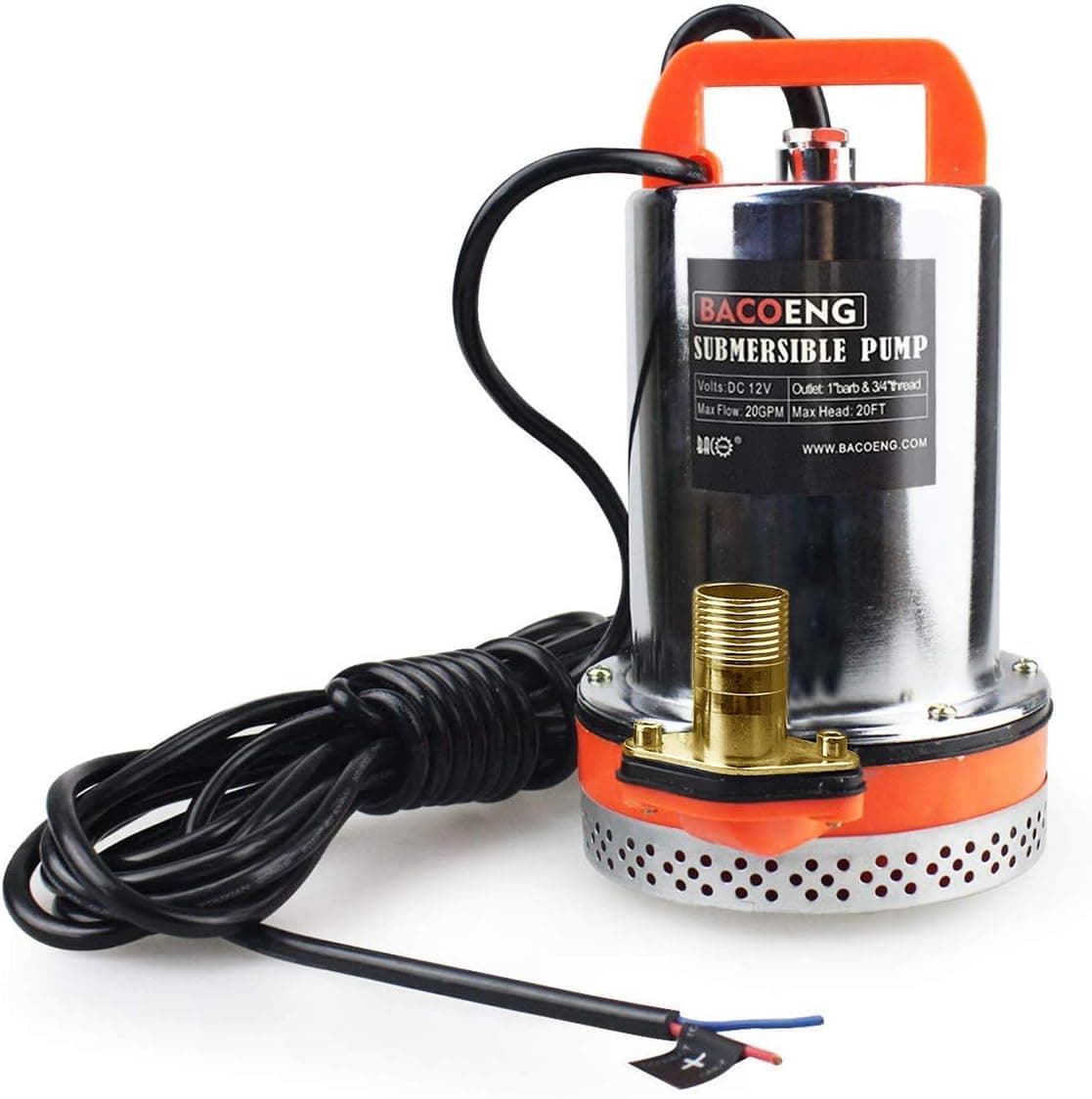
The BACOENG 12V DC Submersible Water Pump is designed for exactly these kinds of applications.
It’s a compact, low-voltage water pump with a 120W power rating, a manufacturer-claimed maximum flow of 20 gallons per minute, and a maximum pumping head of 20 feet.
And because it operates on 12V DC, it can be integrated with compatible solar and battery systems.
No complicated technology.
No WiFi.
No smartphone app.
Just a motor, an impeller, and the ability to move water.
Sometimes, that’s all you need.
Check the latest price on Amazon:
https://link.amazon/B073tpsr7
As an Amazon Associate, we may earn from qualifying purchases.
A Water Pump Designed for Off-Grid Applications
Let’s start with what makes this pump interesting.
Most conventional water pumps are designed to run on household AC electricity.
That works perfectly well if you’ve got a power outlet nearby.
But what if you don’t?
Maybe you’re working on a farm.
Maybe you’ve got livestock in a remote field.
Maybe you’re transferring water between storage tanks.
Or maybe you’re maintaining a small aquaculture setup where electrical infrastructure is limited.
Running a long electrical cable isn’t always practical.
That’s where a 12V DC water pump becomes useful.
Instead of requiring a conventional AC outlet, the BACOENG pump operates from a suitable 12V DC power source.
That could be a compatible battery system.
Or a properly configured solar-powered setup.
For off-grid applications, that flexibility is a major advantage.
The 120W Motor Is the Key Specification
The BACOENG pump is rated at 120 watts.
That’s a relatively modest electrical power requirement compared with many larger water pumps.
And it makes the pump an interesting candidate for small solar installations.
At its rated voltage and power, the basic electrical calculation looks like this:
120W ÷ 12V = 10A
So the pump’s nominal electrical demand works out to approximately 10 amps at 12 volts.
Actual current draw may vary with operating conditions, and motor startup can introduce additional electrical demands.
But this gives us a useful starting point.
If you’re building an off-grid water pumping system, you need a power source capable of supplying the pump’s operating current safely.
And if you’re using a battery, you’ll also need to think about how long you want the pump to run.
How Much Energy Does It Actually Use?
Let’s put the power consumption into perspective.
At a constant 120W electrical draw:
| Operating Time | Energy Consumption |
|---|---|
| 30 minutes | 60Wh |
| 1 hour | 120Wh |
| 2 hours | 240Wh |
| 4 hours | 480Wh |
| 8 hours | 960Wh |
These are theoretical calculations based on the pump drawing 120W continuously.
Actual energy consumption can differ.
But they illustrate something important.
A 120W pump doesn’t necessarily require a huge solar energy system.
For short, intermittent pumping sessions, a relatively small battery and solar installation may be sufficient.
The exact sizing depends on the required operating time, available sunlight, system losses, and the pump’s actual electrical characteristics.
Up to 20 Gallons Per Minute
Now let’s talk about water flow.
BACOENG advertises a maximum capacity of 20 US gallons per minute, or approximately 75.7 liters per minute.
That’s a substantial amount of water for a compact 12V pump.
At that theoretical maximum flow rate, the pump could move:
- Approximately 75.7 liters in one minute
- Approximately 757 liters in ten minutes
- Approximately 2,271 liters in thirty minutes
- Approximately 4,542 liters in one hour
But there’s a very important catch.
Maximum flow rate doesn’t mean you’ll get that flow rate under every operating condition.
Water pumps have a relationship between flow and pumping head.
As the pump needs to lift water higher or overcome greater resistance, the available flow typically decreases.
So you shouldn’t assume this pump will deliver 20 gallons per minute while simultaneously lifting water to its maximum rated height.
Those are generally separate performance limits.
And understanding that distinction is essential when choosing a water pump.
What Does a 20-Foot Maximum Head Mean?
The manufacturer lists a maximum head of 20 feet.
That’s approximately 6.1 meters.
In simple terms, pump head describes the energy available to move water against elevation and other resistance, expressed as an equivalent height of water.
For a basic setup, you can think of it as the pump’s maximum theoretical lifting capability.
But that doesn’t mean you’ll get maximum water flow at 20 feet.
In fact, a centrifugal-style pump may deliver very little flow near its maximum head.
You also need to consider friction losses in the hose, fittings, and other components.
For example, pumping water vertically upward by 10 feet is different from moving it horizontally through a long, narrow hose.
Both setups create resistance, but in different ways.
The most useful information would be the manufacturer’s pump performance curve, showing flow rate at different head levels.
Unfortunately, the supplied listing doesn’t provide that curve.
So if you need a guaranteed flow rate at a particular height, I’d verify the detailed specifications before purchasing.
The 1-Inch Outlet Makes Sense
The pump comes with a 1-inch barbed outlet.
That gives you a practical connection point for a compatible hose.
And hose diameter matters more than many people realize.
A narrow hose can create significant friction losses, particularly when moving larger volumes of water.
A larger hose generally reduces resistance at the same flow rate.
So if you’re trying to get good performance from the BACOENG pump, don’t automatically connect it to the smallest hose you can find.
Use appropriately sized tubing and secure the connection according to the manufacturer’s instructions.
The goal is to let the pump move water without creating unnecessary restrictions.
Solar Power Is Where Things Get Interesting
Here’s why this product fits into an off-grid setup.
A 12V DC pump can operate from a properly configured 12V electrical system.
And that makes solar integration relatively straightforward compared with equipment requiring high-voltage AC power.
A typical arrangement might look like this:
Solar panel → Solar charge controller → 12V battery → Protected pump circuit → Water pump
The solar panel generates electricity.
The charge controller manages battery charging.
The battery provides a stable power source.
And the pump moves water when required.
You can potentially add a suitable switch, timer, or level-control system depending on the application.
But there’s one important warning.
Don’t assume you can connect the pump directly to any solar panel simply because both are described as 12V devices.
Solar panel voltage varies with sunlight and load, and many nominal 12V panels produce voltages above 12V.
The pump needs an appropriate power supply within its supported electrical limits.
For most battery-based installations, using a properly configured charge controller, battery, wiring, fuse, and switching arrangement is the safer approach.
How Big Should the Solar Panel Be?
The pump is rated at 120W.
So does that mean you only need a 120W solar panel?
Not necessarily.
A solar panel’s nameplate rating represents output under standardized test conditions.
Real-world output changes with sunlight intensity, panel temperature, orientation, shading, and other factors.
A 120W panel might produce substantially less than 120W during many parts of the day.
And the electrical system also has conversion and charging losses.
If you want reliable operation, particularly through a battery, you should size the solar system around the total daily energy requirement rather than simply matching the pump’s wattage.
For example, running the pump for two hours per day at 120W requires approximately 240Wh of energy at the pump.
Your solar installation would need to generate enough energy to supply that demand plus system losses.
The appropriate panel size depends on your location and expected sunlight conditions.
What About the Battery?
Battery capacity determines how long the pump can operate without additional charging.
Let’s say you’re using a hypothetical 12V, 50Ah battery.
Its nominal energy capacity would be:
12V × 50Ah = 600Wh
At a constant 120W load, that’s theoretically five hours of operation.
But real-world usable runtime will be lower depending on battery chemistry, allowable depth of discharge, voltage, efficiency, and operating conditions.
A lead-acid battery, for example, may have significantly less usable capacity than its nominal rating if you’re trying to preserve battery life.
A suitable lithium battery may provide a different usable capacity, but its battery management system must support the pump’s operating and startup currents.
So battery sizing isn’t just about getting the largest amp-hour number.
It’s about matching the battery to the application.
This Could Be Useful for Livestock Watering
One of the most practical applications is moving water on farms and ranches.
Imagine you’ve got a water storage tank near a field.
You need to transfer water into another tank or trough.
But there’s no convenient AC electrical supply.
A small DC pump could potentially do the job.
Combine it with a properly designed solar and battery system, and you can create a relatively simple off-grid water transfer setup.
Of course, the pump’s 20-foot maximum head means it isn’t suitable for every installation.
You need to consider the elevation difference, hose length, required flow, and duty cycle.
But for appropriate low-head water transfer applications, the concept makes sense.
Aquaculture Is Another Potential Application
The manufacturer also lists aquaculture among the intended uses.
And that’s interesting.
Aquaculture operations often involve moving water between tanks, reservoirs, and other parts of a water management system.
A compact submersible pump can be useful for certain water transfer tasks.
But I’d make an important distinction here.
A water transfer pump isn’t automatically a substitute for a dedicated aquarium circulation pump, filtration pump, or aeration system.
Different applications have different requirements.
If you’re working with fish or other aquatic animals, verify the pump’s suitability for the intended water conditions, materials, operating schedule, and required flow.
For life-support applications, reliability and backup systems are especially important.
What About Drainage?
BACOENG also promotes the pump for drainage applications.
That could include moving accumulated water from a suitable collection area or transferring water between containers.
But I’d be careful about assuming it can handle dirty water.
The listing doesn’t specify the maximum allowable particle size or whether the pump is designed for debris-laden water.
That’s important.
Some submersible pumps are designed primarily for clean water.
Others are designed to handle solids or dirty water.
Those are very different categories.
Before using the pump for drainage, verify the manufacturer’s requirements for water quality and allowable debris.
A pump that works perfectly in clean water might struggle or become damaged when exposed to mud, sand, or larger particles.
Simple Construction Can Be an Advantage
One of the manufacturer’s selling points is the pump’s simple structure and relatively small number of components.
And that’s something I appreciate in practical equipment.
Complexity isn’t always an advantage.
Especially when you’re installing equipment somewhere remote.
If a pump is used on a farm or at an off-grid site, ease of inspection and maintenance can be more valuable than having additional electronic features.
The manufacturer describes the BACOENG pump as relatively easy to maintain and repair.
However, I’d still verify the availability of replacement components and the recommended maintenance procedures.
Simple construction is useful.
But repairability also depends on whether you can actually obtain the necessary parts.
Corrosion Resistance Matters
Water pumps spend their working lives in an environment that can be tough on materials.
Moisture.
Minerals.
Sediment.
Potentially corrosive substances.
So the manufacturer’s claim of good corrosion resistance is relevant.
However, the listing doesn’t provide detailed information about the pump’s construction materials or compatibility with different water types.
That’s something worth checking.
Freshwater and saltwater applications are not interchangeable.
Neither are clean water and chemically aggressive industrial fluids.
If you’re planning to use this pump in a corrosive environment, verify the specific material compatibility before installation.
What I Like
The strongest feature of the BACOENG pump is its straightforward specification.
You get a 12V DC submersible pump rated at 120W, with a claimed maximum flow of 20 gallons per minute, a maximum head of 20 feet, and a 1-inch barbed outlet.
That makes it an interesting option for low-voltage water transfer applications.
I also like the compatibility with properly configured solar and battery systems.
For farms, gardens, and other off-grid locations, the ability to operate without conventional AC electricity is useful.
And the relatively simple mechanical design could make maintenance more manageable.
This isn’t trying to be a smart pump.
It’s trying to be a practical one.
What You Should Know Before Buying
There are several important limitations.
First, 20 gallons per minute is the advertised maximum flow, not a guaranteed flow at every pumping height.
Second, the 20-foot maximum head doesn’t mean the pump will deliver its maximum flow at that height.
Third, the supplied listing doesn’t include a detailed pump performance curve, so verify actual flow at your required operating head.
Fourth, the 120W rating implies approximately 10A at 12V under nominal conditions. Your power source, wiring, connectors, and protection devices need to be appropriately sized.
Fifth, a solar panel and battery are not listed as included accessories. You’ll need a compatible power system if you want solar operation.
Sixth, don’t assume the pump is suitable for saltwater, abrasive liquids, or water containing debris without checking material and particle-handling specifications.
Seventh, verify the recommended duty cycle if you plan to run the pump continuously for long periods.
And finally, if you’re installing it for livestock or aquaculture, consider how water supply will be maintained if the pump or electrical system fails.
Who Is This For?
The BACOENG 12V DC Submersible Water Pump makes the most sense for someone who needs a relatively compact, low-voltage pump for water transfer in a location without convenient AC power.
Maybe you’ve got a small farm.
A ranch.
A garden with a remote water tank.
A suitable aquaculture setup.
Or an off-grid property where you want to move water using solar energy.
It could also be useful for certain drainage tasks, provided the water conditions match the manufacturer’s specifications.
For deep wells or applications requiring significant pumping height, however, this probably isn’t the right category of pump.
The advertised maximum head is only 20 feet.
And for high-pressure irrigation systems, you’d need to verify whether the available pressure and flow are sufficient.
The Bottom Line
The BACOENG 12V DC Submersible Water Pump is a good example of how useful low-voltage equipment can be in off-grid applications.
On paper, the specifications are straightforward.
You get 120W of rated power, a 12V DC input, a manufacturer-claimed maximum flow of 20 US gallons per minute, a maximum head of 20 feet, and a 1-inch hose connection.
It’s designed for water transfer tasks across farming, ranching, aquaculture, drainage, and other suitable applications.
And because it operates on 12V DC, it can be integrated into a properly designed solar and battery system.
The biggest thing to understand is that pump performance depends on the actual installation.
The advertised maximum flow and maximum head aren’t necessarily available at the same time.
Hose restrictions matter.
Elevation matters.
And electrical supply matters.
But if your application fits within those limitations, this could be a practical way to move water without depending on a nearby AC outlet.
And that’s what makes small-scale solar technology interesting.
It doesn’t always need to power an entire building.
Sometimes, it just needs to move water from one tank to another.
And for the person who needs that water, that can be every bit as useful.
Check the BACOENG 12V DC Solar-Compatible Submersible Water Pump on Amazon:
https://link.amazon/B073tpsr7