
DIY Small Wind Turbine Generator Kit Review: Wind Power You Can Actually See
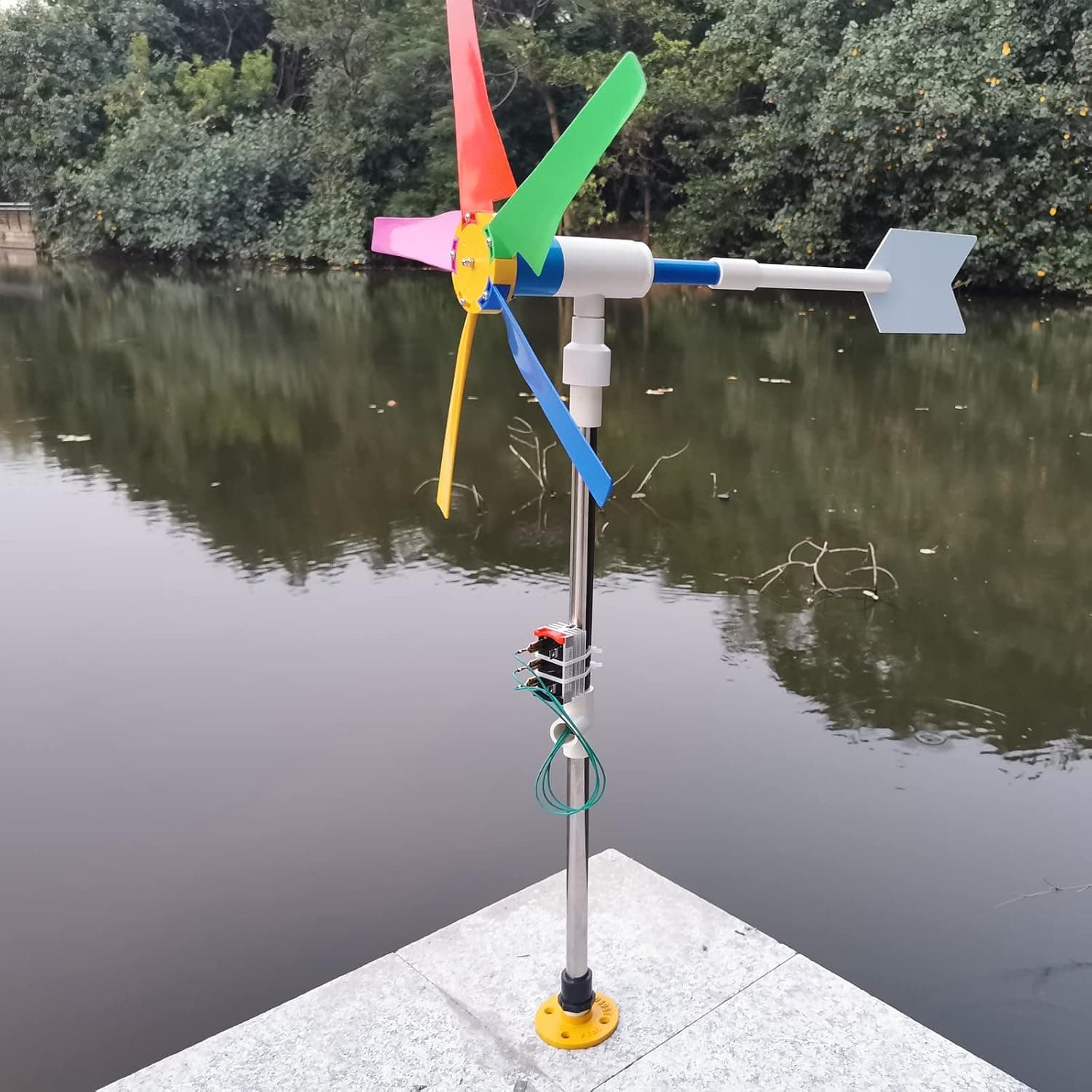
Wind turbines are cool.
But here’s the problem with most small wind turbine projects.
You install the turbine, connect it to a battery or multimeter, wait for some wind, and then stare at a number on a screen.
Technically interesting.
Visually, not so much.
This DIY Small Wind Turbine Generator Kit takes a much more entertaining approach.
Instead of primarily trying to charge a battery, it converts wind energy directly into something you can see.
Light.
The kit includes a small wind turbine and a 10-meter colorful LED light strip. When the wind blows, the turbine spins, generates electricity, and powers the lights.
More wind means more electricity.
More electricity means brighter lights.
It’s basically a tiny renewable energy experiment that doubles as backyard decoration.
And that’s actually pretty cool.
Check the latest price on Amazon:
https://link.amazon/B0dFKZhUo
As an Amazon Associate, we may earn from qualifying purchases.
This Isn’t Really a Home Wind Turbine
Let’s establish something immediately.
If you’re looking at this thinking you’re about to reduce your electricity bill, that’s not really the point.
This is a small DIY wind generator with an approximately 18-inch diameter designed to power the included decorative lighting.
It’s much closer to an educational renewable energy project than a serious residential power system.
And I actually think that’s what makes it interesting.
Large wind turbines can feel abstract.
You see them spinning somewhere in the distance, but you don’t directly experience the relationship between the wind and the electricity being produced.
This gives you that relationship in miniature.
Wind blows.
Turbine spins.
Lights turn on.
Simple.
The LED Strip Is Basically the Power Meter
Here’s my favorite part.
The brightness of the LED strip changes depending on the strength of the wind, according to the manufacturer.
That’s such a simple concept, but it turns the entire installation into a visual representation of energy generation.
When there’s relatively little wind, the lights are dimmer.
When the wind gets stronger, they become brighter.
So instead of opening an app to see a generation graph, you can literally look outside.
The LEDs effectively become a giant visual power meter.
And because the strip is 10 meters long, or roughly 33 feet, there’s enough lighting to create a fairly substantial decorative installation around a railing, fence, pergola, garden feature, or other outdoor area.
No Battery Required
The other interesting part is what’s missing.
There’s no battery required for the basic lighting concept.
The turbine generates electricity from the wind and uses that energy to power the lights.
That means the experience is directly tied to the weather.
No wind?
No wind-generated light.
Wind starts blowing?
The lights come alive.
From a practical lighting perspective, that’s obviously less reliable than a normal outdoor light connected to a battery or electrical outlet.
But that’s missing the point.
This is supposed to make wind energy visible.
The unpredictability is part of the experience.
It’s Basically Kinetic Garden Decoration
We’ve all seen solar garden lights.
They’re everywhere.
Tiny solar panel on top.
Battery inside.
LED underneath.
The light charges during the day and turns on at night.
This wind turbine creates a very different experience.
It’s dynamic.
The turbine itself is moving.
The LED brightness can change.
The whole installation responds to what’s happening in the environment.
That makes it closer to a piece of kinetic garden art that happens to demonstrate renewable energy.
And unlike a purely decorative windmill, the spinning blades are actually doing something useful.
They’re generating electricity.
The Turbine Is About 18 Inches Across
The turbine has a diameter of approximately 18 inches.
So this isn’t some tiny desktop science experiment.
It’s large enough to become a visible feature in a backyard or garden while still being dramatically smaller than the wind turbines used for serious off-grid electricity generation.
The manufacturer includes a mounting flange and four screws, allowing the turbine to be attached to suitable railings, elevated structures, or other open locations.
And location is important.
Very important.
Wind Turbines Really Care About Placement
Solar panels want sunlight.
Wind turbines want clean airflow.
Putting this turbine somewhere surrounded by walls, trees, fences, and buildings could dramatically reduce how effectively it operates.
The manufacturer specifically recommends installing it in an open area.
That makes sense.
Wind becomes turbulent when it moves around obstacles.
A location might feel windy to you while still providing inconsistent airflow to a small turbine.
Generally, you want the turbine somewhere exposed where the blades can receive relatively unobstructed wind.
A higher mounting location may help in some environments, assuming it can be installed safely and securely.
This is one of those products where placement can probably make the difference between:
“Wow, this is really cool.”
and
“Why isn’t this thing spinning?”
It Automatically Faces the Wind
There’s also a tail vane behind the turbine.
This is another simple piece of engineering that does something important.
Wind direction changes.
Instead of requiring you to manually reposition the turbine, the tail helps orient the rotor toward the incoming airflow.
The entire turbine can therefore adjust as the wind direction changes.
It’s a design that’s been used on small wind turbines for a very long time because it works.
No electronic wind-direction sensor.
No motorized rotation system.
Just aerodynamics.
Sometimes simple engineering is the best engineering.
Brushless Motor Design
The generator uses a brushless motor design.
For something that’s going to sit outside and potentially spin for long periods, reducing mechanical wear is useful.
Traditional brushed motors use physical brushes that contact the commutator, which introduces another wear component.
A brushless design eliminates that particular mechanism.
The manufacturer also says the turbine operates quietly.
That’s especially important here because this isn’t going on some remote hill.
It’s probably going in your backyard.
Nobody wants their decorative renewable energy experiment turning into a tiny helicopter outside the bedroom window.
The Blades Are Built for Outdoor Use
The blades use ASA/PC materials, according to the listing.
They’re designed to resist aging from outdoor exposure and withstand varying weather conditions.
The overall turbine is also described as rain-resistant and suitable for long-term outdoor use.
That’s essential because this thing needs to be exposed to the environment to work properly.
You can’t exactly protect a wind turbine from the wind.
That said, I’d still follow the manufacturer’s mounting and weather guidelines carefully.
Claims about handling strong winds shouldn’t be interpreted as meaning the turbine is indestructible in every storm or extreme-weather situation.
A small turbine still experiences substantial forces when wind speeds increase.
Secure installation matters.
You Assemble It Yourself
This is a DIY kit, so most of the components need to be assembled.
And honestly, that’s probably a feature rather than a downside.
If the goal is purely to illuminate your backyard, there are dramatically easier ways to do that.
Buy some solar lights.
Done.
The appeal here is understanding how the system works.
You assemble the turbine.
Mount it.
Connect the lighting.
Then watch the energy conversion happen in front of you.
Wind contains kinetic energy.
The blades capture some of that energy and rotate.
The generator converts that mechanical rotation into electrical energy.
The electricity powers the LEDs.
That’s essentially the same fundamental energy-conversion process happening inside enormous utility-scale wind turbines.
Obviously, the scale is completely different.
But the physics is recognizable.
This Could Be a Great STEM Project
And that’s where I think this product becomes considerably more interesting.
It’s not just garden decoration.
It could also work as a hands-on renewable energy demonstration for kids, students, or anyone interested in engineering.
You can experiment with placement.
What happens if you mount it higher?
What happens during stronger wind?
How does the LED brightness change?
What happens when the wind changes direction?
How quickly does the tail reposition the turbine?
Suddenly your backyard decoration becomes an experiment.
And unlike a diagram in a textbook, this one reacts to the actual weather outside your house.
That’s a much more memorable way to understand renewable energy.
It Also Demonstrates One of Wind Power’s Biggest Challenges
Interestingly, this tiny turbine also demonstrates one of the fundamental challenges of renewable energy.
Intermittency.
The lights only receive significant power when there’s enough wind.
If the wind disappears, generation drops.
That’s basically the same challenge facing much larger renewable energy systems.
Solar output changes depending on sunlight.
Wind output changes depending on wind conditions.
Real power systems deal with this using combinations of geographic diversity, grid interconnection, flexible generation and demand, forecasting, storage, and other technologies.
This little turbine obviously isn’t solving any of those problems.
But it lets you see the variability firsthand.
When the wind changes, the lights respond.
That’s renewable energy in its simplest possible form.
Don’t Buy It for “Free Electricity”
The listing uses the phrase “free energy generator.”
I’d interpret that carefully.
The turbine is harvesting energy from moving air, so you don’t purchase fuel for the wind itself.
But this isn’t “free energy” in the physics-breaking perpetual-motion sense.
Energy is being converted from one form into another.
The wind provides kinetic energy.
The rotor captures part of it.
The generator converts mechanical energy into electricity.
And the LEDs convert some of that electricity into light.
No laws of physics were harmed in the making of your backyard decoration.
Who Is This Actually For?
I see a few obvious audiences.
First, someone who wants a unique backyard decoration.
A wind-powered LED installation is definitely more interesting than another generic string of outdoor lights.
Second, families with kids who are interested in science.
This turns renewable energy into something tangible.
Third, teachers, makers, and STEM enthusiasts.
You can use the system to demonstrate basic concepts involving wind energy, electricity generation, and energy conversion.
And finally, renewable energy enthusiasts who just think having a tiny working wind turbine in the backyard sounds cool.
I understand.
It does sound cool.
What I Like
The best thing about this kit is that the output is immediately understandable.
You don’t need to understand volts, amps, watts, or charge curves.
Wind blows.
Lights glow.
More wind.
Brighter lights.
That’s it.
The 10-meter LED strip makes the electricity generation visually obvious, while the approximately 18-inch turbine is large enough to feel like an actual outdoor installation rather than a tiny science toy.
I also like the tail-vane system.
There’s something satisfying about watching a completely mechanical system automatically turn itself toward the wind.
No app required.
What You Should Know Before Buying
There are a few important limitations.
First, this is primarily a decorative and educational wind generator, not a serious home energy system.
Second, performance depends heavily on your local wind conditions and installation location.
Third, because the lighting responds directly to available wind energy, you shouldn’t expect consistent brightness like you’d get from mains-powered or battery-backed outdoor lighting.
Fourth, outdoor mounting needs to be secure. Wind turbines experience mechanical forces that increase significantly as wind speed rises.
And finally, claims about strong-wind durability and long-term outdoor performance are manufacturer claims. Installation conditions and weather exposure can vary substantially.
The Bottom Line
The DIY Small Wind Turbine Generator Kit isn’t going to power your house.
And that’s perfectly fine.
Because what it does instead might actually be more fun.
You assemble an approximately 18-inch wind turbine, install it somewhere with good airflow, connect the included 10-meter colorful LED strip, and wait for the wind.
The blades start spinning.
The generator produces electricity.
The lights come on.
And as the wind gets stronger, the lights can become brighter.
It’s backyard decoration, a DIY project, and a miniature renewable energy demonstration all rolled into one.
There are much easier ways to put colorful lights in your garden.
But very few of them let you watch the weather generate the electricity powering those lights in real time.
And that’s what makes this little turbine interesting.
Check the DIY Small Wind Turbine Generator Kit on Amazon:
https://link.amazon/B0dFKZhUo