
HEKIWAY Solar Drip Irrigation Kit Review: Let the Sun Water Your Plants
There are some things technology should absolutely automate.
Turning lights off when nobody is in the room.
Backing up your photos.
Running the robot vacuum.
And watering the plants when you’re on vacation.
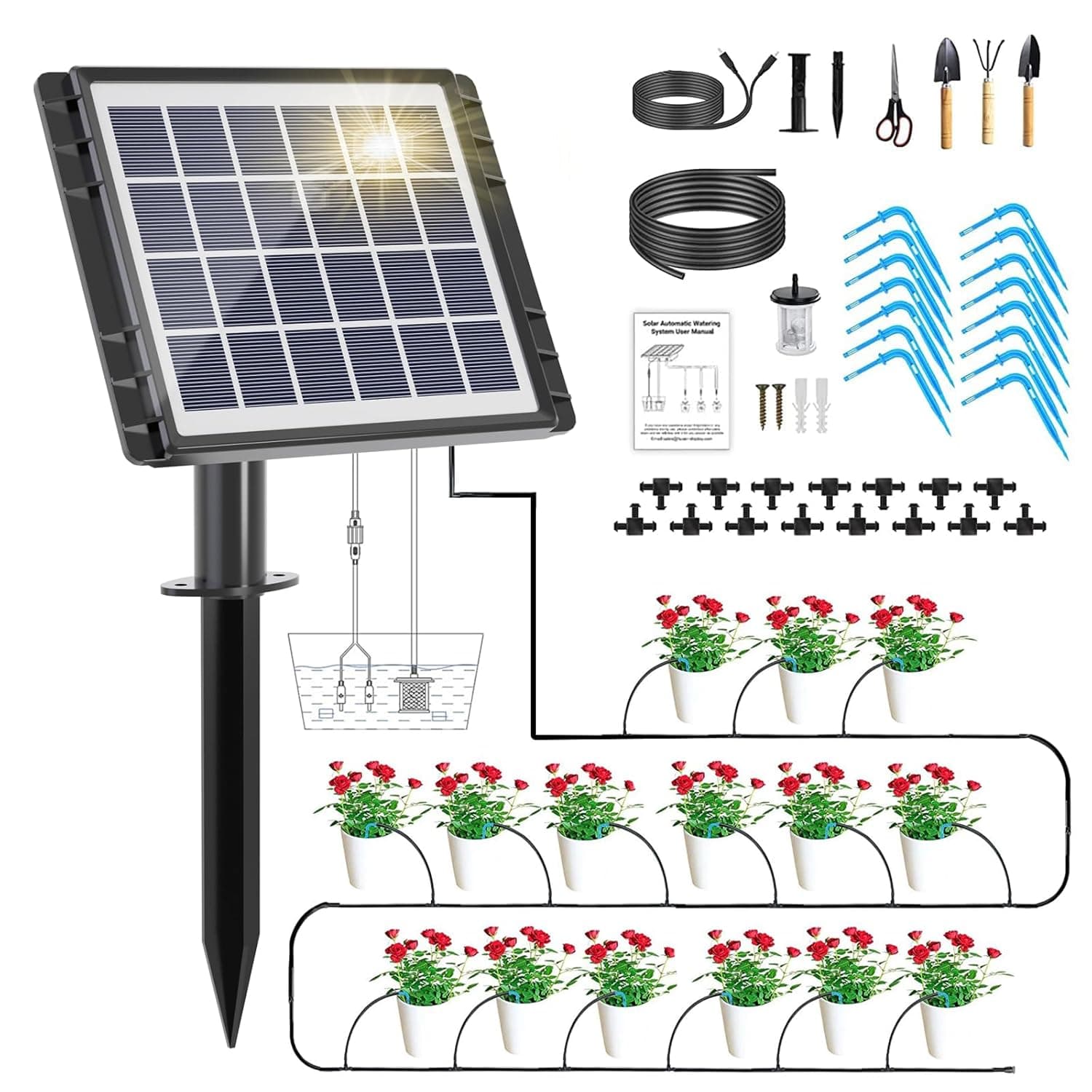
The HEKIWAY 49FT Solar Drip Irrigation System is basically an automatic watering system for up to 15 potted plants. It combines a small pump, solar power, USB-C charging, approximately 50 feet of tubing, 15 watering stakes, and a programmable timer with 25 watering modes.
And the concept is almost perfect for solar power.
Plants need more water when it’s hot and sunny.
Solar panels produce more energy when it’s sunny.
Put those two things together and you’ve got a tiny off-grid irrigation system sitting on your balcony.
Check the latest price on Amazon:
https://link.amazon/B0h1BBqPR
As an Amazon Associate, we may earn from qualifying purchases.
This Is Basically a Tiny Automatic Irrigation Network
The concept is pretty simple.
Instead of walking around with a watering can and individually watering every pot, you run small tubes from a central water source to your plants.
The pump moves water through the tubing.
T-joints split that water across multiple branches.
Watering stakes deliver it to individual pots.
And the timer decides when everything happens.
Once you’ve got it configured properly, the system can take over one of the most repetitive parts of keeping plants alive.
And if you’ve ever returned from a vacation to a collection of extremely crispy plants, you already understand the appeal.
It Can Water Up to 15 Pots
The kit includes 15 watering stakes and 15 T-joints, allowing you to create a custom watering network for up to 15 plants.
That’s enough for a pretty substantial balcony garden.
Herbs.
Flowers.
Vegetables.
Indoor plants.
Small patio gardens.
You could arrange the tubing around shelves, planters, pots, and different growing areas depending on your setup.
The manufacturer includes approximately 50 feet of tubing, giving you quite a bit of flexibility when designing the layout.
And that’s important because plants are rarely positioned in one perfectly organized straight line.
Solar Power Is the Clever Part
The system includes solar power for outdoor operation.
And this is one of those applications where solar makes immediate sense.
A garden irrigation system doesn’t necessarily need huge amounts of electricity.
It needs enough energy to periodically run a small pump and control electronics.
So instead of running an extension cable across the patio or constantly replacing batteries, you can use sunlight.
Put the solar panel somewhere with good exposure.
Let it collect energy.
Then the system uses that stored energy when it’s time to water the plants.
For a balcony, patio, greenhouse, or garden without a convenient electrical outlet, that’s a really useful design.
But It Also Has USB-C
And this might be even more important than the solar panel.
The system also supports USB-C charging.
That gives you a backup.
Solar power is great when you’ve got enough sunlight.
But maybe it’s winter.
Maybe you’re using the system indoors.
Maybe you’ve had several cloudy days.
Maybe your balcony barely gets direct sunlight.
Instead of the system becoming useless, you can recharge it through USB-C.
That’s the right approach to a solar-powered gadget.
Solar when conditions are good.
Wired charging when they aren’t.
You get renewable energy without becoming completely dependent on the weather.
That Makes It Useful Indoors Too
This is where the HEKIWAY system becomes more versatile than a purely solar irrigation kit.
Move the plants indoors during winter?
No problem.
The manufacturer specifically recommends using the Type-C charging port to maintain operation when solar conditions aren’t sufficient.
That means the same watering system can potentially stay in use year-round.
Summer on the balcony.
Winter indoors.
You don’t necessarily need separate watering solutions for each environment.
And because the water comes from your own container, you aren’t dependent on connecting the system directly to a household tap.
There Are 25 Timer Modes
Automation only works if you can control it properly.
HEKIWAY provides 25 customizable timer modes.
You can set watering durations from approximately 3 to 20 minutes and watering intervals between 12 and 96 hours, according to the manufacturer.
That gives you quite a bit of flexibility.
Maybe you want a short watering session every day.
Maybe your plants need a longer session every three days.
Maybe you’re using larger containers that retain moisture for much longer.
You can adjust the schedule around the plants rather than forcing every plant into the same daily routine.
Different Plants Need Different Amounts of Water
And this is the part that no automatic watering system can completely solve for you.
Plants are different.
A small succulent and a large tomato plant shouldn’t necessarily receive the same amount of water.
The manufacturer provides some suggested starting points.
For small indoor plants, it suggests roughly 2 to 5 minutes every two to three days.
For medium plants, around 5 to 10 minutes every three to four days.
For larger plants, around 10 to 15 minutes every five to seven days.
Outdoor gardens may need longer watering periods and different intervals.
But treat those as starting points, not universal rules.
Plant species matters.
Pot size matters.
Soil matters.
Temperature matters.
Humidity matters.
Sun exposure matters.
Drainage matters.
The best schedule is the one that works for your actual plants.
You Still Need to Tune the System
This is where I’d spend some time during the first week.
Don’t install everything, set a timer, and immediately leave for a three-week vacation.
Run the system.
Watch what happens.
Check how much water each pot receives.
Look at the soil afterward.
Check it again the next day.
Adjust the watering duration.
Adjust the interval.
Once you’ve dialed everything in, then automation becomes useful.
The setup process is basically calibration.
You’re teaching the system how much water your particular garden needs.
Up to 900mL Per Minute
The pump is rated for a flow of up to 900mL per minute, according to the manufacturer.
That’s the total pump flow specification, not necessarily the amount every individual plant receives.
Once you’ve split the system across multiple branches and watering points, actual distribution will depend on the tubing layout, number of outlets, height differences, restrictions, and other factors.
That’s something worth remembering when designing a 15-pot system.
The plant closest to the pump shouldn’t necessarily be assumed to receive exactly the same amount of water as one sitting at the end of a long tubing run.
Testing the complete layout before relying on it unattended is a good idea.
Drip Irrigation Can Be More Efficient
One of the advantages of drip-style watering is that you can deliver water directly where it’s needed.
Instead of spraying a large area, you’re targeting the soil around individual plants.
That can reduce unnecessary water loss compared with less targeted watering methods.
For potted plants, it also means you aren’t watering the balcony floor, furniture, walls, or everything else surrounding the pot.
Water goes through the tube.
Into the pot.
Near the plant.
Simple.
The Water Container Is Up to You
One useful aspect of this kind of system is that you can choose an appropriately sized water reservoir.
The kit draws water from a container rather than requiring a permanent plumbing connection.
That could be a bucket or another suitable reservoir, depending on the installation and manufacturer’s requirements.
And reservoir size determines how long the system can operate unattended.
If your plants collectively consume several liters every watering cycle and you’ve got a tiny container, you’re going to run out pretty quickly.
Use a larger reservoir and you’ve got much more autonomy.
So if you’re building this specifically for vacation watering, calculate approximately how much water the plants consume per cycle and multiply that by the number of scheduled cycles while you’re away.
Then leave yourself some margin.
There’s a Low-Water Warning
This is one of the smartest features in the kit.
The system can alert you if the water container is empty.
That’s useful because an automatic irrigation system without water is basically just an automatic timer making optimistic noises.
The system can use a buzzer or flashing indicator to tell you something is wrong.
That gives you a chance to refill the reservoir before your plants start suffering.
Of course, this only helps when someone is around to notice the warning.
If you’re leaving home for a long period, reservoir sizing is still important.
It Can Also Detect Blockages
The warning system can also indicate problems with the pump or filter.
That’s important because small irrigation tubing and pumps can potentially become blocked by debris.
The kit includes a filter to help reduce that problem.
But filters themselves need maintenance.
The manufacturer also notes that dirt buildup around the water-level sensor can cause false low-water alarms.
So occasional cleaning is part of ownership.
Automation reduces maintenance.
It doesn’t eliminate maintenance.
This Is Where the Filter Matters
If you’re pulling water from an open container, dust and small debris can eventually find their way into the reservoir.
Without filtration, that material could enter the pump or small irrigation tubes.
A blocked tube means one plant may stop receiving water while the rest of the system appears to be working normally.
That’s particularly dangerous because you might not notice immediately.
So keep the reservoir reasonably clean.
Check the filter.
Inspect the watering outlets periodically.
A five-minute maintenance check could save a plant later.
The 50-Foot Tubing Gives You Options
The kit includes approximately 49 to 50 feet of tubing, depending on how the listing rounds the measurement.
That’s around 15 meters.
For 15 pots, that’s a reasonable amount of flexibility.
You can run the main line along a balcony railing.
Across shelving.
Around a patio.
Through a collection of indoor plants.
Then use the T-connectors to branch toward individual pots.
The key is planning the layout before cutting everything.
Measure twice.
Cut once.
Classic DIY rule.
This Could Be Fantastic for Vacations
Honestly, this is probably the most obvious reason to buy it.
You love plants.
You also like traveling.
Those two hobbies occasionally conflict.
You can ask someone to come over every few days.
You can move everything into the shade and hope for the best.
Or you can automate the watering.
With a properly configured HEKIWAY system, you could fill a sufficiently large reservoir, verify the solar or battery power, test the watering schedule, and let the system handle routine watering while you’re away.
I would still thoroughly test everything before depending on it for an extended absence.
But once properly configured, this is exactly the kind of automation that can remove a lot of travel anxiety for plant owners.
It’s Also Useful When You’re Home
You don’t actually need to travel to benefit from automatic watering.
Consistency is useful.
People forget.
People get busy.
You might water the plants on Monday and then suddenly realize it’s Saturday.
An automatic system doesn’t forget.
It follows the schedule.
That can be especially useful for balcony vegetables and other plants that prefer relatively consistent moisture conditions.
Instead of watering based on memory, you’re watering based on a programmed routine.
The Solar Aspect Makes the Whole Thing More Interesting
What I like most about this product is how well the power source matches the application.
This isn’t solar power for the sake of putting “solar” on the box.
The system is often used outdoors.
Outdoor spaces have sunlight.
The electrical demand is relatively small.
The pump only runs periodically.
So solar charging makes sense.
And when sunlight isn’t sufficient, USB-C provides the backup.
That’s exactly how small-scale solar should work.
Use renewable energy where it’s convenient.
Keep a practical backup when nature doesn’t cooperate.
What I Like
The overall package is surprisingly complete.
You get solar power, USB-C charging, 25 timer modes, adjustable watering intervals, up to 900mL/min pump flow, around 50 feet of tubing, 15 watering stakes, 15 T-joints, a filter, and warning functions for low water or blockages.
The ability to use the same system indoors and outdoors is particularly useful.
And I like that the solar panel isn’t the only charging option.
Purely solar gadgets can become frustrating during long periods of poor sunlight.
USB-C solves that problem.
What You Should Know Before Buying
First, the 900mL/min specification refers to the system’s pump flow, not necessarily the amount each of 15 plants will receive.
Second, you’ll need to experiment with watering duration and frequency. The manufacturer’s suggested schedules are starting points, not universal recommendations for every plant.
Third, choose a water reservoir large enough for the amount of time you want the system to operate unattended.
Fourth, keep the filter and water-level sensor clean. The manufacturer notes that dirt on the sensor can cause false low-water warnings.
Fifth, test the complete 15-pot layout before relying on it during a long trip.
And finally, remember that automatic irrigation isn’t completely maintenance-free. Tubes, filters, pumps, reservoirs, and watering stakes still need occasional inspection.
Who Is This For?
The HEKIWAY system makes the most sense for someone with a collection of potted plants who wants to automate routine watering.
Maybe you’ve got a balcony garden.
A patio full of flowers.
Indoor plants spread around a sunny room.
A small vegetable garden.
A greenhouse.
Or fifteen pots that somehow turned into thirty because that’s apparently what happens when you start buying plants.
It’s especially appealing if you travel regularly.
But even if you’re home every day, automatic watering can make plant care more consistent and considerably less repetitive.
The Bottom Line
The HEKIWAY 49FT Solar Drip Irrigation System takes one repetitive household task and turns it into something you can mostly automate.
Set up the tubing.
Put a watering stake in each pot.
Fill the reservoir.
Choose the schedule.
Give the solar panel some sunlight.
And let the system handle the routine.
You get support for up to 15 watering points, approximately 50 feet of tubing, 25 timer modes, up to 900mL/min pump flow, solar charging, USB-C backup power, low-water warnings, and blockage detection.
It still requires some initial experimentation.
You’ll need to figure out how much water your plants actually need.
You’ll need to keep the reservoir filled.
And you’ll occasionally need to clean the filter and sensors.
But once everything is dialed in, this is exactly the kind of smart-home technology I like.
It doesn’t need an AI assistant.
It doesn’t need a giant touchscreen.
It doesn’t need another subscription.
It just needs to remember to water your plants.
And apparently, that’s already more reliable than some of us.
Check the HEKIWAY Solar Drip Irrigation System on Amazon:
https://link.amazon/B0h1BBqPR