
Mini Wind Turbine Charge Controller Review: A Tiny Box With a Pretty Important Job
Wind turbines get all the attention.
They’re the part that spins. They’re the part you can see from a distance. And they’re the part actually capturing energy from moving air.
But if you’re building a small off-grid wind power system, there’s another component sitting between that turbine and your battery that arguably has an even more important job.
The charge controller.
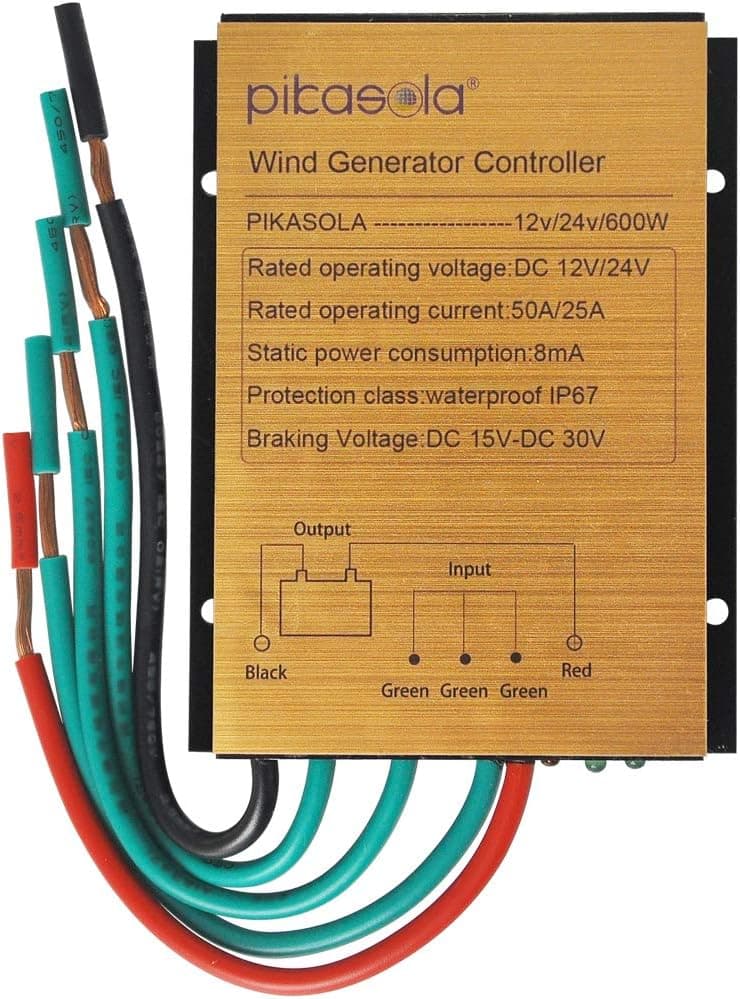
This Mini Wind Turbine Generator Controller is designed for small wind turbines rated from 0 to 600W, automatically supports 12V and 24V battery systems, includes automatic braking and several electrical protection features, and wraps everything inside an IP67-rated aluminum enclosure.
Basically, it’s a small box designed to make a small wind power system considerably easier to manage.
And unlike a solar charge controller, it has to deal with one particularly interesting problem.
You can’t just turn off the wind.
Check the latest price on Amazon:
https://link.amazon/B0enVhA1b
As an Amazon Associate, we may earn from qualifying purchases.
First, What Does a Wind Charge Controller Actually Do?
The basic idea is straightforward.
Your wind turbine generates electricity.
Your battery stores electricity.
The charge controller sits between them and manages the charging process.
But connecting a wind turbine directly to a battery without appropriate control isn’t a great idea.
Wind speed constantly changes, which means the turbine’s electrical output can change as well. The battery also has charging limits that need to be respected.
This controller is designed to regulate that relationship automatically.
When charging is required, energy from the turbine can be directed toward the battery.
When the battery reaches the controller’s full-charge threshold, the system can intervene to prevent continued uncontrolled charging.
And that’s where things get interesting.
It Can Automatically Brake the Turbine
Solar panels are relatively easy to control.
If the battery is full, a solar controller can simply stop or substantially reduce the charging current.
The solar panel just sits there.
A wind turbine is different.
The wind might still be blowing, and the blades might still want to spin.
That’s why this controller incorporates an automatic braking function.
According to the manufacturer, when the battery reaches the appropriate full-charge condition, the controller’s internal circuitry can automatically apply braking to the turbine.
When battery voltage later drops to the specified recovery level, the controller allows the turbine to resume charging.
So the whole process is designed to happen without you constantly monitoring the system.
Battery needs power?
Charge it.
Battery reaches the configured limit?
Control the turbine.
Battery voltage falls again?
Resume charging.
That’s exactly the kind of automation you want from something that might be installed outside and operating 24 hours a day.
Designed for Wind Turbines Up to 600W
This particular controller is designed for wind turbines rated between 0 and 600W.
So we’re firmly in small wind territory.
This isn’t hardware for a giant commercial turbine.
Instead, think small off-grid installations, cabins, sheds, boats where appropriate, remote equipment, experimental renewable energy projects, and other compact battery-based systems.
The key is compatibility.
A controller saying “600W” doesn’t automatically mean it’s suitable for every turbine with 600W printed on the box.
You still need to verify the turbine voltage, battery voltage, electrical characteristics, wiring requirements, and the controller manufacturer’s specifications before connecting everything.
With renewable energy hardware, matching the system correctly matters just as much as the headline wattage.
12V or 24V? It Figures That Out Automatically
One of the nicest features is automatic support for 12V and 24V systems.
According to the manufacturer, the controller can automatically identify and match the appropriate system voltage.
That’s useful because 12V and 24V are both extremely common in small off-grid installations.
A 12V setup might make sense for a smaller system.
Move toward higher power levels and 24V can become increasingly attractive because delivering the same amount of power at a higher voltage requires less current.
And current matters.
For example, ignoring losses and other real-world factors, 600W at 12V corresponds to roughly 50 amps.
At 24V, that same 600W corresponds to roughly 25 amps.
That’s a pretty substantial difference.
It also demonstrates why wiring and system design matter so much in low-voltage renewable energy systems.
Voltage and Current Limiting Are Built In
The controller manages voltage and current limiting during charging, according to the listing.
That’s really the core responsibility of the device.
A battery isn’t just a bucket that you continuously pour electricity into.
Charging needs to happen within appropriate electrical limits.
The controller monitors the system and regulates the charging process while also providing protection for the wind turbine.
The exact charging behavior and compatibility will depend on the controller and battery specifications, so it’s important to verify that your battery chemistry and required charging voltages are actually supported.
That’s particularly important if you’re using lithium batteries.
Don’t assume compatibility purely because the voltage says 12V or 24V.
Battery chemistry matters.
Reverse Polarity Protection Is a Nice Touch
Here’s a practical feature that could save you from a very annoying mistake.
The controller includes reverse-connection protection.
If the battery’s positive and negative connections are accidentally reversed, the manufacturer says you don’t need to replace a fuse.
Instead, you correct the polarity and reconnect the system properly.
Obviously, the better strategy is to connect everything correctly the first time.
Positive to positive.
Negative to negative.
Double-check before energizing anything.
But mistakes happen.
Having protection against one of the most basic wiring errors is reassuring, particularly for a controller that may appeal to DIY renewable energy enthusiasts.
The Aluminum Housing Isn’t Just for Looks
The controller uses an aluminum alloy enclosure with a heat-dissipation structure.
That’s important.
Power electronics generate heat.
Rectification generates heat.
Current flowing through electrical components generates heat.
And heat is one of the biggest enemies of long-term electronic reliability.
The manufacturer says the rectification and braking circuitry uses an integrated module design intended to improve both heat dissipation and reliability compared with more traditional designs.
The aluminum enclosure can also act as part of the thermal-management system by helping transfer heat away from internal components.
So while the metal construction makes the controller look rugged, it’s also doing something functional.
And It’s IP67 Rated
This might be one of the most interesting specifications.
The enclosure is advertised with an IP67 waterproof rating.
IP67 generally indicates a high level of protection against dust ingress and temporary water immersion under specified test conditions.
That’s considerably more protection than you get from electronics intended exclusively for dry indoor environments.
And for wind turbine equipment, environmental protection makes sense.
The turbine itself obviously has to be somewhere windy.
That often means exposure to humidity, rain, condensation, and changing temperatures.
A weather-resistant controller gives you more flexibility when designing the system.
But I’d still avoid interpreting IP67 as “install this anywhere and forget about it forever.”
Connections, cable entry points, terminals, mounting orientation, and the rest of the electrical system still need appropriate environmental protection.
Waterproofing the controller doesn’t automatically waterproof your entire installation.
There Are Several Protection Features
The controller also includes a collection of protection functions.
According to the manufacturer, these include automatic over-voltage braking, battery reverse-connection protection, open-circuit protection, and lightning protection.
That’s a useful list.
But there’s one claim worth putting into context.
“Lightning protection” should not be interpreted as meaning the controller is guaranteed to survive a direct lightning strike.
A proper outdoor renewable energy installation may require appropriate grounding, surge protection, disconnects, overcurrent protection, and other measures depending on the system and local electrical requirements.
An integrated protection circuit is useful.
It’s not a force field.
Why Wind Controllers Are Different From Solar Controllers
At first glance, you might wonder why you can’t simply use a normal solar charge controller.
The answer comes back to the characteristics of the energy source.
Solar panels don’t contain rotating mechanical parts.
A wind turbine does.
When electrical load changes, the behavior of the turbine itself can change.
That’s why features like automatic braking are so important.
The controller isn’t only thinking about the battery.
It also has to think about what the generator is doing.
This is what makes small wind systems surprisingly interesting from an engineering perspective.
The electrical and mechanical systems are connected.
This Controller Is Refreshingly Simple
There’s another thing I like here.
This doesn’t appear to be trying to become a smart-home gadget.
There’s no cloud subscription.
No Wi-Fi.
No account.
No AI.
No app telling you your wind turbine achieved a new personal best today.
It’s a purpose-built piece of power electronics.
Connect a compatible turbine.
Connect a compatible battery system.
Install everything correctly.
And let the controller do its job.
For equipment that’s supposed to operate continuously in the background, simplicity can be a feature.
Where Would You Actually Use This?
The obvious use case is a small off-grid wind power system.
Maybe you have a remote cabin where running grid electricity isn’t practical.
Maybe you’re experimenting with a small backyard turbine.
Maybe you’re building a renewable-energy demonstration system.
Maybe you have remote equipment that needs battery charging in a location with suitable wind resources.
Small wind can also be paired with solar in some off-grid systems.
Solar produces during daylight when conditions are favorable.
Wind generation depends on wind conditions and isn’t inherently limited to daytime.
Combining the two can potentially give a battery system more opportunities to receive energy.
In that scenario, this device handles the wind side of the equation.
But Check Your Wind Resource First
There’s a bigger consideration before buying any small wind turbine equipment.
Do you actually have enough wind?
A turbine’s rated output doesn’t mean it continuously generates that amount of power.
Far from it.
Actual generation depends heavily on wind speed, turbine design, installation height, surrounding obstacles, turbulence, and local conditions.
Putting a turbine low behind your house because “it feels pretty windy outside” isn’t necessarily enough.
Wind resource and turbine placement are fundamental to system performance.
The best charge controller in the world can’t generate electricity from wind that isn’t there.
Installation Matters
This also isn’t the kind of product I’d treat like a USB charger.
At the upper end of its operating range, you’re dealing with hundreds of watts flowing through a low-voltage DC system.
That can mean substantial current.
Correct cable sizing matters.
Connections matter.
Fusing and overcurrent protection matter.
Polarity matters.
Battery specifications matter.
Grounding and surge protection may matter.
And the turbine itself needs to be installed correctly and safely.
If you’re not comfortable working with battery-based renewable energy systems, having someone experienced with small wind or off-grid electrical installations design or inspect the system is sensible.
What I Like
The specification sheet focuses on exactly the things I’d want from a basic wind controller.
It supports up to 600W of wind generation.
It can automatically recognize 12V and 24V systems.
It manages voltage and current during charging.
It can automatically brake the turbine when required.
It has reverse-polarity protection.
The aluminum enclosure helps with thermal management.
And the IP67 rating makes sense for equipment intended to operate around outdoor renewable energy installations.
Nothing here sounds particularly glamorous.
But that’s fine.
Charge controllers aren’t supposed to be glamorous.
They’re supposed to quietly work.
What You Should Know Before Buying
The most important thing is compatibility.
Before buying, verify the specifications of your wind turbine, battery, and complete electrical system rather than relying solely on the 600W headline rating.
Second, check battery compatibility carefully, particularly if you’re using lithium chemistry.
Third, IP67 protection applies to the controller as specified by the manufacturer. Your connectors, cables, fuses, battery, and other components need their own appropriate protection.
Fourth, don’t interpret integrated “lightning protection” as a replacement for proper system-level surge and grounding measures.
And finally, make sure you actually have an appropriate wind resource before investing heavily in small wind generation.
Who Is This For?
This controller makes the most sense for someone building or maintaining a small 12V or 24V wind turbine system.
You don’t need hybrid solar management inside the same controller.
You don’t need an elaborate monitoring platform.
You just need something that sits between a turbine rated at up to 600W and a compatible battery system, manages charging, and helps protect both sides of the setup.
That’s a very specific job.
And sometimes a product being designed for one specific job is exactly what you want.
The Bottom Line
The Mini Wind Turbine Generator Controller is basically the quiet middleman in a small wind energy system.
The turbine spins.
The battery stores energy.
And this little aluminum box sits between them making sure the charging process stays under control.
It supports 0 to 600W wind turbines, automatically recognizes 12V or 24V systems, regulates charging voltage and current, provides automatic turbine braking, includes reverse-polarity and other protection functions, and wraps the electronics inside an IP67-rated aluminum enclosure.
That’s a lot of responsibility for something that looks relatively simple.
And that’s really the point.
A good charge controller shouldn’t be the most exciting part of your renewable energy system.
It should be the part you don’t have to constantly think about.
Check the Mini Wind Turbine Generator Controller on Amazon:
https://link.amazon/B0enVhA1b