
PRIMECOM 80A Level 2 EV Charger Review: Do You Really Need 19.2kW at Home?
Most people don’t need an 80-amp EV charger.
Let’s just get that out of the way.
A typical Level 2 home charger is already fast enough to plug in after work, charge overnight, and wake up with more than enough range for the next day.
But then there’s the PRIMECOM 80 Amp Level 2 EV Charger.
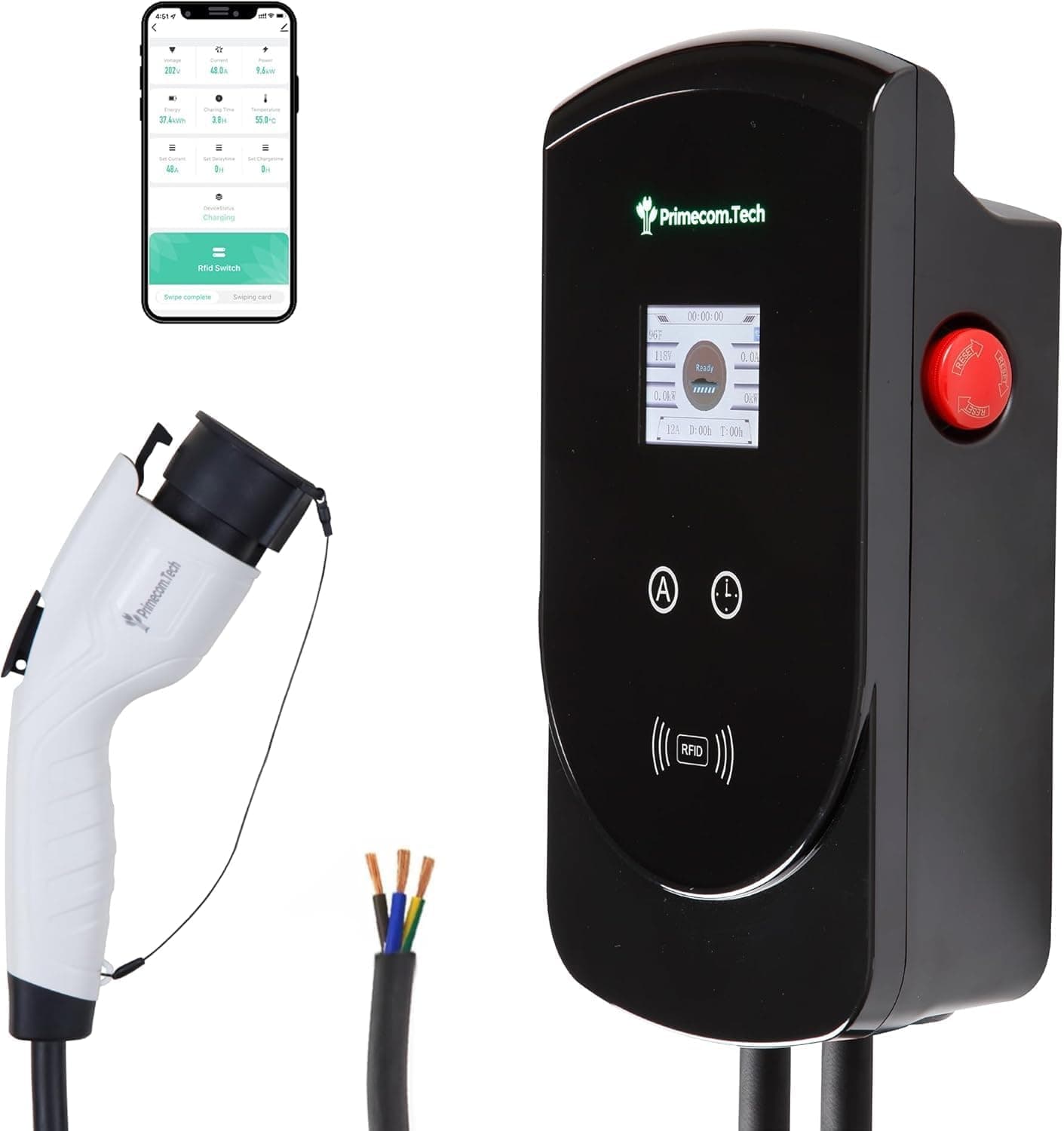
At 240V and 80A, you’re looking at up to approximately 19.2kW of charging power. The manufacturer advertises up to 75 miles of added range per hour, multiple adjustable current levels, smartphone controls, scheduled charging, outdoor operation, and cable options stretching all the way to 50 feet.
This is basically the home EV charger for someone who looked at 40 amps and thought:
Can we double that?
Yes.
But whether your car can actually use all that power is a completely different question.
Check the latest price on Amazon:
https://link.amazon/B0gDN1js9
As an Amazon Associate, we may earn from qualifying purchases.
80 Amps Is a Lot
Let’s start with the headline number.
80 amps.
At 240 volts, that works out to:
240V × 80A = 19,200 watts
or about 19.2kW.
That’s serious AC charging power for a residential installation.
The Amazon title also mentions 22kW at 220V, but those numbers don’t mathematically line up with an 80A limit. At 220V and 80A, you’d have about 17.6kW.
So for a typical 240V North American installation, I’d think of this primarily as a maximum 19.2kW-class EV charger, subject to the manufacturer’s electrical specifications.
And 19.2kW is still extremely fast for home AC charging.
Up to 75 Miles of Range Per Hour
PRIMECOM claims the charger can add up to 75 miles of range per hour.
That’s an impressive number.
But miles per charging hour is always vehicle-dependent.
An efficient EV consuming relatively little electricity per mile will add more range from the same amount of energy than a large, heavy electric truck.
Give 19.2kWh of energy to an efficient sedan and you might add a lot of miles.
Give the same energy to a giant electric pickup and you’ll add fewer.
So the better specification is the electrical one.
Up to approximately 19.2kW at 240V and 80A.
Your particular EV determines what that translates to in miles.
Your Car Might Not Accept 19.2kW
And this is probably the biggest thing to understand before buying.
The PRIMECOM charger can make up to 80A available.
That doesn’t mean your car can accept it.
When you’re Level 2 charging, your EV uses an onboard AC charger to convert incoming AC electricity into DC electricity for the battery.
That onboard charger has a maximum power rating.
If your EV accepts a maximum of 11.5kW AC, connecting it to a 19.2kW EVSE doesn’t turn it into a 19.2kW car.
You’ll still get roughly the vehicle’s supported maximum.
So before spending extra money on an 80A charger, check your EV’s maximum AC charging rate.
That’s the number that matters.
But Some Vehicles Can Actually Use Serious AC Power
There are situations where this kind of charging capacity becomes interesting.
The listing specifically targets vehicles including the Ford F-150 Lightning, Ford Transit, Lucid Air, Porsche Taycan, Polestar models, and Tesla vehicles, among others.
Compatibility and maximum AC charging rates vary by model, configuration, and model year, so check your exact vehicle.
But large-battery EVs are where high-powered home charging can make the most sense.
Imagine arriving home in an electric truck with a very large battery at a low state of charge.
If your vehicle and electrical system can take advantage of high-power AC charging, recovering that energy significantly faster can be useful.
You Probably Don’t Need Maximum Power Every Night
Here’s the other side of the argument.
Let’s say you normally drive 30 miles per day.
You come home with 70 percent battery.
You plug in at 7 PM.
You don’t need the car again until 7 AM.
You’ve got 12 hours.
Does it really matter whether the car finishes charging at 9 PM or midnight?
Probably not.
That’s why home charging is fundamentally different from public fast charging.
At a highway charger, speed matters because you’re standing around waiting.
At home, the car is probably going to sit there for hours anyway.
So 80A isn’t necessarily about everyday charging.
It’s about having additional capacity available when you actually need it.
Fortunately, You Can Turn It Down
And this is one of the PRIMECOM charger’s most useful features.
You don’t have to run it at 80A.
The charger provides multiple selectable current settings:
24A, 28A, 30A, 32A, 40A, 48A, 50A, and 80A.
That’s a pretty wide range.
Maybe your current electrical installation supports 40A charging.
Use 40A.
Maybe you upgrade the electrical system later.
Now you’ve potentially got more headroom.
Maybe you simply don’t need maximum charging speed tonight.
Lower the setting.
That flexibility makes the charger more useful across different installations.
The Electrical Installation Is the Serious Part
Here’s where 80A stops being just a cool specification.
EV charging is generally considered a continuous electrical load.
For an 80A continuous charging load, you’re typically looking at a circuit sized substantially above 80A, subject to applicable electrical codes, equipment specifications, and installation requirements.
This isn’t the kind of charger where you find an old dryer outlet in the garage and say:
“Perfect.”
A high-powered EV charging circuit needs appropriate wiring, breaker capacity, panel capacity, grounding, connections, and installation.
At this power level, I’d absolutely involve a qualified electrician.
The wall box might be simple.
The infrastructure behind the wall isn’t.
Your House Needs to Support It Too
There’s another limitation people sometimes overlook.
Your EV might support high-power charging.
Your charger might support high-power charging.
But can your house?
Homes have finite electrical service capacity.
You’ve potentially got:
Air conditioning.
Electric water heating.
Induction cooking.
Dryers.
Pool equipment.
Heat pumps.
And now a giant EV battery asking for up to 19.2kW.
An electrician may need to perform a load calculation to determine whether the existing electrical service can support the charger at its maximum setting.
If not, lowering the charging current may be the practical solution.
And that’s exactly why having adjustable amperage is useful.
The App Makes More Sense Than You Might Expect
PRIMECOM includes smartphone app connectivity.
Through the app, the manufacturer says you can monitor charging, schedule sessions, track energy consumption, and receive charging updates.
Those aren’t revolutionary features anymore, but they’re genuinely useful.
Energy tracking is particularly interesting.
Once your car starts consuming a significant amount of electricity at home, you may want to know exactly how much energy is going into it.
The app gives you a better picture of charging behavior without requiring separate energy-monitoring hardware.
Scheduling Could Actually Save Money
The scheduling feature can be even more valuable.
Some electricity providers offer lower rates during off-peak periods.
If that’s available where you live, you don’t necessarily want your car to begin charging the moment you plug it in.
Maybe electricity gets cheaper at midnight.
Plug the car in at 7 PM.
Schedule charging for later.
Go inside.
Forget about it.
The charger handles the rest.
PRIMECOM also includes a delay timer of up to 15 hours in one-hour increments, giving you another way to control when charging begins.
Over years of EV ownership, consistently charging during lower-cost periods could potentially make a meaningful difference to your electricity costs, depending on your utility tariff.
Cable Length Options Are Excellent
Here’s another feature I really like.
You can choose from multiple charging cable lengths:
18 feet
25 feet
30 feet
40 feet
50 feet
The version in this listing is described as having an approximately 18.5-foot cable, but the broader product line offers significantly longer options.
And cable length matters more than people think.
Today, your car might have the charging port near the driver’s door.
Your next car might have it at the rear.
Maybe you reverse into the garage.
Maybe your partner parks differently.
Maybe you occasionally need to charge a car in the driveway.
A longer cable gives you flexibility.
Of course, you don’t automatically need 50 feet.
Long cables are heavier and take up more space.
Choose the shortest cable that comfortably reaches the places where you’ll realistically park.
Universal Compatibility Needs Some Context
PRIMECOM says the charger works with a wide range of EVs and plug-in hybrids.
But connector compatibility matters.
The listing refers to J1772 compatibility and Tesla use through an appropriate adapter.
That’s especially important now because North American charging standards are changing.
Many older and current non-Tesla EVs use J1772 for AC charging.
Tesla vehicles historically used the Tesla/NACS connector.
And newer North American EVs are increasingly moving toward native NACS/J3400 connections.
So check the charging port on your exact vehicle and verify whether an adapter is needed.
Don’t buy based solely on the car manufacturer’s name.
About the Tesla Adapter Claim
The listing says Tesla vehicles require a J1772 adapter and suggests that an appropriate adapter comes with new Tesla vehicles.
I’d verify what accessories actually come with your specific vehicle rather than assuming one will always be included.
Vehicle accessories and included hardware can change over time.
The important point is simply that a compatible adapter may allow an appropriately equipped Tesla/NACS vehicle to charge from a J1772 EVSE.
The adapter doesn’t increase charging speed.
It just provides the necessary physical and electrical interface.
It’s Designed for Outdoor Use
PRIMECOM also describes the charger as waterproof and suitable for outdoor operation.
That’s useful because not everyone has an enclosed garage.
Some chargers live on exterior walls.
Some are mounted beside driveways.
Some spend their entire lives exposed to temperature swings, humidity, dust, and rain.
A durable enclosure is therefore important.
I’d still follow the manufacturer’s installation requirements regarding mounting position, electrical connections, environmental exposure, and cable management.
Weather-resistant equipment still needs to be installed correctly.
This Is Technically EVSE
Here’s the nerdy terminology.
The wall box isn’t technically the AC charger inside your car.
It’s Electric Vehicle Supply Equipment, or EVSE.
It communicates with the vehicle and safely supplies AC electricity.
Your vehicle’s onboard charger converts that AC electricity into the DC energy stored in the battery.
That’s why buying a more powerful wall unit doesn’t automatically make the car charge faster.
If your onboard charger tops out at 11kW, that’s basically where your AC charging speed stops even if the EVSE can provide much more.
It’s the same idea as plugging a device that accepts 30W into a 100W USB-C power supply.
The supply can offer more.
The device only takes what it supports.
80A Could Be Useful for Future-Proofing
This is probably the strongest argument for buying more charging capacity than your current car needs.
Your next EV might be different.
Maybe today’s car accepts 11.5kW.
Five years from now, you buy an electric truck with a huge battery and higher AC charging capability.
If your house and charger are already designed for higher power, you may not need to replace the EVSE.
Home electrical infrastructure can outlive multiple cars.
So there’s some logic to installing additional capacity now if the cost difference is reasonable and your electrical system can support it.
But I wouldn’t spend heavily on an electrical service upgrade purely for theoretical future-proofing without considering your actual driving and charging needs.
What I Like
The most impressive thing isn’t simply the 80A number.
It’s the flexibility.
You can select from 24A all the way to 80A.
You get app monitoring.
Energy tracking.
Scheduled charging.
A delay timer.
Multiple cable-length options.
Outdoor-oriented construction.
And compatibility with a broad range of appropriately equipped EVs and PHEVs.
That means you don’t necessarily have to use it as an 80A charger from day one.
You can configure it around the electrical system and vehicle you actually have.
What You Should Know Before Buying
First, check your vehicle’s maximum AC charging rate. If your EV only accepts 7.2kW or 11.5kW, you won’t get 19.2kW charging simply because the PRIMECOM can supply it.
Second, treat the manufacturer’s 75 miles per hour figure as a best-case estimate. Actual range added depends on vehicle efficiency and charging conditions.
Third, the listing’s 22kW wording doesn’t align with 80A at typical 220V or 240V supply voltages. At 240V and 80A, the theoretical figure is approximately 19.2kW.
Fourth, verify connector compatibility with your exact vehicle.
Fifth, high-current charging requires an appropriately designed electrical circuit. At the 80A level, professional installation and proper electrical load calculations are especially important.
And finally, don’t automatically assume faster is better.
If your car sits in the garage for ten hours every night, a lower charging rate may already be more than enough.
Who Is This For?
The PRIMECOM 80A charger makes the most sense for someone who wants a seriously capable home charging installation.
Maybe you’ve got a large-battery EV or electric truck.
Maybe your vehicle can actually take advantage of high-power Level 2 charging.
Maybe you drive long distances every day and need rapid overnight recovery.
Maybe you’ve got multiple EVs.
Maybe you’re installing a new electrical circuit anyway and want additional future capacity.
Or maybe you simply want one charger with enough adjustable range to work across several vehicles and charging scenarios.
For someone driving 20 miles a day in an EV that accepts 7kW AC?
This is probably overkill.
But overkill can be useful when it’s adjustable.
The Bottom Line
The PRIMECOM 80 Amp Level 2 EV Charger is basically the home charger equivalent of buying a ridiculously powerful laptop.
You probably won’t use all of its performance every day.
But the capacity is there when you need it.
At 80A and 240V, you’re looking at up to approximately 19.2kW of theoretical charging power, assuming the vehicle and electrical installation support it.
You also get adjustable current from 24A to 80A, smartphone monitoring, energy tracking, scheduled charging, a 15-hour delay timer, multiple cable-length options, and weather-resistant construction.
But the most important thing to understand is this:
The EVSE doesn’t determine your charging speed by itself.
Your car matters.
Your electrical circuit matters.
Your home’s service capacity matters.
And your actual driving habits matter.
If all of those pieces line up and you genuinely need high-power AC charging, 80A is impressive.
If they don’t, that’s okay too.
Turn it down.
Because sometimes the best feature of having 80 amps available is knowing you don’t actually have to use all 80.
Check the PRIMECOM 80 Amp Level 2 EV Charger on Amazon:
https://link.amazon/B0gDN1js9