
RainPoint WiFi Solar Drip Irrigation System Review: Smart Plant Watering That Actually Makes Sense
Smart home technology is supposed to make life easier.
But sometimes, it feels like we’ve gone a little too far.
Do we really need an app for everything?
Probably not.
But an app that waters your plants while you’re on vacation?
Now we’re talking.
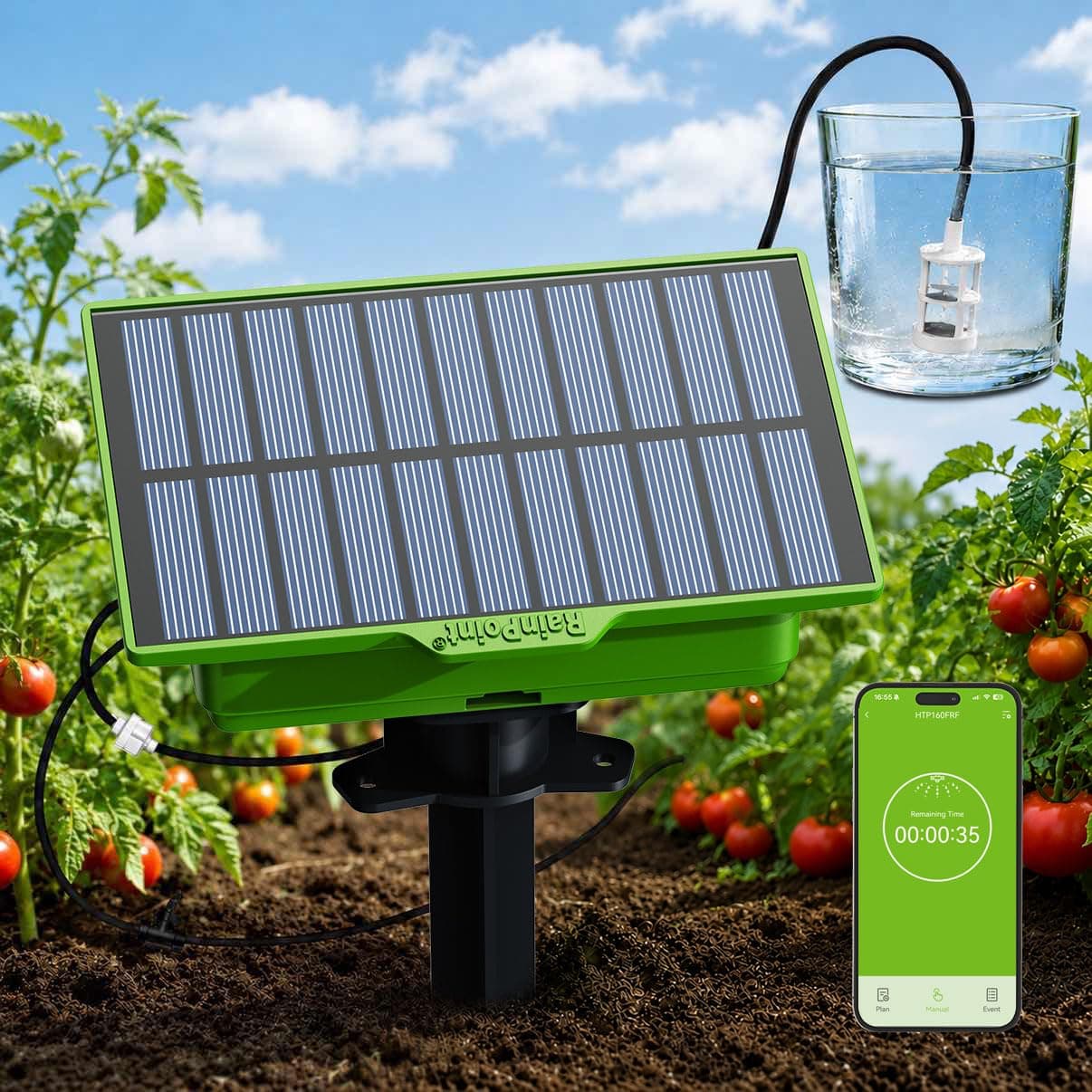
The RainPoint WiFi Solar Drip Irrigation System is a smart automatic watering kit designed for balconies, patios, backyards, and container gardens. It combines solar charging, WiFi connectivity, smartphone controls, automatic watering schedules, and a rechargeable battery into one compact system.
And here’s the interesting part.
It can keep watering your plants even when your WiFi goes down.
That’s exactly the kind of smart-home feature I want to see.
Because the whole point of automation is that it should keep working when you’re not paying attention.
Check the latest price on Amazon:
https://link.amazon/B0e8EfBmV
As an Amazon Associate, we may earn from qualifying purchases.
A Smart Watering System That Doesn’t Need a Tap
Let’s start with the basics.
Most traditional garden irrigation systems connect directly to a water tap.
That’s great if you’ve got an outdoor faucet nearby.
But what if you live in an apartment?
What if your balcony doesn’t have a water connection?
What if you’ve got a collection of potted plants on a patio?
That’s where the RainPoint system becomes interesting.
It’s a tap-free irrigation system that uses a small pump to draw water from a separate reservoir and distribute it through drip irrigation tubing.
You provide the water container.
The system handles the pumping and scheduling.
No permanent plumbing connection required.
For apartment dwellers and balcony gardeners, that’s a pretty big deal.
Solar Power Is a Perfect Fit
The RainPoint system uses solar charging with a built-in rechargeable battery.
And honestly, this is one of those applications where solar power makes complete sense.
A plant watering system doesn’t need to operate continuously.
It only needs to run its pump for a few minutes at scheduled intervals.
So instead of connecting it permanently to a wall outlet, you can use sunlight to keep the battery charged.
Mount it somewhere with good solar exposure.
Set your watering schedule.
And let the system do its thing.
The manufacturer also supports USB-C charging, which gives you another way to recharge the system when sunlight isn’t sufficient.
That’s a smart combination.
Solar when it’s available.
USB-C when you need it.
Up to 60 Days on Battery Power?
Here’s a particularly interesting specification.
RainPoint claims that the system can operate for up to 60 days on a full battery charge, based on one five-minute watering cycle per day.
That’s impressive for a small automatic irrigation system.
But there’s an important distinction.
This is a manufacturer-provided estimate under a specific operating pattern.
Actual battery life will depend on factors such as watering frequency, pump workload, battery condition, and environmental conditions.
If you’re watering several times per day, you shouldn’t automatically expect the same 60-day runtime.
Still, the claimed endurance suggests the system is designed around relatively low power consumption.
And with solar charging available, you may not need to rely exclusively on the battery.
WiFi Control Is Actually Useful Here
The system connects to the RainPoint Home app through the included Mini Hub Gen 2.
And unlike some smart gadgets where the app feels completely unnecessary, remote access is genuinely useful for plant watering.
Imagine you’re traveling.
You’re hundreds of miles away from home.
And suddenly you remember that your balcony plants might need more water because the weather has been unusually hot.
Instead of calling someone to visit your house, you can open the app and adjust the watering schedule.
You can also check watering activity and receive supported system alerts.
That’s the kind of convenience that makes smart-home technology worthwhile.
It Keeps Working Without WiFi
This might be my favorite feature.
RainPoint stores your watering schedule locally.
That means the system can continue following its preset watering schedule even when the WiFi connection is interrupted.
Your router restarts?
The watering schedule keeps running.
Your internet goes down?
The system doesn’t suddenly forget how to water your plants.
That’s important because an irrigation system should never depend entirely on having a perfect internet connection.
The internet should provide convenience.
It shouldn’t be a single point of failure for the basic watering schedule.
Of course, remote app access and notifications may be unavailable while the system is offline, and the pump still needs power and water.
But the local scheduling approach is exactly the right design philosophy.
The RainPoint Home App Does More Than Scheduling
The app includes several features designed to make plant care easier.
You can monitor watering activity logs, adjust schedules, receive low-water and low-battery alerts, and share access with family members or friends.
That last feature is particularly useful.
Maybe you’re away on vacation and want someone else to check the system.
Instead of explaining a complicated series of buttons, you can share access to the compatible smart setup.
The activity logs are useful too.
You can review whether watering cycles have occurred rather than simply assuming everything worked.
For a device responsible for keeping living things alive, that extra visibility matters.
You Can Skip Watering When It Rains
Here’s a feature I really like.
The app supports a watering delay of one to three days.
Imagine you’ve programmed your outdoor plants to receive water every morning.
Then it rains heavily.
You probably don’t want to add more water unnecessarily.
Instead of completely reprogramming the schedule, you can temporarily delay watering.
Once the delay period ends, normal scheduling can resume.
It’s a small feature.
But it makes the system feel much more practical.
Of course, this isn’t necessarily automatic weather detection. The supplied description indicates that you can set the delay through the app.
You still need to make the decision based on actual conditions.
Direct-to-Root Watering Makes Sense
The RainPoint kit uses drip irrigation.
Instead of spraying water over the entire plant, it delivers water through small emitters positioned near the soil.
That can have several advantages.
First, you’re putting water closer to where the plant needs it.
Second, you can reduce unnecessary water loss from spraying surrounding surfaces.
Third, you can avoid repeatedly wetting leaves, which may help reduce certain moisture-related plant problems.
And finally, it makes watering a collection of pots much cleaner.
No watering can.
No splashing everywhere.
No accidentally soaking the balcony floor.
Just controlled water delivery through small tubes.
It Comes Ready for 10 Plants
This is one specification worth reading carefully.
The product title mentions 10 to 15 plants.
But the standard package includes enough drip emitters and fittings for 10 plants.
If you want to expand the system to 15 plants, RainPoint says you’ll need an additional accessory kit, sold separately.
That’s important.
You don’t want to order the system expecting to water 15 pots immediately and discover that you only have 10 emitters in the box.
For a small balcony garden, 10 plants may already be plenty.
But if you’ve got a larger collection, factor the expansion accessories into your budget.
What’s Included in the Box?
RainPoint includes the core equipment needed to create a small drip irrigation network.
The package contains:
- 1 WiFi solar automatic plant waterer
- 1 Mini Hub Gen 2
- 1 main-line tubing section, 1/6-inch
- 1 branch-line tubing section, 1/8-inch
- 10 T-barb fittings
- 10 drip emitters
- 1 T-cross barb fitting
- 1 anti-siphon valve
- 1 filter
- 3 tubing end plugs
That’s a reasonably complete starting package.
You still need to provide a suitable water reservoir and arrange the tubing around your plants.
But the major irrigation components are included.
The Anti-Siphon Valve Is a Nice Detail
One component that might go unnoticed is the anti-siphon valve.
In a water delivery system, siphoning can sometimes cause unwanted water movement even after a pump stops.
An appropriately installed anti-siphon valve helps prevent that behavior.
That’s useful because you don’t want the watering system to continue draining your reservoir unintentionally after the scheduled cycle has ended.
It’s a small piece of hardware.
But it can make a meaningful difference to how reliably the system operates.
Follow the manufacturer’s installation instructions because valve placement matters.
The Filter Matters Too
The kit also includes a filter.
And that’s important for any irrigation system drawing water from a container.
Dust, debris, and sediment can eventually enter the reservoir.
Without filtration, that material could reach the pump or narrow drip emitters.
And a blocked emitter can create a frustrating problem.
Nine plants get watered.
One doesn’t.
Everything looks normal until that one plant starts looking unhealthy.
So keeping the reservoir clean and periodically inspecting the filter and emitters is part of maintaining the system.
Automation doesn’t eliminate maintenance.
It just reduces the amount of repetitive work.
It Works Indoors and Outdoors
Another interesting feature is the flexibility of the charging system.
RainPoint says the unit can receive solar charging outdoors, near sunny windows, or under sufficiently intense grow lights.
That makes it useful for more than just outdoor gardens.
You could potentially use it for indoor herbs.
Houseplants.
A small greenhouse.
A collection of plants near a bright window.
Or a balcony garden.
If there’s insufficient light for solar charging, USB-C provides an alternative.
That’s especially useful during winter or prolonged cloudy weather.
What About Different Plant Types?
Here’s something important.
Not every plant needs the same watering schedule.
A basil plant sitting in direct sunlight might need much more frequent watering than a succulent in a shaded corner.
A large container retains water differently from a tiny pot.
Soil composition matters.
Humidity matters.
Temperature matters.
And drainage matters.
The RainPoint system gives you control over watering schedules, but you still need to understand what your plants actually require.
Also, when multiple plants share one irrigation circuit, their water delivery may be linked.
The app doesn’t necessarily provide independent watering schedules for every single emitter.
If you’ve got plants with dramatically different watering needs, you may need to adjust emitter placement, flow characteristics, or group plants with similar requirements.
This Could Be a Great Vacation Gadget
Let’s say you’re leaving home for two weeks.
You’ve got ten plants on the balcony.
Normally, you’d have three options.
Ask someone to water them.
Move them somewhere shaded and hope for the best.
Or accept that a few plants might not survive.
With a properly configured automatic irrigation system, there’s a fourth option.
Fill a sufficiently large reservoir.
Check the battery and solar exposure.
Test the tubing.
Program the watering schedule.
And let the system handle routine watering while you’re away.
The app adds another layer of reassurance because you can review activity and receive supported alerts remotely when the network is connected.
Just remember that remote monitoring doesn’t refill an empty reservoir.
And a low-water alert only helps if someone can actually respond.
So reservoir capacity still matters.
The Smart Ecosystem Could Be Interesting
RainPoint also mentions compatibility with other smart plant-care devices, including certain soil moisture meters.
That’s an interesting direction.
Because scheduled watering is useful.
But watering based on actual soil conditions could be even better.
Instead of simply watering every two days, a more advanced setup could potentially incorporate moisture information into plant-care decisions.
However, I’d verify the specific integration and automation features before assuming that adding a soil sensor automatically creates a fully moisture-responsive watering system.
Compatibility doesn’t always mean every device can control every function.
Still, having an expandable ecosystem is a nice advantage.
What I Like
The standout feature is the combination of solar power, USB-C backup charging, WiFi app control, and offline scheduling.
That’s a thoughtful design.
You get the convenience of remote monitoring without making the basic watering schedule completely dependent on the internet.
The claimed 60-day battery endurance is interesting too, although actual performance will depend on usage.
I also like the low-water and low-battery alerts, activity logs, temporary watering delays, and family access sharing.
And the fact that it’s tap-free makes it especially attractive for apartment balconies and container gardens.
What You Should Know Before Buying
There are a few things worth considering.
First, the standard package supports 10 watering points, not 15. Expanding to 15 requires additional accessories.
Second, the up to 60 days of battery life is based on a specific manufacturer-defined watering pattern. Your results may vary.
Third, you’ll need a suitable water reservoir, and its capacity determines how long the system can water your plants unattended.
Fourth, you’ll need to test the watering distribution and schedule. Different plants may require different amounts of water.
Fifth, remote app features depend on the relevant WiFi and hub connectivity, even though the preset watering schedule can continue locally.
And finally, drip emitters, tubing, filters, and reservoirs still need occasional maintenance.
Who Is This For?
The RainPoint WiFi Solar Drip Irrigation System makes the most sense for someone who enjoys plants but doesn’t want watering to become a daily chore.
Maybe you’ve got a balcony garden.
A collection of herbs.
Some vegetables in containers.
A small greenhouse.
Or ten houseplants that somehow require more attention than your actual pets.
It’s also especially appealing if you travel frequently.
The ability to monitor watering remotely, adjust schedules, and receive alerts could provide useful peace of mind while you’re away.
And if you enjoy smart-home gadgets, this is one of those devices where connectivity genuinely improves the experience.
The Bottom Line
The RainPoint WiFi Solar Drip Irrigation System is a pretty compelling example of smart-home technology solving a real problem.
It doesn’t try to reinvent gardening.
It just automates one of the most repetitive parts.
You get solar charging, USB-C backup power, WiFi app control, locally stored watering schedules, activity logs, low-water and battery alerts, temporary watering delays, and drip irrigation for 10 plants out of the box.
You can expand to 15 plants with additional accessories.
And the manufacturer claims up to 60 days of operation on a full battery charge under its specified usage conditions.
But my favorite part is still the offline functionality.
Because a smart watering system should be smart enough to keep watering when your router decides to take the day off.
That’s good automation.
You set it up.
You test it.
You fill the reservoir.
And then you get to spend more time enjoying your plants instead of constantly remembering to water them.
Sometimes the best smart-home gadgets aren’t the ones that do something futuristic.
They’re the ones that quietly handle something boring.
And keep doing it.
Check the RainPoint WiFi Solar Drip Irrigation System on Amazon:
https://link.amazon/B0e8EfBmV