
Solar Predator Eye Lights Review: A Simple, Solar-Powered Way to Keep Wildlife Away
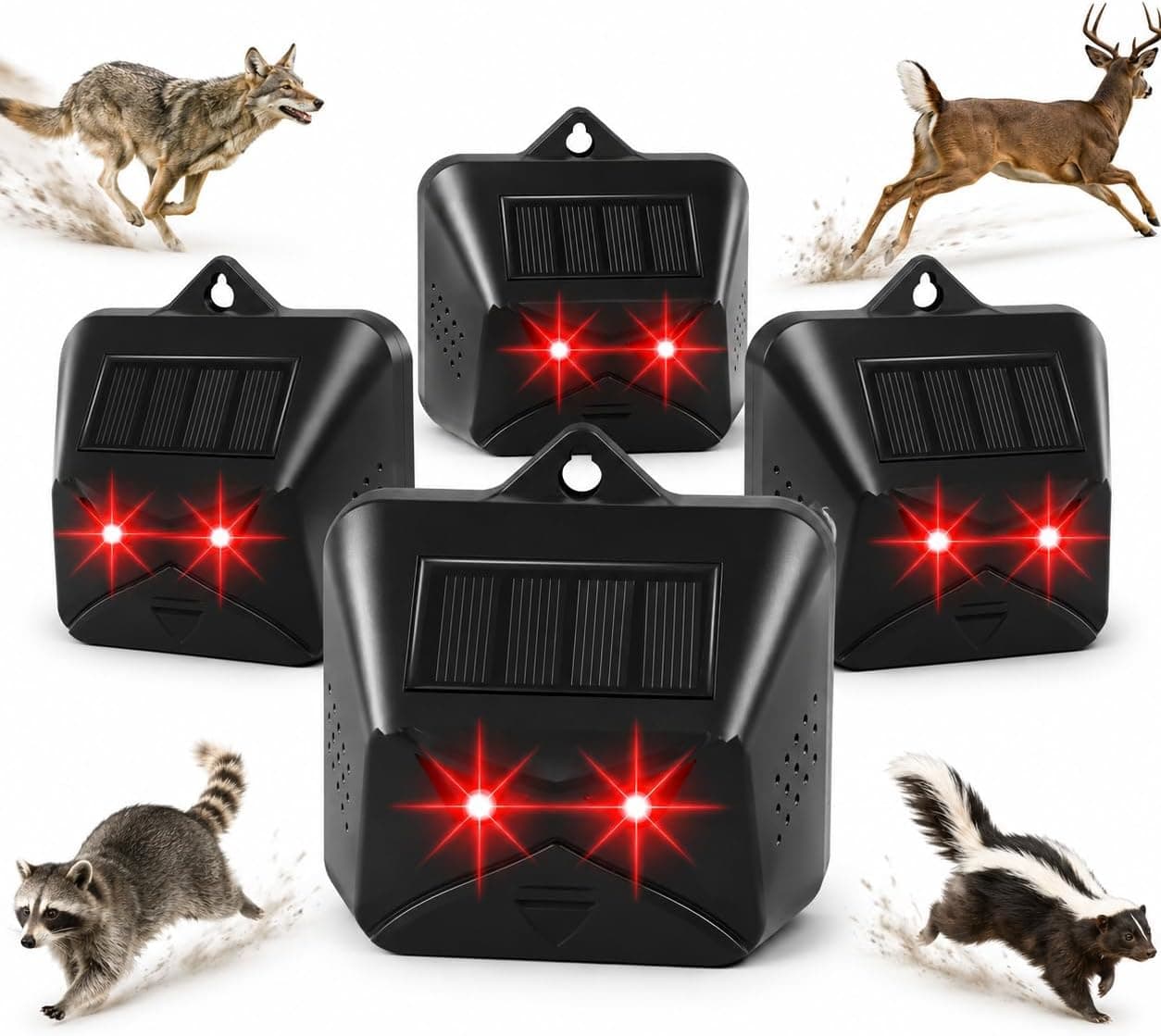
If you’ve ever woken up to find your garden destroyed by deer, your trash scattered by raccoons, or your chicken coop visited by a fox, you know how frustrating unwanted wildlife can be.
There are plenty of ways to deal with these nighttime visitors, from expensive fencing systems to motion-activated sprinklers. But what if you could discourage animals using nothing more than a pair of flashing red LEDs?
That’s the idea behind the Solar Predator Eye Lights, a 4-pack of solar-powered animal deterrents designed to help keep coyotes, deer, foxes, raccoons, and other nocturnal animals away from your property.
It’s a surprisingly simple concept. No complicated electronics, no smartphone app, and no monthly subscription. Just solar power, flashing lights, and a little animal psychology.
But does it actually make sense?
Let’s take a closer look.
Check the Solar Predator Eye Lights on Amazon
A Simple Idea That Mimics Predator Eyes
The technology behind these solar predator lights is pretty straightforward.
Each unit features two red LED lights that flash at a frequency of 4Hz, meaning four flashes per second. The idea is to create the appearance of predator eyes watching from the darkness.
For animals that naturally avoid predators, an unfamiliar pair of flashing red lights may be enough to make them hesitate or choose another route.
Think of it as a visual warning system rather than a physical barrier.
Unlike ultrasonic animal repellents, which emit high-frequency sounds, these lights rely entirely on visual stimulation. That means no annoying noises, no chemicals, and no traps.
Of course, there’s an important distinction here. These lights are designed to discourage wildlife, not guarantee that animals will stay away.
Some animals may respond to the flashing lights, while others might eventually become accustomed to them. Effectiveness can depend on the species, environment, and placement.
Still, as a low-maintenance first line of defense, the concept is interesting.
Four Lights, Four Different Areas of Protection
One of the biggest advantages of this particular package is that you get four separate predator eye lights.
And that’s actually useful because wildlife rarely approaches a property from just one direction.
You could install one near your vegetable garden, another beside your chicken coop, a third along your backyard fence, and the fourth near your trash storage area.
Each light can face a different approach route, helping you cover multiple vulnerable locations without needing a single large deterrent system.
For homeowners with larger gardens, small farms, or backyard poultry setups, this flexibility is a practical benefit.
Rather than relying on one device to protect an entire property, you can create several targeted deterrent points.
Solar Powered, So There’s Almost Nothing to Maintain
Here’s where the product becomes particularly appealing.
Each predator eye light includes a built-in rechargeable battery and solar panel.
During the day, the solar panel collects energy from sunlight. Once darkness falls, the lights automatically activate, provided the unit has been switched on.
That means you don’t need to run electrical cables across your garden, replace disposable batteries regularly, or remember to switch the lights on every evening.
It’s essentially a set-it-and-forget-it setup.
There is one catch, though.
Solar-powered devices depend heavily on sunlight. If you install these lights underneath thick tree branches or in permanently shaded areas, charging performance may suffer.
For the best results, position the solar panel where it receives ample direct sunlight and occasionally clean away dirt or debris.
It’s not completely maintenance-free, but it’s pretty close.
Built for Outdoor Installation
Since these lights are intended for gardens, farms, and backyard fences, outdoor durability matters.
The units come with an IP44 rating, which means they offer protection against small solid objects and splashing water.
In practical terms, they are designed to handle ordinary outdoor conditions, including rain splashes.
However, IP44 does not mean waterproof under every circumstance. You shouldn’t submerge them or assume they can withstand high-pressure water jets.
Installation is also straightforward.
Each light has a built-in hanging hole, allowing you to mount it on fences, wooden posts, trees, or exterior walls.
There’s no complicated mounting mechanism to figure out.
The more important consideration is positioning.
For example, if you’re trying to discourage raccoons approaching a chicken coop, the LEDs should face the route those animals typically use. If deer are entering your garden through a particular opening, aim the lights toward that entry point.
The goal is to make the flashing lights visible before the animal reaches the area you’re protecting.
A More Humane Approach to Wildlife Deterrence
One thing I appreciate about the concept is that it doesn’t involve harming animals.
Traditional wildlife control methods sometimes rely on traps, chemical repellents, or physical exclusion systems.
These solar predator lights take a different approach by attempting to influence animal behavior through visual cues.
There are no ultrasonic emissions, no chemical sprays, and no direct physical contact with wildlife.
For people who simply want animals to stay away from their gardens without injuring them, that’s an attractive proposition.
But it’s worth emphasizing that visual deterrents work best as part of a broader wildlife management strategy.
If you’re protecting chickens, for example, secure fencing and properly locked enclosures remain essential. These flashing lights shouldn’t be your only defense against predators.
Similarly, keeping trash containers closed and removing accessible food sources can make your property less attractive to raccoons and other wildlife.
Think of the lights as an additional layer of protection rather than a replacement for proper prevention.
What I Like and What Could Be Better
Here’s how the product stacks up based on its advertised features.
| What I Like | What to Consider |
|---|---|
| Solar charging eliminates regular battery replacement | Needs sufficient sunlight |
| Automatic nighttime activation | Effectiveness varies by animal |
| Four units cover multiple entry points | Animals may become accustomed to the lights |
| No chemicals, traps, or ultrasonic noise | Does not physically prevent entry |
| Simple installation on fences or posts | IP44 is splash-resistant, not fully waterproof |
| Minimal daily maintenance | No guaranteed protection against predators |
The biggest strength here is simplicity.
You’re not paying for unnecessary smart features, connectivity, or complicated automation.
The product focuses on one job: making certain outdoor areas appear less inviting to nighttime wildlife.
The biggest uncertainty is effectiveness. Without controlled testing or reliable field results for this particular model, it’s difficult to predict how well it will work against different animals.
Who Should Buy These Solar Predator Eye Lights?
I can see these lights being particularly useful for homeowners with recurring wildlife visitors, gardeners dealing with deer, and backyard chicken owners looking for an additional deterrent.
They’re also worth considering for small farms or rural properties where running electrical wiring to multiple locations would be inconvenient.
On the other hand, if you’re dealing with aggressive predators or animals that have already established a reliable food source on your property, flashing LEDs alone probably won’t solve the problem.
In those situations, physical barriers and eliminating food attractants should take priority.
Final Verdict: Simple Technology, Practical Potential
Not every useful outdoor gadget needs to be complicated.
Sometimes, the most interesting products are the ones that solve a specific problem using the simplest possible technology.
The Solar Predator Eye Lights take that approach with two flashing red LEDs, a rechargeable battery, and a small solar panel.
You get four units, automatic nighttime operation, and the flexibility to install them around gardens, fences, chicken coops, or farm boundaries.
There’s no guarantee that every deer, fox, raccoon, or coyote will be frightened away. Animal behavior is unpredictable, and visual deterrents have their limitations.
But if you’re looking for an inexpensive-to-operate, non-contact addition to your wildlife prevention setup, these solar predator lights are worth considering.
The bottom line: They’re simple, solar-powered, and easy to deploy. Just keep your expectations realistic and use them alongside more reliable physical protection where necessary.