
Tandefio Turbine Roof Vent Review: Cooling Your Roof With Zero Electricity
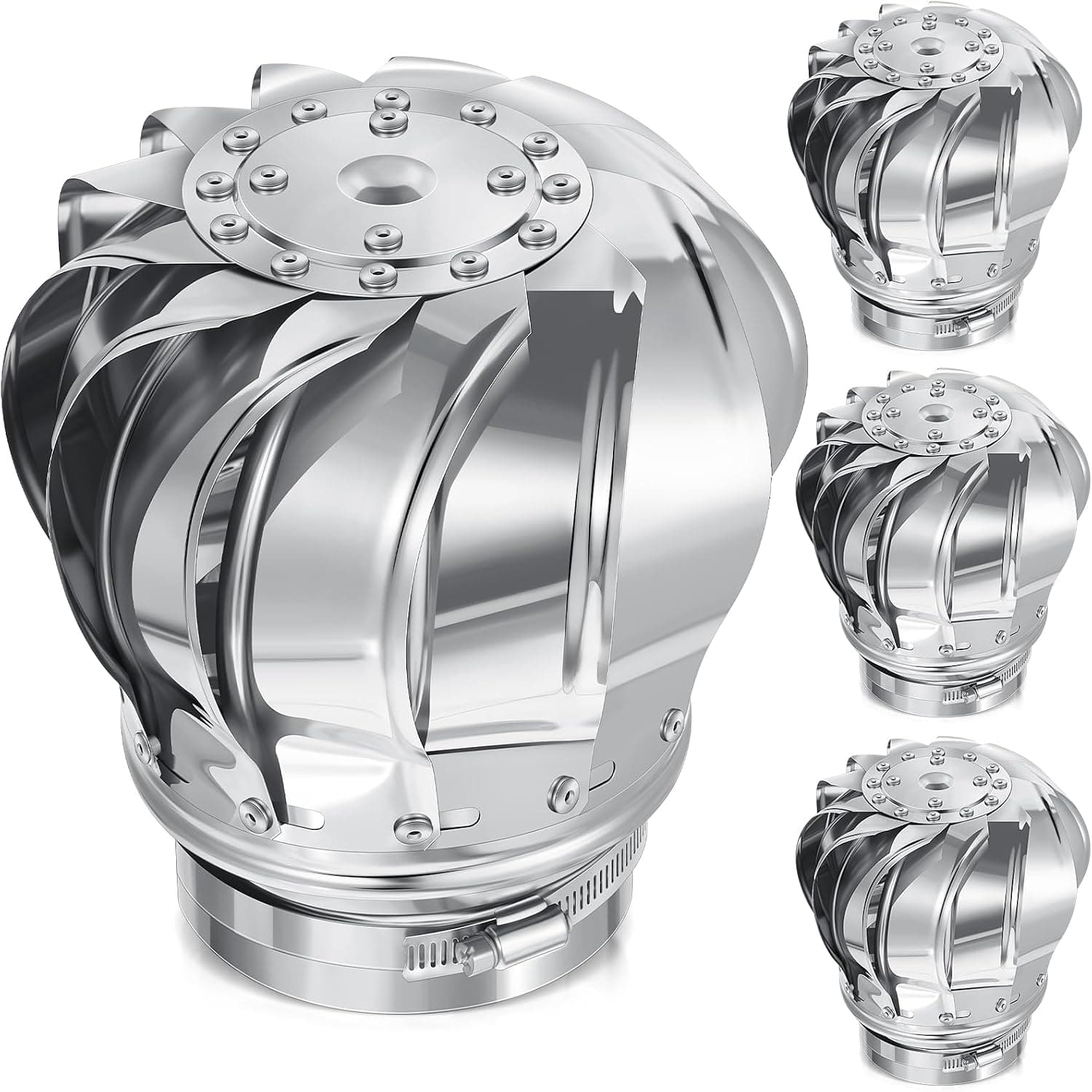
Not every wind turbine generates electricity.
Some of them just move air.
And honestly, that’s a pretty clever use of wind too.
The Tandefio Turbine Roof Vent is a completely passive ventilation system that sits on top of a roof and uses wind to help pull warm, stale air out of the space below.
No motor.
No wiring.
No solar panel.
No battery.
No electricity bill.
You get four turbine ventilators in the package, each built from 201 stainless steel with a roughly 4.33-inch connection tube and 7.48-inch turbine.
It’s basically a mechanical ventilation system powered by whatever the weather is already giving you.
Check the latest price on Amazon:
https://link.amazon/B0gQiyQOS
As an Amazon Associate, we may earn from qualifying purchases.
First, This Isn’t an Electricity-Generating Wind Turbine
When you see the words “wind turbine,” you probably imagine a giant three-bladed machine generating renewable electricity.
That’s not what’s happening here.
This is a wind-driven roof ventilator.
Wind causes the turbine at the top to rotate. That rotation helps create airflow through the vent, allowing warm or stale air from inside the structure to escape.
So instead of converting wind into electricity, you’re using wind mechanically.
That’s actually more efficient for this particular job because there’s no reason to go through multiple energy conversions.
You don’t need to turn wind into electricity and then electricity into mechanical ventilation.
Wind comes in.
Turbine spins.
Air moves.
Simple.
Why Ventilate a Roof in the First Place?
Heat rises.
That’s basic physics, but it becomes particularly relevant inside an attic, workshop, factory, or other enclosed space beneath a roof.
During the day, sunlight heats the roof surface.
That heat can transfer into the space underneath, where warm air accumulates.
Without adequate ventilation, that space can become extremely hot.
A roof ventilator provides another route for warm air to escape.
And as air exits, replacement air can enter through appropriately designed intake vents elsewhere in the building.
The result is continuous air exchange without requiring a powered exhaust fan.
The Turbine Does the Work
The most visually interesting part is obviously the spinning turbine.
As wind moves across the ventilator, it causes the curved turbine vanes to rotate.
That rotation helps promote airflow through the vent below.
And the clever part is that the energy required to do this comes directly from the wind.
There’s no electric motor inside trying to spin the turbine.
The turbine is being driven by the environment.
It’s almost the opposite of a wind generator.
A wind generator captures rotation and converts it into electricity.
This takes wind energy and uses the rotation directly to assist ventilation.
No intermediate step required.
It Can Also Benefit From Natural Convection
Wind isn’t the only thing helping roof ventilation.
There’s also natural convection.
Hot air is less dense than cooler air, so warmer air tends to rise.
If you’ve got hot air accumulating beneath a roof and an appropriately positioned opening above it, that temperature difference can contribute to natural airflow.
The turbine vent complements that process.
So you potentially have two mechanisms working together.
Warm air naturally wants to move upward.
Wind helps drive the ventilator.
It’s a remarkably simple system.
And It Uses Zero Electricity
This is probably the biggest selling point.
The Tandefio vent requires no electrical connection for operation.
That means no wiring.
No motor.
No power adapter.
No battery.
No charge controller.
No inverter.
And no ongoing electricity consumption from the ventilator itself.
Once properly installed, the basic operating principle is entirely mechanical.
That’s particularly interesting for buildings where ventilation is desirable but installing or continuously operating electric exhaust fans isn’t practical.
You Get Four of Them
This particular package contains four turbine roof ventilators.
That’s important because ventilation isn’t necessarily about putting one turbine somewhere on a giant roof and expecting it to solve everything.
Multiple vents can potentially be distributed across an appropriate roof area as part of a broader ventilation design.
The four-pack also makes more sense for workshops, agricultural structures, production spaces, or other buildings where several ventilation points may be useful.
Of course, more vents don’t automatically mean better ventilation.
The overall system still needs to be designed properly.
Exhaust is only one half of airflow.
You also need somewhere for replacement air to enter.
They’re Relatively Compact
Each unit has a connection tube diameter of approximately 4.33 inches, or 11cm, while the turbine itself measures approximately 7.48 inches, or 19cm, in diameter.
So these aren’t the giant commercial turbine vents you might see spinning on top of warehouses.
They’re relatively compact.
That makes them better suited to smaller ventilation openings and light-duty applications.
The manufacturer mentions residential roofs as well as factories, farms, workshops, kitchens, and other spaces.
The important thing is matching the ventilation capacity and dimensions to your actual application rather than assuming four small turbines can ventilate any size building.
201 Stainless Steel Construction
The vents are made from 201 stainless steel.
That’s a sensible material choice for something that’s going to spend its entire life outside.
You’ve got sunlight.
Rain.
Humidity.
Temperature changes.
Wind.
Dust.
And whatever else the environment throws at your roof.
Stainless steel offers corrosion resistance and structural durability, although it’s worth understanding that not all stainless steel grades have identical corrosion resistance.
201 stainless is generally more economical than grades such as 304 or 316.
For particularly harsh or highly corrosive environments, material grade is something worth considering before installation.
But compared with a basic untreated steel construction, stainless steel makes a lot of sense here.
The Lack of a Motor Has Another Advantage
No electric motor also means one less mechanical and electrical component that can fail.
A powered ventilation fan has bearings, a motor, electrical wiring, controls, and potentially sensors.
A passive turbine ventilator is dramatically simpler.
The wind spins the turbine.
That’s basically the system.
There are still moving components, so this isn’t maintenance-free forever. Bearings and rotating parts can eventually wear.
But from a complexity standpoint, it’s hard to get much simpler.
And simple systems can be remarkably durable when they’re designed properly.
Quiet Operation Matters
The manufacturer also emphasizes low-noise operation.
That’s important because a turbine ventilator is essentially a rotating object permanently installed on your roof.
You definitely don’t want to hear it spinning every time the wind picks up.
This becomes especially important for residential installations, workshops where people spend long periods, and other occupied buildings.
Proper installation also matters here.
A poorly installed or damaged rotating component can potentially produce vibration or noise regardless of how quiet the product is supposed to be.
This Makes a Lot of Sense for Workshops
One use case that immediately stands out is a workshop.
Workshops can get hot.
Especially buildings with metal roofs exposed to direct sunlight.
You may have equipment generating additional heat inside, and depending on the work being done, stale air can accumulate as well.
Adding passive roof ventilation provides a way for warm air to escape without continuously running another electrical appliance.
The same basic logic applies to sheds, agricultural structures, garages, and certain light commercial spaces.
It’s not air conditioning.
That’s important.
But ventilation and air conditioning aren’t the same thing.
Ventilation Doesn’t Mean Cooling to Outdoor Temperature
This is worth emphasizing.
A turbine roof vent doesn’t create cold air.
There’s no refrigeration cycle.
No compressor.
No evaporator.
It simply helps exchange air.
If your attic is dramatically hotter than the outdoor temperature because heat is trapped inside, improved ventilation may help reduce that heat buildup.
But if it’s 35°C outside, a passive roof turbine isn’t magically going to turn your attic into a 22°C room.
Physics still wins.
Think of this as heat and airflow management rather than air conditioning.
The Intake Side Matters Too
Here’s something that’s easy to overlook.
You can’t continuously remove air from an enclosed space without replacement air entering somewhere else.
A good roof ventilation system therefore isn’t just about exhaust vents.
It’s about airflow.
Ideally, cooler outside air enters through appropriately positioned intake vents while warmer air exits higher up through the roof ventilation system.
If the building is sealed extremely tightly with insufficient intake ventilation, simply adding more exhaust vents may not deliver the result you expect.
So I’d think about the Tandefio vents as one component of the overall ventilation design rather than the entire system.
Installation Is the Part I’d Take Seriously
Putting something through a roof is different from mounting a gadget on a wall.
Because roofs have one extremely important job.
Keeping water outside.
The vent needs to be properly integrated with the roof so rainwater doesn’t enter around the opening.
The correct installation method will depend on the roof material and structure.
Metal roofing, tiles, shingles, and other roofing systems can require different flashing and waterproofing approaches.
If you’re not familiar with roof penetrations, professional installation is worth considering.
Saving some money on installation stops being useful very quickly if your roof starts leaking.
What I Like
The best thing about the Tandefio turbine vent is how little technology it needs.
There is no electricity.
No app.
No controller.
No battery.
No solar panel.
No smart-home integration.
It’s just aerodynamics and mechanical engineering.
Wind turns the turbine.
Warm air escapes.
And because the package contains four ventilators, you’ve got flexibility when designing ventilation across a suitable roof area.
The stainless steel construction also makes sense for something permanently exposed to outdoor conditions.
What You Should Know Before Buying
First, these are relatively compact turbine vents, with approximately 4.33-inch connection tubes and 7.48-inch turbine diameters. Make sure that size is appropriate for the ventilation requirements of your building.
Second, passive ventilation performance depends on environmental conditions and the overall building design.
Third, exhaust ventilation works best as part of a properly designed airflow system with adequate intake ventilation.
Fourth, 201 stainless steel offers corrosion resistance, but it isn’t the same material as higher-grade 304 or marine-oriented 316 stainless.
And finally, roof installation needs to be properly waterproofed.
The vent itself being made from stainless steel doesn’t help much if water gets through the hole around it.
Who Is This For?
These vents make the most sense for someone looking for simple, electricity-free ventilation.
Maybe you’ve got a hot attic.
A workshop.
A farm building.
A production area.
A shed.
A kitchen or utility space where this type of installation is appropriate.
Or another structure where warm air accumulates near the roof.
If you need precise airflow regardless of weather conditions, a powered ventilation system may be more appropriate.
But if you want something passive, mechanically simple, and capable of operating without consuming electricity, turbine ventilation remains an interesting solution.
The Bottom Line
The Tandefio 4-Piece Turbine Roof Vent is basically wind power in its simplest form.
But instead of generating electricity, it uses the wind directly.
Each unit combines a roughly 7.48-inch turbine with a 4.33-inch connection tube, uses 201 stainless steel construction, requires no electrical power, and is designed to rotate quietly as wind drives airflow through the vent.
And you get four of them in the package.
It’s not going to replace air conditioning.
It’s not going to guarantee a specific indoor temperature.
And its effectiveness will depend heavily on installation, wind conditions, intake ventilation, and the building itself.
But that’s also what makes the concept so appealing.
No electricity.
No electronics.
Just moving air using energy that was already moving past your roof anyway.
Sometimes the smartest technology is barely technology at all.
Check the Tandefio 4-Piece Turbine Roof Vent on Amazon:
https://link.amazon/B0gQiyQOS