
TRJZWA Solar Drip Irrigation System Review: A Simple Way to Automate Watering Your Plants
Some of the best technology doesn’t need a screen.
It doesn’t need WiFi.
It doesn’t need artificial intelligence.
And it definitely doesn’t need another app on your phone.
Sometimes, all you need is a little solar panel, a timer, and a pump that remembers to water your plants.
That’s basically the idea behind the TRJZWA Solar Automatic Drip Irrigation System.
It’s a compact, solar-powered watering kit designed for indoor and outdoor gardens, balconies, patios, and other places without convenient access to electricity or a water tap.
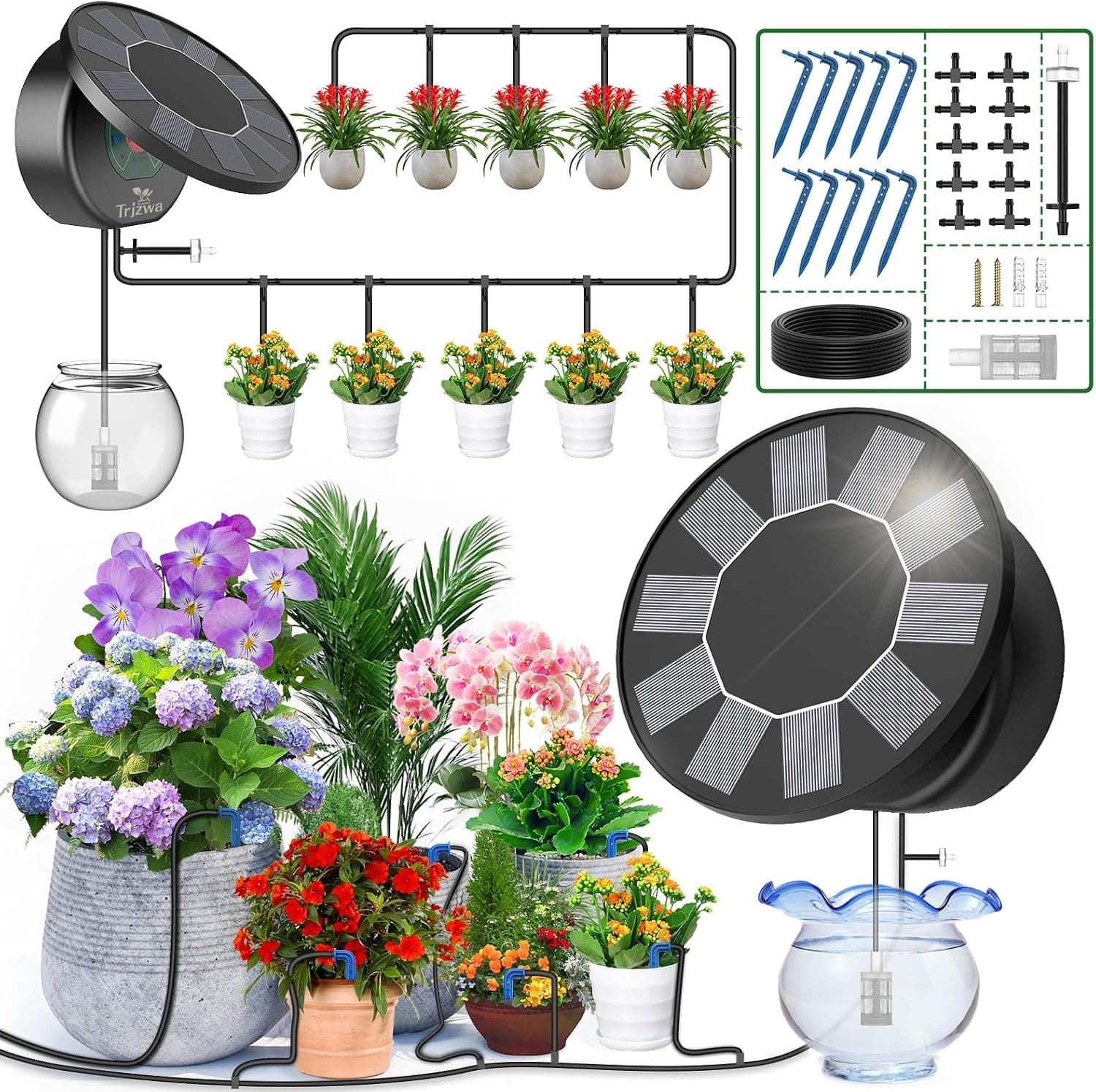
You get an integrated solar panel and timer controller, 9 advertised timing modes, 10 meters of tubing, 10 drip emitters, an anti-siphon valve, and a water filter.
And the whole thing is designed to run automatically.
No complicated smart-home setup.
No permanent plumbing.
Just sunlight, a water reservoir, and a schedule.
Honestly, that’s a pretty good combination.
Check the latest price on Amazon:
https://link.amazon/B01Vo0IJ8
As an Amazon Associate, we may earn from qualifying purchases.
A Solar-Powered Watering System That Makes Sense
Solar power is one of those technologies that works particularly well when the application matches the environment.
And gardening is a perfect example.
Plants are usually kept somewhere with sunlight.
Small irrigation pumps don’t necessarily need enormous amounts of electricity.
And watering only needs to happen periodically.
So instead of installing an electrical outlet on your balcony or running extension cables across your garden, you can use a small solar-powered system.
The TRJZWA kit combines the solar panel and timer controller into one integrated unit.
That keeps the design relatively simple.
The solar panel collects energy.
The controller manages the watering schedule.
And the pump delivers water through the irrigation tubing.
It’s a straightforward solution to a very common problem.
No Water Tap? No Problem
One of the biggest advantages of this system is that it doesn’t require a permanent water connection.
That’s particularly useful for apartment balconies.
Think about it.
You might have ten potted plants sitting outside your apartment.
There’s plenty of sunlight.
But no outdoor faucet.
And probably no convenient electrical outlet either.
A conventional irrigation system could require plumbing modifications.
This kit takes a different approach.
You provide a suitable water reservoir.
The system draws water from that container and distributes it to your plants.
That means you can potentially use it almost anywhere you can position the equipment safely.
Balconies.
Patios.
Small gardens.
Greenhouses.
Or indoor plant collections with a suitable charging location.
The Adjustable Solar Panel Is a Nice Touch
The solar panel can be adjusted to different angles.
And that’s more useful than it sounds.
Solar panels produce more energy when they’re positioned to receive adequate sunlight.
But the direction and angle of sunlight change depending on your location, season, and surroundings.
Maybe your balcony faces east.
Maybe you’ve got a wall blocking afternoon sunlight.
Maybe the panel needs to be angled slightly upward to avoid shadows.
Being able to adjust its position gives you more flexibility.
And for a small solar-powered irrigation system, getting enough sunlight can make the difference between reliable operation and frequent charging problems.
It’s Designed for Outdoor Conditions
The manufacturer advertises an IP65-rated, weather-resistant enclosure.
IP65 generally indicates protection against dust ingress and water jets under standardized test conditions.
That’s useful for equipment that may be exposed to rain, dust, and outdoor humidity.
But IP65 doesn’t mean the equipment can be submerged underwater.
It also doesn’t automatically mean every connection, tube, or accessory has the same protection rating.
So proper installation still matters.
Position the unit according to the manufacturer’s instructions.
Keep electrical connections protected.
And make sure the water reservoir doesn’t create unnecessary risks for the controller.
The Timer Is the Main Feature
Let’s talk about the part that actually makes this system automatic.
The timer.
The TRJZWA irrigation kit allows you to select different watering durations and intervals.
According to the listing, available watering durations include:
- 1 minute
- 5 minutes
- 10 minutes
- 15 minutes
And the watering intervals include:
- Every day
- Every 3 days
- Every 7 days
The product is marketed as offering 9 timing modes, although the four listed durations and three listed intervals suggest more possible combinations.
I’d verify the actual available combinations in the instruction manual before purchasing if a particular schedule is essential.
But the general concept is clear.
Choose how long the pump runs.
Choose how frequently it runs.
And let the system handle the rest.
Simple Scheduling Can Be Better Than Smart Scheduling
Here’s something I appreciate.
This isn’t trying to be an entire smart-home ecosystem.
You don’t need to pair it with your router.
You don’t need to create an account.
You don’t need to troubleshoot Bluetooth connections.
You don’t need to worry about whether a cloud service will still exist five years from now.
You just configure the timer.
And that’s it.
For something as straightforward as watering a few plants, simplicity can be a major advantage.
The system doesn’t need to know the weather forecast.
It doesn’t need machine learning.
It just needs to run the pump at the right time.
Of course, the trade-off is that you won’t get the remote monitoring, app notifications, or detailed activity logs offered by more sophisticated irrigation systems.
But not everyone needs those features.
Drip Irrigation Is More Efficient Than Random Watering
The system uses drip irrigation.
Instead of spraying water across a large area, it delivers water through small tubes and emitters positioned near the plants.
This can help reduce water waste.
The water is delivered closer to the root zone.
Less water lands on surrounding surfaces.
And the soil can absorb the water gradually.
The manufacturer claims the system can save up to 70% of water compared with traditional watering methods.
That’s a significant claim, and actual savings will depend on what watering method you’re comparing it with, soil conditions, emitter flow, and how well the system is configured.
Still, targeted irrigation can be an efficient way to water potted plants.
Especially when you’re trying to avoid runoff and unnecessary evaporation.
It Can Help Prevent Overwatering
Overwatering is one of the most common mistakes people make with houseplants.
And the problem isn’t always that someone pours an enormous amount of water into the pot.
Sometimes it’s simply watering too frequently.
The soil never gets a chance to dry appropriately.
Roots remain in overly wet conditions.
And the plant starts struggling.
A programmable drip irrigation system can help by making watering more consistent and controlled.
But there’s an important distinction.
Automatic watering doesn’t automatically prevent overwatering.
If you program the system to deliver too much water or water too frequently, it can still overwater your plants.
The advantage is control.
You can experiment with watering durations and intervals until you find something that works.
Different Plants Need Different Schedules
This is where a little gardening knowledge becomes important.
A basil plant growing in direct sunlight might need frequent watering.
A cactus probably doesn’t.
A tomato plant in a small container may dry out quickly during hot weather.
A large pot filled with moisture-retaining soil may stay wet for much longer.
So there’s no universal watering schedule that works for every plant.
The TRJZWA system gives you several scheduling options.
But you’ll still need to figure out what your plants actually need.
I’d start conservatively.
Run a short watering cycle.
Check the soil.
Observe how long it stays moist.
Then adjust.
The goal isn’t to deliver the maximum amount of water.
It’s to deliver the right amount.
Ten Drippers for Ten Plants
The kit includes 10 irrigation drippers.
That makes it suitable for a small collection of potted plants.
You could use one dripper per pot.
Or potentially arrange multiple drippers around a larger planter, depending on the available flow and your layout.
The package also includes 10 T-connectors, allowing you to split the tubing into branches.
That’s useful because your plants probably aren’t arranged in a perfect straight line.
Maybe you’ve got four pots on one shelf.
Three along the balcony railing.
And another three near the door.
The tubing and connectors allow you to create a custom layout.
Ten Meters of Tubing Is Plenty for a Small Garden
The kit includes 10 meters of water hose.
That’s approximately 32.8 feet.
For a compact balcony garden or collection of indoor plants, that provides a reasonable amount of flexibility.
You can route the tubing around pots, shelves, and planters.
But I’d recommend planning the layout before cutting anything.
Place the water reservoir.
Position the solar controller.
Figure out where each dripper needs to go.
Then measure and cut the tubing.
Because once you’ve cut a tube too short, you can’t exactly uncut it.
A little planning makes installation much easier.
The Anti-Siphon Valve Is Important
One of the included components is an anti-siphon valve.
And this is a feature that deserves more attention.
In some irrigation setups, water can continue flowing through tubing due to siphoning even after the pump has stopped.
That can result in unwanted water delivery or reservoir drainage.
An appropriately installed anti-siphon valve helps prevent this behavior.
For an automatic watering system, that’s important.
You want the pump to control when water moves.
You don’t want gravity quietly continuing the job after the timer switches off.
Follow the manufacturer’s instructions for positioning the valve because installation affects how well it works.
There’s Also a Water Filter
The kit includes a filter to help keep debris out of the irrigation system.
That’s a useful addition.
Especially if you’re using a water reservoir that may collect dust, sediment, or other small particles.
Narrow irrigation tubing and drip emitters can become blocked.
And a blocked dripper can be surprisingly difficult to notice.
The system might appear to be working normally.
Nine plants receive water.
One doesn’t.
So periodically checking the filter and drippers is important.
A clean water source can also help reduce maintenance.
Installation Should Be Beginner-Friendly
The manufacturer claims the system can be installed in approximately 10 minutes.
That sounds appealing.
The package includes the solar panel and timer controller, tubing, drippers, T-connectors, anti-siphon valve, filter, and mounting screws.
The general setup involves positioning the equipment, connecting the tubing, placing the drippers, preparing the water reservoir, and configuring the timer.
For a simple arrangement of a few pots, installation may be relatively quick.
A more complicated layout with ten plants spread across multiple shelves could take longer.
And that’s fine.
I’d rather spend an extra 20 minutes making sure the tubing is properly positioned than rush the installation and discover a leak later.
This Could Be Great for Vacations
Here’s probably the biggest reason to buy something like this.
You want to travel.
But you’ve got plants.
And plants are terrible at understanding vacation schedules.
You can’t explain that you’ll be back in ten days.
You can’t ask them to wait until next Tuesday.
They still need water.
With an automatic irrigation system, you can potentially prepare a large enough reservoir, configure the timer, and let the system handle routine watering while you’re away.
The manufacturer also says the rechargeable system can continue operating through cloudy periods after being fully charged.
That’s useful.
But I’d still test the entire setup before leaving.
Check the pump.
Check the tubing.
Check the water distribution.
Check the reservoir capacity.
And verify that the system can operate for the intended period without needing intervention.
The Reservoir Determines How Long You Can Leave
This is something people often overlook.
The system can be solar-powered.
The timer can be automatic.
But the water still has to come from somewhere.
If you’re using a small bucket, it may run empty relatively quickly.
If you’re using a larger suitable reservoir, the system can potentially operate longer.
The amount of water needed depends on the number of plants, watering duration, emitter flow, and watering frequency.
So before leaving for a vacation, measure how much water the system consumes during a normal cycle.
Then calculate how many cycles will occur while you’re away.
Add a safety margin.
Because a perfectly functioning irrigation system with an empty reservoir isn’t particularly useful.
Solar Power Doesn’t Mean Unlimited Watering
Another important consideration is the energy budget.
The solar panel charges the system.
The pump consumes energy.
If the pump runs frequently or for long periods, it will consume more electricity.
If the solar panel receives limited sunlight, charging performance may be reduced.
The manufacturer says the system can continue operating during cloudy days after being fully charged.
But the listing doesn’t provide enough information to calculate a guaranteed number of cloudy-day operating cycles.
So I’d avoid assuming it can run indefinitely without sufficient sunlight.
For outdoor use, good solar positioning is important.
For indoor use, verify that the unit receives adequate charging light and that the intended location is suitable.
What I Like
The biggest advantage is the simplicity.
You get solar-powered automatic watering, adjustable timing, 10 drip emitters, 10 meters of tubing, an anti-siphon valve, a filter, and an IP65-rated enclosure.
That’s a practical package for small gardens.
I also like the adjustable solar panel.
Being able to position it for better sunlight is useful.
And the fact that the system doesn’t require a water tap or fixed electrical connection makes it particularly appealing for balconies and patios.
Most importantly, it doesn’t overcomplicate things.
It’s a timer.
A pump.
A solar panel.
And some tubing.
Sometimes that’s all you need.
What You Should Know Before Buying
First, the kit includes 10 drippers, so plan your layout around the number of watering points available.
Second, the listing advertises nine timing modes, but the stated watering durations and intervals don’t clearly explain all available combinations. Check the manual if you need a specific schedule.
Third, the claimed water savings of up to 70% depend on the installation and comparison method.
Fourth, automatic watering still needs calibration. Incorrect timing can result in too much or too little water.
Fifth, solar performance depends on sunlight exposure, battery condition, and pump usage.
Sixth, the system requires a suitable water reservoir, and you’ll need to make sure it contains enough water for the intended operating period.
And finally, clean the filter and inspect the tubing and emitters periodically.
This is low-maintenance equipment.
Not zero-maintenance equipment.
Who Is This For?
The TRJZWA Solar Automatic Drip Irrigation System makes the most sense for someone with a small collection of potted plants who wants simple, automatic watering without complicated smart-home features.
Maybe you’ve got a balcony garden.
A few herbs outside the kitchen.
A patio filled with flowers.
A small greenhouse.
Or ten plants that somehow require more attention than you expected.
It’s also a useful option for people who travel regularly.
You can set up the system to handle routine watering while you’re away, provided the reservoir, solar charging, and watering schedule are properly prepared.
And because it doesn’t require permanent plumbing, it’s particularly interesting for renters and apartment dwellers.
The Bottom Line
The TRJZWA Solar Automatic Drip Irrigation System is a good example of technology doing something useful without making it unnecessarily complicated.
It takes a repetitive task and automates it.
You get an integrated solar panel and timer controller, adjustable watering schedules, 10 drip emitters, 10 meters of tubing, an anti-siphon valve, a water filter, and IP65-rated weather protection.
The system doesn’t require a fixed water tap or electrical outlet.
And once you’ve configured the watering schedule, it can handle routine irrigation automatically.
Of course, you still need to get the basics right.
The plants need an appropriate amount of water.
The reservoir needs to be large enough.
The solar panel needs sufficient sunlight.
And the tubing needs to be installed correctly.
But once everything is working, the experience should be pretty straightforward.
You set the schedule.
The sun provides the energy.
The pump delivers the water.
And your plants get watered without you having to remember.
No WiFi required.
No subscription.
No complicated setup.
Just a small solar-powered system doing exactly what it’s supposed to do.
And honestly, that’s my favorite kind of technology.
Check the TRJZWA Solar Automatic Drip Irrigation System on Amazon:
https://link.amazon/B01Vo0IJ8