
UsmooJoy Solar Security Alarm Light Review: A 129dB Siren That Barks Like a Dog?
Home security technology has become pretty sophisticated.
We’ve got AI-powered cameras.
Facial recognition.
Smart doorbells.
Cloud recording.
And security systems that can send notifications to your phone from halfway around the world.
But sometimes, the simplest approach is also the most interesting.
What if you just made a really loud noise whenever someone approached your property?
And what if that noise sounded like a barking dog?
Or even gunshots?
That’s basically the idea behind the UsmooJoy Solar Security Alarm Light.
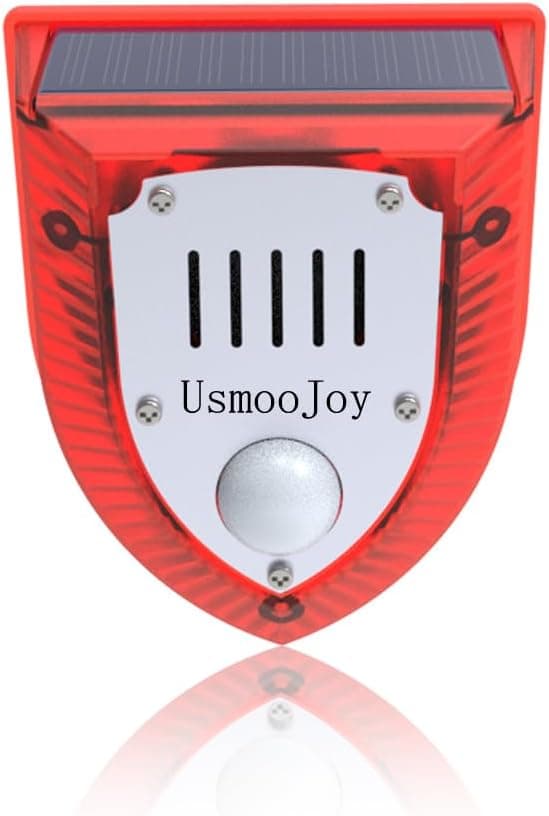
It’s a solar-powered outdoor motion alarm that combines a PIR motion sensor, six LED strobe lights, a manufacturer-claimed 129dB siren, and selectable dog-barking and gunshot sound effects.
It’s designed for farms, barns, gardens, garages, warehouses, and other outdoor areas where you want a visible and audible deterrent.
And because it’s solar-powered, you don’t necessarily need to run electrical cables across your property.
It’s a surprisingly straightforward approach to outdoor security.
Check the latest price on Amazon:
https://link.amazon/B01aYV8iu
As an Amazon Associate, we may earn from qualifying purchases.
This Isn’t a Security Camera
Let’s get something out of the way first.
The UsmooJoy Solar Security Alarm Light isn’t trying to compete with a Ring doorbell or a sophisticated CCTV system.
It doesn’t claim to record video.
It doesn’t identify faces.
It doesn’t send smartphone notifications.
And it doesn’t provide a live camera feed.
Instead, it focuses on something much simpler.
Detect movement and make a lot of noise.
When the motion sensor detects activity within its operating range, the device can activate an audible alarm and flashing lights.
The idea is to draw attention to movement around your property and potentially discourage unwanted visitors.
It’s a deterrent rather than a surveillance system.
And that distinction matters.
The 129dB Siren Is the Headline Feature
The manufacturer advertises an alarm output of 129 decibels.
That’s an extremely high sound level if achieved under the relevant measurement conditions.
For perspective, prolonged exposure to loud sounds can damage hearing, and very intense sounds can pose a risk even with brief exposure.
So this isn’t something you’d want activating right next to someone’s ears.
But there’s an important detail.
The product listing doesn’t specify the measurement distance or testing method used for the 129dB claim.
And those details matter.
Sound pressure levels decrease with distance, and the perceived loudness will also depend on the environment.
An alarm mounted on an open farm may sound very different from one installed in an enclosed garage.
So I’d treat 129dB as the manufacturer’s advertised maximum rather than an independently verified measurement.
Still, the product is clearly designed to be attention-grabbing.
It Can Bark Like a Dog
Here’s where things get interesting.
Instead of relying exclusively on a conventional siren, the UsmooJoy alarm includes dog-barking sound effects.
And the logic is pretty simple.
A barking dog can make someone think twice about entering a property.
Especially if they can’t immediately see where the sound is coming from.
The device attempts to create that impression electronically.
It’s not going to replace an actual guard dog.
And there’s no guarantee that someone will mistake the recording for a real animal.
But as an additional audible deterrent, it’s an unusual feature.
And for farms, barns, or storage areas where keeping a dog isn’t practical, I can see why someone might find it appealing.
And It Also Makes Gunshot Sounds
Yes, you read that correctly.
The alarm also includes simulated gunshot sound effects.
That’s definitely not something you see on most consumer security products.
The manufacturer presents these sounds as another way to discourage unwanted activity.
But this is also the feature I’d approach most carefully.
Simulated gunfire can frighten neighbors, visitors, animals, or passersby.
In some situations, it could cause unnecessary panic or prompt someone to believe an actual firearm has been discharged.
Local noise regulations and rules about alarm devices may also apply.
For residential neighborhoods or shared spaces, I’d strongly consider whether the conventional alarm or barking sound is more appropriate.
The most aggressive sound effect isn’t necessarily the best one.
A security device should improve safety without creating avoidable confusion.
The PIR Motion Sensor Covers 125 Degrees
The UsmooJoy alarm uses a passive infrared motion sensor, commonly called a PIR sensor.
PIR sensors detect changes in infrared radiation within their field of view.
In practical terms, they’re commonly used to detect the movement of people or animals.
The manufacturer advertises a 125-degree detection angle.
That’s a relatively wide field of view for monitoring an entrance, path, or open area.
For example, you could mount the alarm overlooking a barn entrance.
Or position it near a gate.
Or use it to monitor movement around an outdoor storage area.
The wider detection angle helps cover more of the surrounding space.
But placement is still important.
Detection Range of 5 to 8 Meters
According to the manufacturer, the PIR sensor can detect movement at approximately 5 to 8 meters.
That’s roughly 16 to 26 feet.
So this isn’t a long-distance perimeter detection system.
It’s designed to react when something enters a relatively nearby area.
And that’s worth understanding before buying.
If you’ve got a large farm, one unit isn’t going to monitor the entire property.
But it could potentially help cover a specific entrance, shed, gate, or storage location.
Actual detection performance may vary depending on the size of the moving object, temperature differences, movement direction, mounting angle, and surrounding conditions.
A person walking across the sensor’s field of view may be detected differently from someone moving directly toward it.
And animals, moving vegetation, or other environmental factors may contribute to unwanted activations.
Six LED Strobe Lights Add a Visual Warning
The alarm doesn’t just make noise.
It also includes six LED strobe lights.
When activated, the lights flash to draw attention to the location.
That’s useful for a few reasons.
First, the flashing lights can make the alarm more noticeable.
Second, they provide a visible indication that motion has been detected.
And third, they may discourage someone from continuing toward the protected area.
The combination of sound and light is more noticeable than either one alone.
Especially at night.
Of course, the listing doesn’t provide measured brightness, beam intensity, or visibility distance.
So I’d avoid assuming these LEDs can illuminate an entire field.
They’re warning lights, not necessarily a replacement for outdoor floodlights.
Three Operating Modes
One of the most useful features is the ability to choose between three operating modes.
Different locations have different security needs.
And a device that behaves appropriately on a remote farm might be completely unsuitable for a residential balcony.
Here’s how the manufacturer describes the modes.
Mode 1: 24-Hour Motion-Activated Alarm
In this mode, the alarm can respond to detected movement during both day and night.
When the sensor detects activity, the sound and flashing lights activate.
This could be useful for locations where you want monitoring throughout the day.
For example, an isolated storage area or a restricted farm entrance.
But remember that every detected movement could potentially trigger a loud alarm.
That might become annoying in areas with frequent legitimate activity.
Mode 2: Nighttime Motion-Activated Alarm
This mode activates the sound and flashing lights in response to movement at night.
For many users, this is probably the most practical setting.
You might have workers, visitors, or family members moving around during the day.
But you want an additional deterrent after dark.
Nighttime-only activation could help reduce unnecessary daytime alarms.
It’s a simple feature, but a useful one.
Mode 3: Nighttime Cyclic Warning
The third mode is quite different.
Instead of waiting for motion detection, the alarm periodically activates its warning sounds and lights at night.
The manufacturer says the cycle repeats approximately every five minutes.
And importantly, this mode doesn’t rely on the motion sensor.
That means the device can generate repeated warnings even when nobody is nearby.
For a remote location, someone might find that useful.
But in a neighborhood, campsite, or area with nearby homes, repeated barking and simulated gunfire could become a serious nuisance.
I’d use this mode only where it’s appropriate, permitted, and unlikely to disturb people or animals.
Solar Power Makes Installation Easier
Now let’s talk about the energy system.
The UsmooJoy alarm includes a solar charging system.
And this is one of the product’s biggest practical advantages.
A conventional outdoor alarm might need an electrical outlet or a dedicated power cable.
That can be inconvenient if you’re installing it on a remote shed or farm building.
A solar-powered device is much more flexible.
You can potentially install it wherever there’s suitable sunlight and a secure mounting location.
The solar panel collects energy during the day.
The internal battery stores that energy.
And the alarm uses the stored power when needed.
That’s a particularly useful arrangement for equipment that spends most of its time waiting for motion.
It Also Supports DC Charging
The manufacturer includes DC charging as an alternative to solar power.
That’s important.
Because solar charging depends on the weather.
And sometimes the weather doesn’t cooperate.
Maybe you’ve had several days of rain.
Maybe the alarm is installed somewhere with partial shade.
Or maybe you’re setting it up for the first time and want to charge the battery before installation.
DC charging gives you another option.
According to the listing, the device can be charged using a compatible DC adapter in approximately one hour under the stated conditions.
The manufacturer also claims the alarm can operate for a full day after approximately eight hours of sunlight.
Those are useful claims, but actual performance will depend on sunlight, battery condition, the number of alarm activations, and the selected operating mode.
A device that activates every five minutes will have a very different energy requirement from one that triggers only occasionally.
How Long Can It Run Without Sunlight?
This is one question I’d want answered before installing it in a remote location.
The manufacturer describes solar charging and battery-backed operation.
But the supplied listing doesn’t specify the battery’s energy capacity in watt-hours.
It also doesn’t provide detailed standby power consumption or alarm activation energy requirements.
That makes it difficult to estimate how many cloudy days the device can operate without recharging.
For occasional motion-triggered use, energy consumption may be relatively low.
But frequent siren and strobe activation will increase power demand.
So if you’re planning to install the alarm somewhere with limited sunlight, I’d verify the battery specifications and test its endurance under your intended operating mode.
IP55 Weather Resistance
Outdoor security equipment needs to handle the elements.
The UsmooJoy alarm comes with an advertised IP55-rated enclosure.
IP55 generally indicates protection against limited dust ingress and water jets under standardized testing conditions.
That’s useful for equipment exposed to rain and outdoor dust.
But there’s an important distinction.
IP55 doesn’t mean waterproof under every possible condition.
It doesn’t mean the device can be submerged.
And it doesn’t guarantee that prolonged exposure to extreme weather will never cause problems.
For installation, I’d follow the manufacturer’s mounting recommendations and avoid locations where water can accumulate around the housing or charging connections.
If possible, choose a position that receives adequate sunlight while minimizing unnecessary exposure to harsh conditions.
ABS Housing for Outdoor Use
The manufacturer says the alarm uses an ABS plastic enclosure.
ABS is commonly used in electronic housings because it can provide a useful combination of strength, durability, and relatively low weight.
For an outdoor alarm, that makes sense.
You want something that’s easy to mount.
Resistant to normal handling.
And capable of protecting the electronics.
However, long-term outdoor durability also depends on factors such as UV resistance, temperature exposure, seals, and construction quality.
The listing describes the casing as sturdy, but it doesn’t provide enough information to independently evaluate its expected lifespan.
Farms and Barns Are the Most Obvious Use Cases
The product is marketed heavily toward farms and barns.
And I think that’s where the concept makes the most sense.
Imagine you’ve got a storage shed containing tools and equipment.
It’s located away from your house.
There’s no electrical outlet nearby.
And you want something that can draw attention to movement around the entrance.
A solar-powered motion alarm could provide an additional deterrent without requiring extensive wiring.
The same idea applies to certain agricultural storage areas, remote gates, and outbuildings.
Of course, you still need to consider whether the alarm might be triggered by livestock, wildlife, or legitimate farm activity.
And loud sound effects may be unsuitable around animals that are easily startled.
Placement and operating mode matter.
Could You Use It at Home?
Yes, but I’d be selective about where and how.
A detached garage might be a reasonable location.
An isolated garden shed could be another.
But placing a 129dB-rated alarm near a shared residential walkway could create problems.
Especially if the device produces barking or simulated gunshot sounds whenever someone walks past.
False alarms can annoy neighbors.
They can disturb animals.
And repeated activations may eventually cause people to ignore the warning entirely.
For residential use, a quieter alarm, conventional security light, or camera-based system may sometimes be more appropriate.
The UsmooJoy device makes the most sense where a loud audible deterrent is actually desirable and permitted.
What About Wildlife?
The manufacturer lists orchards and farms among the intended locations.
And you might wonder whether the alarm could also discourage wildlife.
Potentially, some animals may react to sudden lights or loud noises.
But that doesn’t mean the device is a reliable wildlife deterrent.
Different species respond differently.
Some may become accustomed to repeated sounds.
Others may be frightened or stressed.
And sudden loud noises can be particularly problematic around livestock and domestic animals.
I wouldn’t rely on this as a dedicated wildlife management solution without considering the species involved and appropriate animal welfare practices.
What I Like
The biggest advantage is the simplicity of the concept.
You get solar charging, DC backup charging, a 125-degree PIR motion sensor, an advertised 5 to 8-meter detection range, six LED strobe lights, three operating modes, and an IP55-rated outdoor enclosure.
That’s a practical combination for a basic outdoor alarm.
I also like that you can choose between daytime and nighttime motion activation.
That makes the device more flexible.
And solar power is particularly useful for remote locations where running an electrical cable would be inconvenient.
The barking sound is unusual, but I can see its potential appeal as an alternative warning effect.
What You Should Know Before Buying
There are several important considerations.
First, the 129dB sound level is a manufacturer claim, and the listing doesn’t specify the measurement distance or testing conditions. Treat it as a potentially very loud device and avoid close-range exposure.
Second, the motion sensor’s advertised detection range is only 5 to 8 meters, so this is intended for monitoring specific areas rather than an entire large property.
Third, the simulated gunshot sound can cause unnecessary alarm or confusion. Check local regulations and consider the impact on neighbors, visitors, and animals before enabling it.
Fourth, the nighttime cyclic mode activates repeatedly without motion detection. That could create substantial noise in unsuitable locations.
Fifth, solar runtime depends on sunlight, battery condition, and alarm activity. The supplied listing doesn’t provide enough information to guarantee multi-day operation without charging.
Sixth, IP55 weather resistance doesn’t mean the device is submersible or immune to every outdoor condition.
And finally, this is an audible and visual deterrent, not a complete security system. It doesn’t replace cameras, locks, access controls, or professional monitoring where those are needed.
Who Is This For?
The UsmooJoy Solar Security Alarm Light makes the most sense for someone who wants a simple, loud, motion-activated warning device for a suitable outdoor location without convenient electrical power.
Maybe you’ve got a farm.
A barn.
A remote storage shed.
A garage.
An orchard.
Or an outbuilding where you want an additional deterrent.
It’s especially appealing if you don’t want to install wiring or manage a complicated smart security system.
But for densely populated residential areas, I’d think carefully about the noise level and available sound effects.
Not every security problem needs a 129dB-rated alarm.
Sometimes a motion-activated light or camera is a better fit.
The Bottom Line
The UsmooJoy Solar Security Alarm Light takes a very straightforward approach to outdoor security.
Detect movement.
Flash the lights.
Make noise.
And hopefully discourage unwanted activity.
The manufacturer advertises a 129dB alarm, dog-barking and gunshot sound effects, six LED strobe lights, a 125-degree PIR sensor, 5 to 8 meters of detection range, three operating modes, solar and DC charging, and IP55 weather resistance.
The solar-powered design is particularly interesting for farms, barns, and remote outbuildings where installing electrical infrastructure would be inconvenient.
But the loudness is both its biggest selling point and its biggest consideration.
A powerful alarm can attract attention.
It can also disturb neighbors, frighten animals, and create confusion if the simulated gunshot sounds are used in the wrong environment.
So I’d treat this as a specialized outdoor deterrent rather than a universal home security solution.
Choose the right location.
Use an appropriate operating mode.
Test the motion detection.
And make sure the sound won’t create more problems than it solves.
Because good security isn’t necessarily about making the loudest noise possible.
It’s about making the right warning at the right time.
And for the right property, a simple solar-powered alarm could be a useful addition to a broader security setup.
Check the UsmooJoy Solar Security Alarm Light on Amazon:
https://link.amazon/B01aYV8iu