
VDLPOWERVP 50A Level 2 EV Charger Review: Fast Home Charging With WiFi and a Seriously Long Cable
Buying an EV changes one surprisingly important part of your daily routine.
You stop going somewhere to refuel.
Your house becomes the gas station.
And once you get used to plugging in when you arrive home and waking up with a charged car, going somewhere specifically to refuel starts feeling strangely old-fashioned.
That’s where a proper Level 2 home charger comes in.
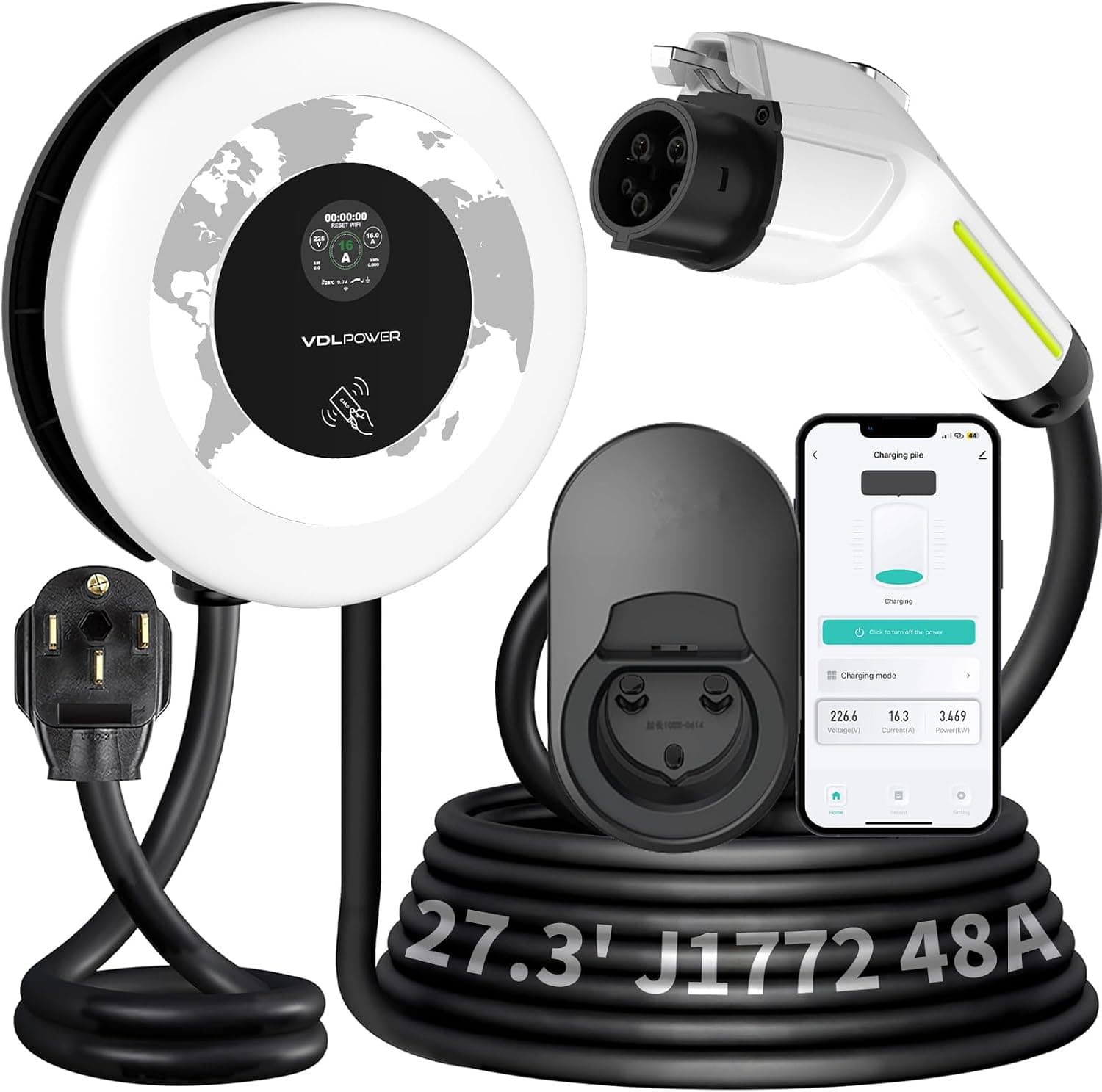
The VDLPOWERVP Level 2 EV Charger is built around a pretty compelling specification sheet: up to 11.5kW of advertised charging power, adjustable current up to 50A, WiFi connectivity, app-based scheduling and monitoring, a J1772 connector, NEMA 14-50 plug, and an unusually long 27.3-foot charging cable.
Basically, it takes the most important home EV charging features and puts them into one wall-mounted box.
And for me, there’s one feature here that might be even more useful than the headline charging speed.
That ridiculously long cable.
Check the latest price on Amazon:
https://link.amazon/B01QgUWVe
As an Amazon Associate, we may earn from qualifying purchases.
Level 2 Charging Is the Home EV Sweet Spot
There are broadly three charging experiences EV owners encounter.
First, there’s basic Level 1 charging from a standard household outlet.
It’s convenient because the outlet already exists.
But it’s slow.
Really slow.
Then you’ve got DC fast charging.
That’s the stuff you use on road trips or when you need a large amount of energy quickly.
It’s incredibly useful, but you’re probably not installing a DC fast charger in your garage.
Between those two sits Level 2 AC charging.
And for most home charging, this is the sweet spot.
You arrive home.
Plug in.
Go inside.
Sleep.
Come back the next morning.
Car charged.
That’s exactly the experience this VDLPOWERVP charger is designed to provide.
Up to 11.5kW Is Plenty of Home Charging Power
The headline specification is up to 11.5kW at 240V, with the charger advertised as supporting currents up to 50A.
That’s dramatically faster than charging from a standard 120V household outlet.
The manufacturer claims up to 9 times faster charging than a standard wall-outlet EV charger.
The exact difference will obviously depend on what you’re comparing it with, your vehicle, voltage, charging current, and electrical installation.
But the broader point is correct.
Moving from Level 1 to a high-powered Level 2 setup is a huge upgrade.
If your car can accept the available AC power, you can add a substantial amount of range overnight.
And that’s really what matters.
You don’t necessarily need your EV to charge in 20 minutes at home.
You need it charged by the time you leave tomorrow.
Your Car Still Determines the Actual Charging Speed
This is an important distinction.
A charger being capable of supplying 11.5kW doesn’t mean every EV connected to it will charge at 11.5kW.
The vehicle has an onboard AC charger.
That onboard charger determines how much AC power the car can actually accept.
If your EV only supports 7.2kW AC charging, connecting it to an 11.5kW EVSE doesn’t magically make it accept 11.5kW.
The car will charge at the lower supported rate.
Think of the EV charger as making power available.
The vehicle decides how much of that available power it can actually use.
Adjustable Current Is More Useful Than It Sounds
The VDLPOWERVP charger provides multiple selectable current settings:
16A, 32A, 40A, 48A, and 50A.
At first, you might wonder why anyone would voluntarily make their charger slower.
There are several reasons.
Your electrical circuit may not support the maximum setting.
You might want to manage household electrical load.
You might not need maximum charging speed overnight.
Or your installation may have specific continuous-load requirements.
Being able to adjust current gives you considerably more flexibility than a charger that simply operates at one fixed level.
But electrical safety comes first.
The charging current needs to be appropriate for the circuit, breaker, receptacle, wiring, and applicable electrical requirements.
There’s an Important NEMA 14-50 Detail
The charger comes with a NEMA 14-50 plug.
That’s convenient because if you already have an appropriately installed compatible outlet, installation can potentially be much simpler than hardwiring a charger.
But there’s an important technical consideration here.
The listing advertises charging at up to 50A while also using a NEMA 14-50 connection.
EV charging is generally treated as a continuous electrical load, which affects circuit sizing and allowable continuous current.
So don’t simply plug the unit into a NEMA 14-50 outlet and assume the maximum 50A setting is automatically appropriate.
Verify the charger’s manual, circuit requirements, local electrical code, breaker size, wiring, receptacle rating, and maximum continuous charging setting.
If you’re uncertain, this is exactly the kind of installation worth having a qualified electrician evaluate.
Fast charging is great.
Overheated wiring is not.
The 27.3-Foot Cable Is Fantastic
This might actually be my favorite specification.
The charging cable is 27.3 feet long.
That’s about 8.3 meters.
And cable length is one of those boring specifications you don’t think about until you’ve installed the charger.
Maybe your car’s charging port is on the front.
Your next EV has it on the rear quarter panel.
Maybe you normally reverse into the garage.
Sometimes you park nose-first.
Maybe the charger is mounted inside the garage but you occasionally want to charge a vehicle parked outside.
A longer cable gives you options.
And 27.3 feet is genuinely long for a home EV charger.
Instead of arranging your parking position around the charger, the charger has a better chance of reaching wherever the car happens to be.
That’s the kind of convenience you appreciate every single day.
WiFi Makes This a Proper Smart Charger
Then there’s the WiFi connectivity.
Connect the charger to the companion app and you can monitor charging remotely.
The manufacturer lists functionality including:
Charging status.
Remote monitoring.
Scheduling.
Real-time charging information.
For a device you’re going to use repeatedly for years, those smart features can actually be useful.
You don’t necessarily need to walk into the garage to check whether the vehicle is charging.
Open the app.
Check the status.
Done.
It’s the kind of feature that sounds unnecessary until you get used to having it.
Scheduled Charging Could Save Money
The scheduling feature is probably the most practically useful part of the app.
If your electricity provider offers time-of-use rates, electricity may cost less during certain periods.
Instead of immediately charging when you arrive home, you could schedule charging to begin during the cheaper window.
Plug the car in at 7 PM.
Tell the charger to start later.
Go to sleep.
The charging session happens automatically.
Over a few days, the difference might not feel particularly dramatic.
Over years of EV ownership, consistently shifting a large electrical load into cheaper periods can potentially add up.
Of course, the actual savings depend entirely on your electricity tariff.
If you pay the same rate all day, scheduling won’t magically make the electricity cheaper.
J1772 Means Broad EV Compatibility
The charger uses the J1772 connector.
That’s the familiar AC charging connector used by many EVs and plug-in hybrids in North America, particularly vehicles designed around the J1772 standard.
The manufacturer lists compatibility with vehicles from brands including Chevrolet, Ford, Hyundai, Honda, BMW, Volkswagen, Cadillac, Nissan, Audi, Toyota, Subaru, Mercedes-Benz, Kia, Rivian, Acura, and Porsche.
But connector standards in the North American EV market are changing.
Many newer vehicles are moving toward the NACS/J3400 connector, so it’s worth checking the charging port on your specific vehicle rather than relying only on the brand name.
For vehicles that don’t have a native J1772 inlet, an appropriate compatible adapter may be required.
Tesla Owners Will Need an Adapter
The manufacturer specifically notes that Tesla vehicles require an adapter, which isn’t included.
That’s worth factoring into the purchase price if you’re buying this specifically for a Tesla.
The charger supplies AC electricity through J1772.
An appropriate adapter allows compatible Tesla vehicles to interface with that connector.
Again, always check compatibility with your specific model and model year.
Charging standards are evolving quickly.
Installation Is Pretty Straightforward on Paper
The package includes a metal wall-mount bracket, connector holder, screws, expansion bolts, installation templates, manual, warranty card, and the charger itself with its NEMA 14-50 plug and 27.3-foot cable.
The basic physical installation is straightforward.
Mount the bracket.
Hang the charger.
Install the connector holder.
Plug it into an appropriate NEMA 14-50 outlet.
Connect your vehicle.
The cable can also be wrapped around the charger body when you’re finished, which helps keep everything relatively tidy.
But there’s a big difference between physically mounting the charger and electrically preparing the circuit.
If you don’t already have a correctly installed NEMA 14-50 circuit suitable for EV charging, that’s the part where professional electrical work may be necessary.
A Wall-Mounted Charger Makes EV Ownership Feel Better
This is something that’s difficult to communicate through specifications.
A proper wall-mounted EV charger just makes the entire ownership experience cleaner.
You pull into the garage.
Grab the connector.
Plug it in.
Done.
The cable has a dedicated place.
The connector has a holder.
You aren’t constantly unpacking a portable charging cable from the trunk.
You aren’t plugging and unplugging equipment from the wall every day.
It becomes infrastructure.
And that’s when home EV charging starts to feel natural rather than something you’re actively managing.
The Charger Isn’t Actually the Charger
Here’s a slightly nerdy technical detail.
What we commonly call a “home EV charger” is technically usually EVSE, or Electric Vehicle Supply Equipment.
The actual AC-to-DC charging hardware is inside the vehicle.
The wall unit communicates with the car and safely supplies AC electricity at an appropriate current.
The car’s onboard charger converts that AC electricity into DC for the battery.
Does that distinction matter when you’re buying one?
Not really.
But it’s useful for understanding why your car’s onboard charging limit determines the maximum speed.
The wall box can offer 11.5kW.
The vehicle still decides what it can accept.
Do You Actually Need 11.5kW?
Maybe not.
And that’s okay.
Let’s say you drive 30 or 40 miles on an average day.
You don’t need to recharge the entire battery every night.
You only need to replace the energy you used that day.
Even at a lower Level 2 charging rate, you may easily recover that energy while you sleep.
The advantage of having more available power is flexibility.
You arrive home with a nearly empty battery after a long trip.
Plug in.
Now the higher charging rate becomes much more useful.
It’s similar to having fast internet.
You don’t max out the connection every second.
But you’re glad the capacity exists when you need it.
The App Is Useful, but There’s a Trade-Off
Smart connectivity is convenient.
But there’s something worth considering with any app-connected hardware.
The physical charging equipment might last for many years.
Apps and cloud services are less predictable.
Software gets updated.
Platforms change.
Companies change their services.
So I’d always prefer a smart EV charger that can continue performing its fundamental charging function even if the app or internet connection isn’t available.
The core job is still simple.
Safely supply electricity to the vehicle.
Everything else should ideally be an enhancement rather than a dependency.
The Warranty Is a Little Unusual
The listing says the charger includes a one-year warranty, with an additional year available by contacting customer service.
That’s worth confirming at the time of purchase.
EV chargers are long-term infrastructure.
Unlike a phone accessory you might replace next year, this is something you could potentially use several times a week for many years.
Warranty coverage, support availability, and replacement options are therefore worth considering alongside charging speed and app features.
One More Thing: The New Version Has No NFC Cards
The listing specifically mentions that older versions included NFC cards while the newer version does not.
That’s worth knowing if you’ve seen older photos, reviews, or product information showing NFC functionality.
If NFC access control is important to you, verify exactly which hardware revision you’re purchasing.
For most home users, this probably isn’t a major issue.
But it’s better to know before the box arrives.
Who Is This For?
This charger makes the most sense for someone who wants a high-powered Level 2 home charging setup with smart functionality.
Maybe you’ve recently bought your first EV and Level 1 charging is becoming frustrating.
Maybe you have a long daily commute and want faster overnight charging.
Maybe your electricity plan has cheaper off-peak rates and you want scheduled charging.
Maybe you have an awkward garage layout and genuinely need that 27.3-foot cable.
Or maybe you simply want to pull into your garage, plug in, and stop thinking about charging.
That’s ultimately what a good home EV charger should accomplish.
What I Like
The feature combination is strong.
You get up to 11.5kW of advertised charging power, selectable 16A to 50A current settings, WiFi connectivity, app monitoring, scheduled charging, a J1772 connector, NEMA 14-50 plug, wall mounting hardware, and that excellent 27.3-foot cable.
The adjustable current is particularly useful because not every installation needs or supports maximum output.
And I genuinely think the extra-long cable could matter more in everyday use than several of the smarter features.
Apps are nice.
Being able to physically reach your car is nicer.
What You Should Know Before Buying
There are several things I’d check first.
Make sure your EV actually uses J1772 or supports it through an appropriate adapter.
Check your vehicle’s maximum AC charging rate so you know how much of the charger’s available power it can use.
Verify the electrical requirements for the advertised 48A and 50A settings, especially when using the supplied NEMA 14-50 plug.
Make sure your outlet, breaker, wiring, and circuit are suitable for continuous EV charging.
Confirm whether the app provides the features you specifically need.
And if you’re installing a new high-power circuit, use a qualified electrician and follow applicable electrical codes and manufacturer instructions.
The Bottom Line
The VDLPOWERVP Level 2 EV Charger gets the fundamentals right on paper.
It’s fast.
It’s adjustable.
It’s connected.
And it’s flexible.
The headline feature is up to 11.5kW of Level 2 charging power, but the complete package is more interesting than that single number.
You get selectable charging current, WiFi and app controls, scheduling, J1772 compatibility, a NEMA 14-50 connection, wall-mounted cable management, and a massive 27.3-foot charging cable.
That last feature might sound boring.
But home charging is all about reducing friction.
You don’t want to think about where you parked.
You don’t want to move the car because the cable is three feet too short.
You don’t want to stop at a charging station tomorrow morning because you forgot to charge.
You just want to come home, plug in, and wake up ready to drive.
That’s when an EV starts feeling less like a new piece of technology and more like a better daily routine.
Check the VDLPOWERVP Level 2 EV Charger on Amazon:
https://link.amazon/B01QgUWVe