
Yosoo Health Gear Wind Turbine Controller Review: A Compact MPPT Controller for Small Wind Systems
Wind turbines are simple until you actually try to connect one to a battery.
The turbine spins.
Electricity comes out.
Battery charges.
Easy, right?
Not quite.
Wind is constantly changing. The turbine’s electrical output changes with it. The battery has its own charging requirements. And when the battery is full, you still have a physical turbine outside that may continue spinning.
That’s why the charge controller is such an important part of a small wind energy system.
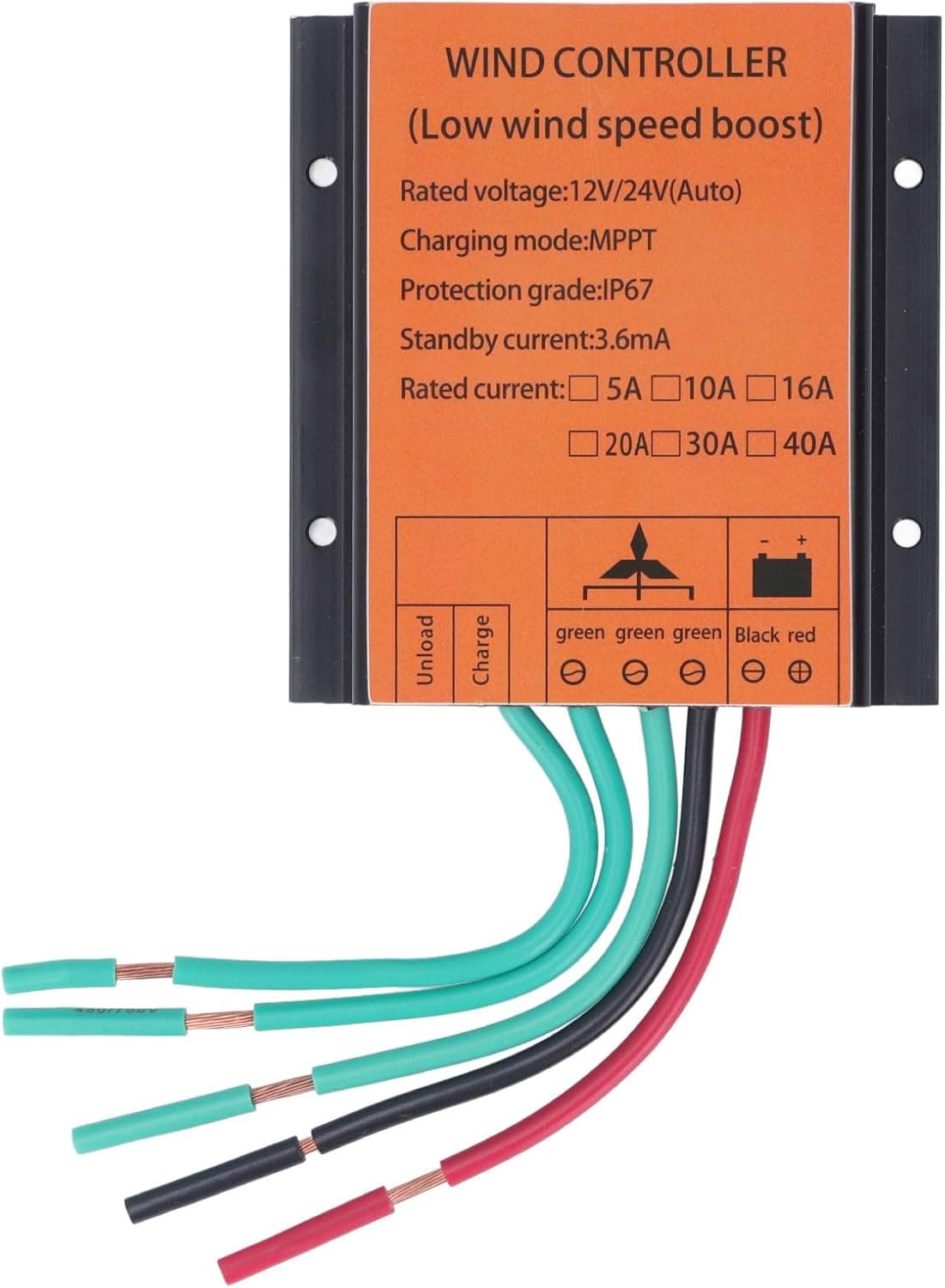
The Yosoo Health Gear Wind Turbine Controller is designed for 12V and 24V systems using wind turbines from approximately 300W to 1000W. It combines MPPT charging, PWM-based unloading, automatic braking, multiple battery protections, and an IP67-rated aluminum enclosure into a surprisingly compact orange box.
It isn’t the part of your renewable energy system anyone is going to notice.
But it might be one of the most important.
Check the latest price on Amazon:
https://link.amazon/B0ecNeDfg
As an Amazon Associate, we may earn from qualifying purchases.
What Does a Wind Turbine Controller Actually Do?
The controller sits between your wind turbine and battery.
Its basic job is to take the electrical energy coming from the turbine and manage how that energy reaches the battery.
That sounds straightforward until you remember that wind isn’t constant.
A solar panel has variable output too, of course, but a wind turbine adds another layer of complexity because there’s a rotating mechanical system involved.
Wind gets stronger.
The turbine accelerates.
Wind drops.
The turbine slows down.
Battery voltage changes as it charges and discharges.
The controller has to manage all of that while keeping the electrical system within its intended operating limits.
So while the turbine gets to be the cool spinning thing on the roof or tower, the controller is quietly doing the management work behind the scenes.
The Big Feature Here Is MPPT
The headline feature is MPPT, or Maximum Power Point Tracking.
MPPT technology is designed to dynamically manage the electrical operating point of a renewable energy source to improve energy harvesting under changing conditions.
And changing conditions basically describe wind power perfectly.
Wind speed can vary from one moment to the next.
The turbine’s rotational speed changes.
Its voltage and current characteristics change.
The controller’s job is to find an effective operating point and transfer that energy toward the battery.
The manufacturer claims this implementation can improve power generation by up to 90 percent, particularly under low-wind conditions.
That’s a very substantial claim, so I wouldn’t interpret it as meaning you’ll automatically get 90 percent more energy than every alternative controller.
Real-world improvement depends on the turbine, previous controller, battery, wind conditions, electrical characteristics, and system design.
The more useful takeaway is that this controller is designed to actively optimize wind turbine charging rather than functioning purely as a basic on-off regulator.
Low-Wind Performance Is Especially Interesting
Small wind turbines have an obvious problem.
They’re usually advertised using their maximum or rated output.
But your turbine isn’t operating at rated wind speed all day.
A lot of its life may be spent in considerably weaker wind.
That’s why low-wind energy harvesting matters.
If the turbine is spinning but the charging system can’t effectively make use of the available electrical output, some potential generation is being left on the table.
The Yosoo controller’s MPPT system is intended to improve charging performance across those changing conditions.
That doesn’t mean it can magically turn a gentle breeze into 1000 watts.
The energy still has to exist in the wind.
MPPT is about making better use of available energy, not creating additional energy.
Physics still gets the final say.
It Supports 12V and 24V Systems
The controller supports both 12V and 24V battery systems.
Those are two extremely common voltages for small off-grid renewable energy installations.
A 12V system can make sense for smaller setups and equipment already designed around 12V DC.
As power levels increase, 24V becomes increasingly attractive because you can transfer the same amount of power using less current.
And that becomes very relevant with a controller designed for wind turbines approaching 1000W.
Low-voltage systems can carry surprisingly high current.
That’s why correct wire sizing, connectors, fusing, and installation practices are so important.
Rated for Wind Turbines From 300W to 1000W
According to the listing, the controller is intended for 300W to 1000W wind turbines and has a listed current specification of 16A.
This is exactly where I’d stop looking at the product title and start looking carefully at the detailed electrical specifications before purchasing.
Wattage, voltage, and current all need to make sense together.
Your turbine’s voltage and output characteristics need to be compatible with the controller.
Your battery needs to be compatible.
And your expected current needs to stay within the controller’s specified operating limits.
A “1000W” label by itself doesn’t tell you enough to design the entire system.
For renewable energy equipment, compatibility matters more than matching one big number printed on two product pages.
Automatic Braking Is a Big Deal
Here’s where wind charge controllers become more interesting than they initially appear.
What happens when the battery is full?
With a solar system, the controller can reduce charging and manage the panel input.
A wind turbine is mechanically spinning because the wind is physically pushing it.
You can’t tell the weather to stop.
That’s why the Yosoo controller includes automatic braking functionality.
The controller can help manage the turbine when system conditions require it, including situations involving excessive voltage or a fully charged battery.
This helps protect both the battery and the wind turbine system.
For a device designed to operate autonomously outside for long periods, that’s exactly the kind of feature you want happening automatically.
PWM Unloading Handles Excess Energy
The controller also uses what the manufacturer describes as PWM electrode-less unloading.
PWM stands for Pulse Width Modulation.
In this context, the system is designed to control unloading without relying on conventional mechanical switching methods.
The manufacturer specifically highlights quiet operation as one of the benefits.
That’s useful because renewable energy equipment can potentially be installed near homes, cabins, boats, workshops, or other occupied areas.
The turbine itself may still generate aerodynamic and mechanical sound, of course.
But you don’t want the controller adding unnecessary clicking or switching noise to the equation.
The Protection List Is Pretty Comprehensive
A charge controller is also there to protect the system when something doesn’t behave exactly as expected.
The Yosoo controller includes manufacturer-listed protections against conditions such as overcharging, excessive discharge, reverse connections, and overload.
Automatic turbine braking adds another layer of protection.
These features are particularly useful in battery-based renewable energy systems because batteries can store and deliver significant amounts of energy.
Incorrect polarity or charging conditions aren’t just inconvenient.
They can potentially damage equipment.
Protection circuitry doesn’t replace correct installation, but it’s good to know the controller has multiple layers of defense built in.
Installation Looks Refreshingly Straightforward
According to the manufacturer, the basic wiring arrangement is relatively simple.
The thicker red and black wires connect to the appropriate battery terminals, while three wires connect to the wind turbine.
Those three turbine connections make sense for a compatible three-phase wind generator.
That gives the controller a very appliance-like installation concept.
Battery on one side.
Turbine on the other.
Controller in the middle.
But I wouldn’t interpret “easy installation” as meaning electrical specifications no longer matter.
Before connecting anything, verify polarity, turbine compatibility, battery type, voltage, wire sizing, overcurrent protection, grounding requirements, and the manufacturer’s recommended connection sequence.
Simple wiring doesn’t necessarily mean foolproof system design.
That Orange Aluminum Housing Is Functional
The controller has a pretty distinctive orange aluminum alloy enclosure.
And while it definitely makes the product easier to spot, the aluminum construction isn’t just cosmetic.
Power electronics generate heat.
The controller is handling rectification, charging, unloading, and other electrical functions.
An aluminum enclosure can help transfer heat away from internal components while also providing physical protection.
That’s useful for something designed to operate continuously as part of an energy system.
It’s basically a heatsink that happens to look like a product enclosure.
IP67 Makes Sense for Wind Equipment
The controller carries an IP67 protection rating, according to the listing.
That’s particularly relevant for wind power.
Your turbine needs wind.
And getting good wind usually means installing equipment somewhere exposed.
Exposure brings rain.
Dust.
Humidity.
Condensation.
Temperature changes.
And everything else that comes with outdoor installations.
An IP67-rated enclosure is designed to provide strong protection against dust and water ingress under the conditions defined by that rating.
But there’s an important caveat.
The controller’s enclosure being weather-resistant doesn’t automatically make the entire electrical installation weatherproof.
Connections still matter.
Cable entry points matter.
Fuses matter.
Junction boxes matter.
Battery placement matters.
One IP67 box doesn’t magically give the entire system an IP67 rating.
This Could Fit Nicely Into a Hybrid Wind-Solar System
One of the most interesting applications would be alongside solar.
Solar and wind can complement each other because they depend on different environmental conditions.
Your solar panels generate during daylight when there’s sufficient sunlight.
Your wind turbine can potentially generate during cloudy conditions or at night if the wind is blowing.
Both sources can contribute energy toward the same broader off-grid system when designed correctly.
You might have a dedicated solar MPPT controller handling the panels and this wind controller managing the turbine.
Both then contribute toward an appropriately designed battery system.
Now you’ve got two independent renewable energy sources.
If one isn’t producing, the other might be.
That’s a much more interesting way to think about off-grid energy than simply asking whether wind or solar is “better.”
But Wind Location Still Matters More Than the Controller
Here’s the part that’s easy to forget when shopping for wind power hardware.
A better controller can’t compensate for a terrible wind resource.
Wind turbines need airflow.
And ideally, they need relatively clean airflow rather than turbulent wind bouncing around buildings, walls, and trees.
Installation height matters.
Nearby obstacles matter.
Average local wind speed matters.
Turbine design matters.
A high-quality MPPT controller connected to a turbine sitting in weak, turbulent air isn’t going to suddenly produce huge amounts of electricity.
The controller can optimize the energy available to it.
It can’t create wind.
What I Like
The biggest appeal here is how much functionality is packed into a relatively simple controller.
You get MPPT wind charging, 12V and 24V compatibility, support for a range of small wind turbine sizes, automatic braking, PWM unloading, multiple battery protection features, an aluminum enclosure, and IP67 environmental protection.
I also like the focus on autonomous operation.
Wind systems can run at any time.
Middle of the afternoon.
Middle of the night.
While you’re away from the property.
You don’t want to manually intervene every time the wind changes or the battery reaches a certain voltage.
The controller is supposed to handle those situations automatically.
That’s exactly what a controller should do.
What You Should Know Before Buying
First, treat the manufacturer’s claim of up to 90 percent improvement in power generation carefully. Actual performance improvements will depend heavily on the system and comparison point.
Second, make sure the controller’s voltage, current, and power specifications match your actual wind turbine and battery configuration.
Third, verify battery chemistry compatibility and charging parameters rather than assuming every 12V or 24V battery can be treated identically.
Fourth, IP67 protection applies to the specified controller enclosure, not automatically to your entire installation.
And finally, integrated electrical protections should complement proper fusing, wiring, grounding, surge protection, and installation practices rather than replace them.
Who Is This For?
The Yosoo controller makes the most sense for someone building or upgrading a small battery-based wind energy system.
Maybe you’ve got a turbine at a remote cabin.
Maybe you’re experimenting with backyard wind power.
Maybe you’re building a wind-solar hybrid system.
Maybe you’ve got a small off-grid installation where every additional watt-hour matters.
Or maybe your existing basic controller isn’t doing a particularly good job under variable wind conditions and you’re looking at an MPPT-based alternative.
In all of those situations, the charge controller becomes an important part of extracting useful energy from the turbine while managing the battery and generator.
The Bottom Line
The Yosoo Health Gear Wind Turbine Controller is a good example of why renewable energy systems are about much more than the generator itself.
The wind turbine captures the energy.
The battery stores the energy.
But something still needs to intelligently manage what happens between those two components.
That’s the controller’s job.
Here, you’re getting MPPT charging technology, support for 12V and 24V systems, compatibility with specified 300W to 1000W wind turbine applications, a 16A rating, automatic braking, PWM unloading, multiple protection functions, and an IP67-rated aluminum enclosure.
The manufacturer’s efficiency claims should be treated as claims rather than guaranteed real-world gains, and compatibility needs to be checked carefully before installation.
But conceptually, this is exactly the kind of component that can make a small wind system feel less like an experiment and more like an actual energy system.
Because generating electricity is only half the challenge.
Managing it properly is the other half.
Check the Yosoo Health Gear Wind Turbine Controller on Amazon:
https://link.amazon/B0ecNeDfg